


by Cain Noble-Davies
Worth: $16.50
FilmInk rates movies out of $20 — the score indicates the amount we believe a ticket to the movie to be worth
Cast:
Anne Hathaway, Dakota Johnson, Josh Hartnett
Intro:
… a seductive beauty of a psycho-sexual thriller …
It hasn’t even been a full year since the last Colleen Hoover adaptation, Reminders of Him, and there’s already another one making its way into cinemas. While the marketing and trailer for Verity proffers something different in tone and genre flavouring to the rest of the catalogue, it’s admittedly tricky to look past the less-than-ideal track record thus far, not the least of which for the consistent dalliances with (and regular mishandling of) morbid subject matter that still connects these works together.
Thankfully, Verity is different to the rest for reasons beyond the salacious or in a ‘so bad it’s good’ trainwreck way.
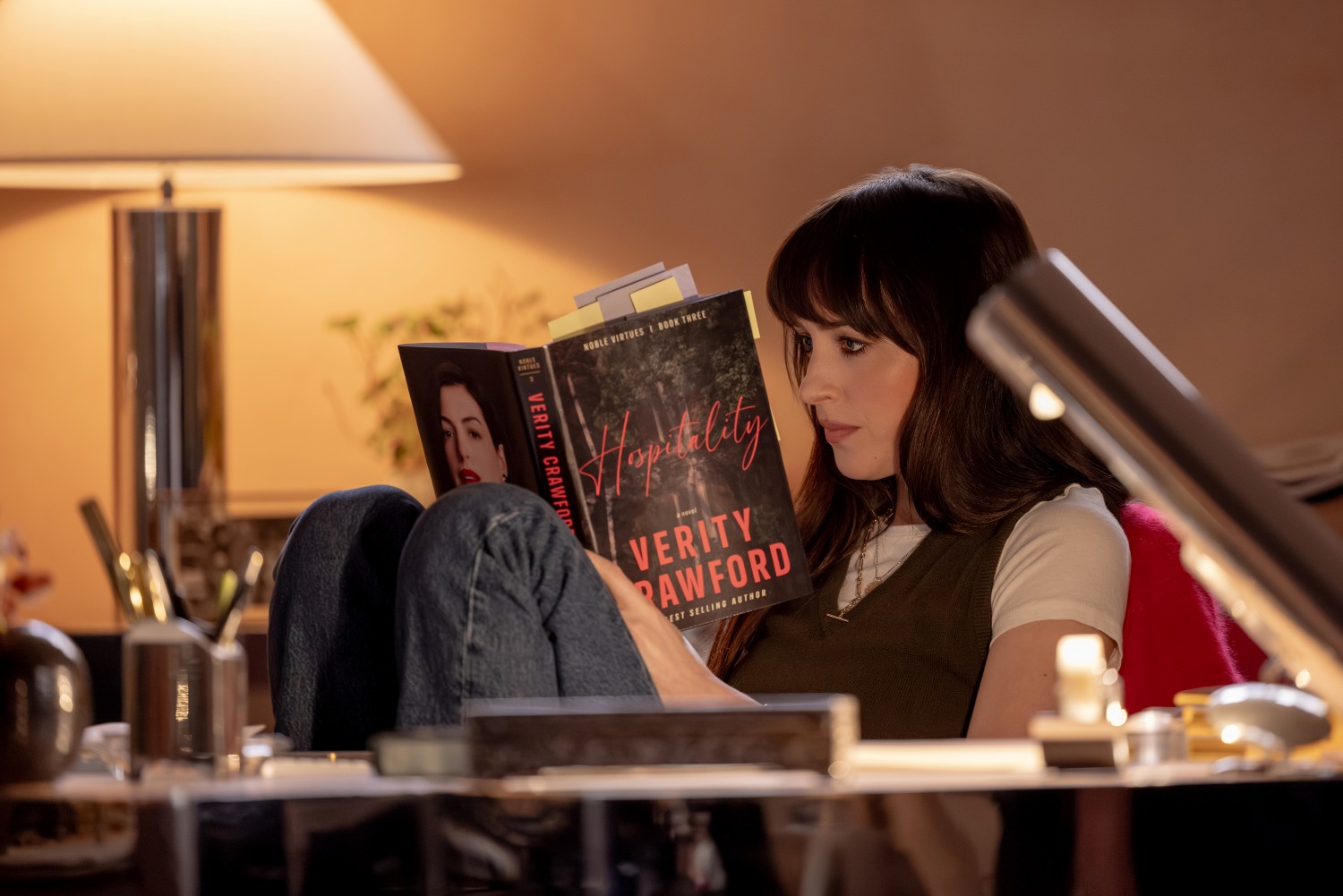
Director Michael Showalter, DP Jim Frohna, and actress/producer Anne Hathaway have already shown an aptitude for 5th-wave-adjacent drama with their collective work on The Idea of You (genuinely the best and most watchable of the entire wave to date), and even while working with a darker crimson shade of mum movie here, their willingness to play into the form’s tropes and expectations make for compelling viewing. The icy scenery, the isolated tension, the low-key lit bursts of sexual desire; it captures the murky allure inherent to this literary niche, which turns out to be an especially vital aspect to get across as the film continues.
It also helps that, unlike Reminders and Regretting You, the film makes no assumptions of or straining attempts to reinforce sympathy for its characters. The central trio, in famous author Verity (Hathaway), her husband Jeremy (Josh Hartnett), and fellow writer Lowen (Dakota Johnson), all have their tender sides as well as potent veins of obsidian ore. No one can be trusted, no one’s side is pure, and as the mystery deepens about Verity’s past and Lowen’s envy of her pedestal within the world of writing, the amount of clear answers is dwarfed considerably by numerous lingering questions. Which, for a film built on ambiguity and uncertainty, does wonders for the thrill quotient.
Its expert balancing of a bendy and psychosexual narrative with just enough camp value to keep things relatively breezy and fun, given its incredibly uncomfortable subject matter regarding motherhood and the creative process, on its own makes this a solid viewing experience. But what it ultimately says in the much grander context of not just Colleen Hoover’s own literary career, but the entire post-Fifty Shades of Grey trend of romantic fiction, pushes it into a whole other strata of dramatic riches.
From Colleen Hoover’s 2021 popularity boom, to Fifty Shades and its pop culture impact crater, even tracing all the way back to Fifty Shades’ own key inspiration with Twilight, there has been a recurring talking point threaded through each work’s discourse. One that is itself part of an even bigger tradition regarding general and critical consensus concerning media primarily made for girls and women: Moral concerns over the content and its impact on ‘impressionable minds’. It’s basically a righteous reskinning of how things that appeal to girls are open season to make fun of without recourse. But because the 5th wave is built from a foundation of fanfiction, which is understood as being much more personal than more professional writing formats, works like Fifty Shades and The Kissing Booth and After, and indeed the works of Colleen Hoover, have been particularly susceptible to such inquiries. They were written for the love of the game, and the subgenre of fanfiction self-insert romantic fantasy is rarely if ever subtle in its depiction of desire for the unattainable, so why wouldn’t they be at least somewhat revealing of the people who wrote them?
Colleen herself, pretty much since she ‘blew up’, has regularly been put under the microscope for how certain themes and ideas present themselves in her work, usually in regards to her treatment of trauma and abusive relationships.
But why is it isolated to this? At a time where collective sentiment about horror media or heavy metal music or rap music or Dungeons & Dragons or anything else under the Satanic Panic umbrella has gained a clear head that transgressive or misanthropic media doesn’t inherently create transgressive or misanthropic people, why does this argument still persist? Our own previous examinations of films based on CoHo’s writing have shown that we’re not exempt from questioning certain creative choices and approaches, but going from “you wrote a questionable book” or “you made a questionable movie” to “you are questionable as a person… or possibly worse than that” isn’t a straight line. One does not simply decode a person’s entire being solely by perusing their creative body of work.
As Verity explores the in-universe prose of its titular author (which actually lives up to the narrative’s hype as far as entertainment value, which is a nice change from the informed brilliance usually shown in media about writers), the biggest question drawn concerning her work and its impact is its antagonistic nature. Told from villainous perspectives, full of lurid descriptions of bloodshed and biting of headboards (rhyming somewhat with the recurrent lip-biting imagery in the original Fifty Shades books), about women indulging in their darkest fantasies. Does this reflect a genuinely twisted mind, or is it just a creative outlet for more mundane stresses? It taps into familiar sentiments about the separation of art and artist, but flipped from its usual ‘can I still enjoy the work of someone I disagree with in real life?’ parameters. And as the bends and twists become more pronounced, it ends up bringing observers into the crosshairs, questioning how much of this supposed ‘influence’ is the product of the work itself… or what already exists in the observer’s psyche.
Verity is a seductive beauty of a psycho-sexual thriller, but what’s written between the lines makes for remarkably poignant statements about the media climate that allowed the source material to be adapted into this film in the first place. The central cast is phenomenal, with Anne Hathaway positively shining in the title role and Dakota Johnson’s sheer presence further adding to the metatextual layers given her own cinematic come-up, let alone how well she plays the role itself, and the presentation that is as unsettling as it is ravishing. While the source material existed long before Colleen Hoover became ensconced in controversy, its adaptation here and now at the height of Hoover on the big screen reads like an active rebuttal to said controversy, and indeed all of the difficult precedents that came before it. There will always be discussions and debates about the work itself, and that in itself isn’t inherently a bad thing, but where Verity is at its strongest is when it pulls back the curtain on how conspicuous the scrutinisation can get, particularly as it bleeds into how audiences and creatives directly interact with each other. Don’t believe everything you read. Not even this.
