



by Nataliia Serebriakova
Worth: $18.00
FilmInk rates movies out of $20 — the score indicates the amount we believe a ticket to the movie to be worth
Cannes Film Festival
Cast:
Kaylon Lancel, Mohamed Coly, Louise Podolski, Kelsie Verdeilles, Alessandro Piquera, Meryl Pires
Intro:
…. funny, suspenseful, tender and occasionally bizarre.
After the success of his mini-series about the mischievous little Ken Ken (Li’l Quinquin and Coincoin and the Extra-Humans), Bruno Dumont turns to even younger protagonists in Red Rocks, which premiered in Cannes Critics Week. The film takes place in a small town on the French Riviera, not far from Cannes, where childhood seems to exist almost entirely outside the adult world.
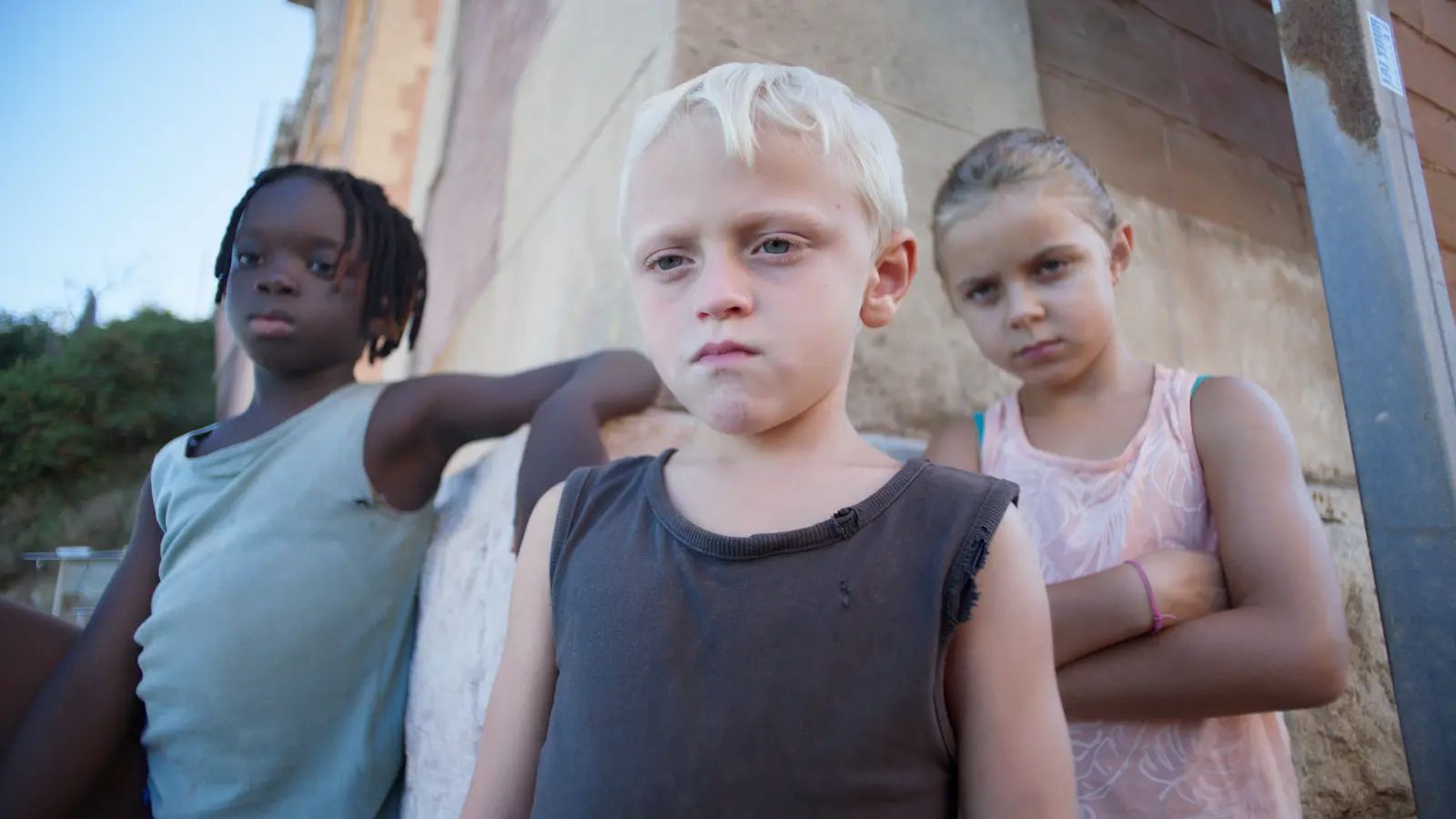
Geo (Kaylon Lancel), who looks barely five, spends his days with his friends Manon (Louise Podolski) and Rouben (Mohamed Coly). They meet near a monumental arch by the town beach, climb onto their miniature quad bikes and head towards the red rocks, where they jump into the sea from heights that would make even an adult think twice. They also raid unlocked cars for sweets and toys, tease respectable holidaymakers and generally behave as if the entire Riviera belongs to them.
Adults are almost absent from this world. And that absence is crucial. Dumont creates a miniature society in which children recreate, without fully understanding them, the rituals and hierarchies of the adult world.
One day, on the red rocks, Geo and his friends encounter another group of children: Eve (Kelsie Verdeilles), her “boyfriend” B (Alessandro Piquera), and Do (Meryl Pires). Although Geo is the shortest and apparently the youngest of the group, his confidence and sheer audacity soon win Eve’s attention. They begin holding hands and hugging, provoking B’s jealousy and turning an innocent game into something resembling a miniature romantic drama.
This is where Red Rocks becomes particularly fascinating. Dumont essentially takes the conventions of the teenage movie and gives them to children who have barely left kindergarten. The miniature quad bikes become motorcycles, cliff-jumping replaces the dangerous games of 1950s youth cinema, and the six-year-olds suddenly find themselves caught in something resembling Romeo and Juliet. At times, the film even feels as though it could be heading towards the fatalistic ending of a French New Wave gangster romance, perhaps something in the spirit of Breathless.
The extraordinary child casting is the film’s greatest achievement. These are not children performing polished versions of adult emotions. They speak as children actually speak at this age, sometimes forgetting a word, losing the thread of what they were saying, or even seemingly forgetting the point of the conversation. Yet their lines are wonderfully concise. “Stop hugging,” Eve tells Geo and Manon. “I love you,” comes with the same directness and seriousness.
Kaylon Lancel is particularly remarkable. Geo’s strange face, small stature and restless physical energy give him something of Jean Paul Belmondo’s charisma. He does not need to perform toughness. It simply seems to exist in him. The other children are equally convincing, especially Kelsie Verdeilles, whose Eve manages to combine childish innocence with the possessiveness and jealousy of a much older romantic heroine.
Dumont’s genius is to understand that children do not need to comprehend the full meaning of their emotions for us to feel their intensity. Their gestures become magnified precisely because they are so simple. Holding hands becomes intimacy. A hug becomes a kiss. A stare becomes a declaration of war.
The film’s tension initially appears to come from the children’s obsession with jumping from increasingly dangerous heights. Every time they approach another cliff, you expect the story to turn into a tragedy. Yet Dumont deliberately redirects that suspense towards the children’s emotional lives. The real danger is not necessarily the rocks beneath them, but jealousy, rivalry and the overwhelming force of feelings that they have no language for yet.
Even the cliff-jumping scenes are handled with remarkable restraint. Dumont often observes the children from a great distance, turning them into tiny figures against the landscape. At other moments, he cleverly replaces the young performers with animated figures climbing the rocks. The alternation between distant shots and close-ups of the children creates both suspense and a protective distance.
And then there is the landscape. Working with cinematographer Carlos Alfonso Corral, Dumont transforms the Riviera into something between a childhood playground and a tourist postcard. Red rocks, deep blue water, green vegetation, white buildings and brilliant sunlight repeatedly interrupt the narrative with almost impossibly beautiful images. The effect is strangely contradictory: the scenery looks idyllic, while the children constantly seem to be one step away from disaster.
The sound design reinforces that tension. Trains passing above the town and waves crashing against the rocks become part of the film’s rhythm, while silence often says more than dialogue.
Red Rocks is remarkably simple, almost deceptively so. But its simplicity is its strength. Dumont takes childhood games, jealousy, first love and physical danger and observes them without overexplaining anything. The result is funny, suspenseful, tender and occasionally bizarre. Above all, it is a wonderfully precise study of emotions at the moment when we experience them for the first time, before we have learned how to name them.
