



by Nataliia Serebriakova
Worth: $16.00
FilmInk rates movies out of $20 — the score indicates the amount we believe a ticket to the movie to be worth
Toronto International Film Festival
Cast:
Nikoletta, Sofia, Echo`
Intro:
… a painful portrait of Ukrainian youth …
Black Sunflowers is another strong examination of the war in Ukraine by a Western filmmaker, following a line of films such as Jan De Pue’s Mariinka. But Marcus James Haney approaches the subject from a distinctly generational perspective. It is about young Ukrainians whose twenties — the years that should have been devoted to studying, falling in love, partying and deciding what kind of adults they want to become — have been consumed by Russia’s war.
The film opens with a night-time drifting scene in Kyiv, immediately placing its young protagonists somewhere far away from the familiar imagery of war documentaries. Two young men embody two radically different relationships with the war. One serves in the Ukrainian Armed Forces; the other deeply respects his friend and the people fighting for Ukraine, but is terrified that he will be mobilised. He recalls the one time he held a weapon and fired it, only to realise that he never wanted to do it again. His fear does not make him indifferent to his country’s fate. On the contrary, the contradiction is precisely what makes his story so painful: he knows why others are fighting, but cannot imagine himself becoming a soldier.
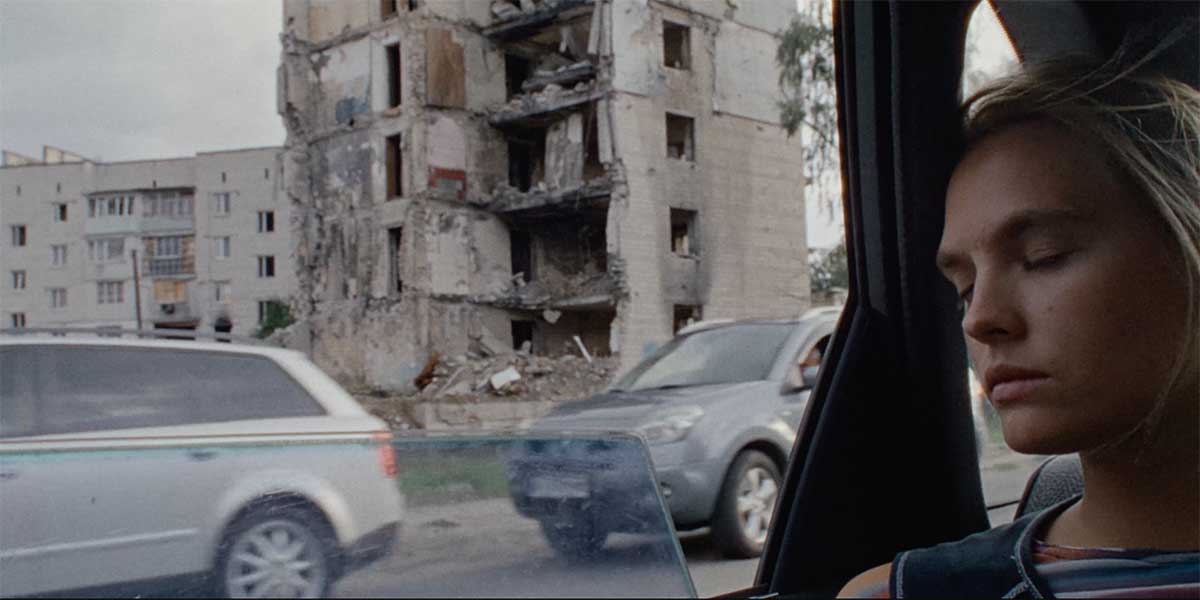
From there, Black Sunflowers moves between several young Ukrainians, creating a portrait of a generation living between the normal life they remember and the one that war has imposed on them. Nikoletta is a young photographer documenting the destruction of Odesa, eastern Ukraine and other parts of the country. Her camera gives her a role in the war, but it does not make her immune to it. She struggles with something close to depression and PTSD while imagining the life that she might have had without the invasion — travelling, working, discovering who she could become.
The relationship between 18-year-old paramedic Sofia and 22-year-old Echo, a Ukrainian soldier she met while serving, is even more heartbreaking. They talk about the future as if it were a country they might someday reach. In peacetime, they imagine getting married and celebrating their wedding in Zakarpattia, with Ukrainian jazz and everyone wearing vyshyvankas. Sofia wants to become a full-fledged soldier and serve at the front alongside the man she loves, while Echo tries to persuade her not to. His own experience has already changed his understanding of military service. “I’m a veteran, I have this piece of paper, but what does it give me?” he asks.
Haney, shooting with Misha Lubarsky, deliberately refuses to separate these lives into categories of “front” and “home.” The film moves from trenches where shells are genuinely falling to a Kyiv rave where twin artist sisters dance through the night. Their stories reach back to the time before the invasion, when they were still schoolgirls, and forward to a future they cannot yet imagine. They argue with their grandparents, who remember the Soviet past with nostalgia. Their grandfather recalls serving alongside Russian soldiers in the Soviet army. One of the sisters answers this nostalgia by invoking Ukraine’s Executed Renaissance — the generation of Ukrainian writers and artists destroyed by Stalinist repression. The exchange quietly connects the present war with a much longer history of Russian and Soviet attempts to erase Ukrainian identity.
This is where the film becomes more than a collection of wartime testimonies. Its young characters are not presented as a “lost generation” waiting passively for history to end. Some of them fight; others fear that they will have to. Some have survived the front with bodies permanently changed, and the film includes veterans living with prosthetic limbs.
The contrast between rave culture and the battlefield is one of Haney’s most effective formal ideas. The pounding electronic music gives the film the rhythm of a generation refusing to disappear, while the sudden silence of the front makes the danger feel even more physical.
The film also carries the political shadow of Donald Trump’s return to the White House and the consequences of changing American support for Ukraine. For Ukrainians, the possibility of losing a major international ally is not an abstract geopolitical development but another source of uncertainty. Their disappointment is understandable, and the film is openly critical of the right-wing political turn in the West. Yet these passages are also where Black Sunflowers feels most constructed. Haney seems particularly eager to translate the Ukrainian experience into a political language that will be immediately legible to a Western audience, and the result is less subtle than the intimate stories surrounding it.
Produced in part by Anna and Volodymyr Yatsenko, among Ukraine’s most experienced film producers, Black Sunflowers ultimately offers a painful portrait of Ukrainian youth caught at the moment when life should have been opening up. Instead, an entire generation has been forced to learn how to live alongside death. Haney’s film does not reduce them to victims or heroic symbols. It allows them to remain complicated, frightened, funny, romantic and stubbornly alive — which may be the most important thing they are fighting to preserve.
View this post on Instagram
