



by Sakib Iftekhar
Worth: $16.00
FilmInk rates movies out of $20 — the score indicates the amount we believe a ticket to the movie to be worth
Venice, TIFF
Cast:
Zaineen Chowdhury Karim, Saberi Alam Motaher, Azmeri Haque, Reekita Nondine Shimu, Sunerah Binte Kamal
Intro:
… beautiful, unsettling and occasionally more emphatic than it needs to be …
There is a peculiar contradiction at the heart of becoming a bride in a culture that feeds on insecurity. You are told repeatedly that you are beautiful, sometimes almost excessively so, while being handed an increasingly long list of things that still need fixing before the big day. Rubaiyat Hossain builds The Difficult Bride around this tension, taking the familiar rituals of a South Asian wedding and gradually allowing psychological horror and the supernatural to seep in.
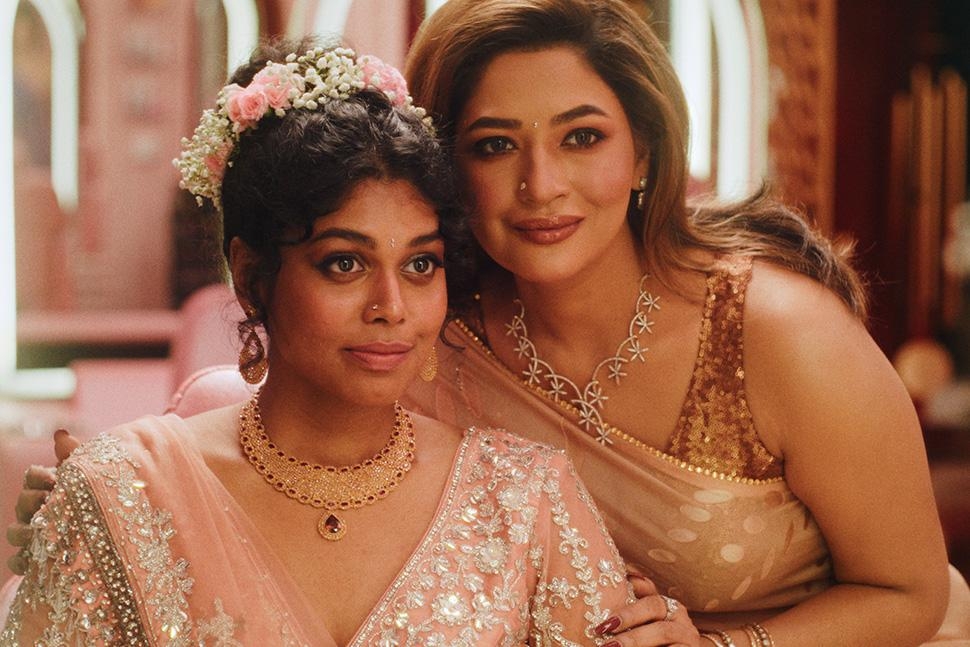
The film arrives with the distinction of being the first Bangladeshi feature to compete in the Orizzonti section of the Venice Film Festival, followed by selections at the Toronto International Film Festival and BFI London. Hossain once again concerns herself with a woman negotiating the structures around her, although this time she moves into an affluent corner of contemporary Dhaka. Zaineen (Zaineen Chowdhury Karim) has a comfortable home, a longtime family chauffeur and access to the expensive Mayfair beauty salon. She is preparing to marry Aarman (Dameer Khan), and there is little to suggest that she is entering this marriage unwillingly.
That distinction matters. Hossain is not telling the simpler story of a woman being dragged towards a marriage that she plainly rejects. Zaineen wants the wedding, or at least believes that she does. What troubles her is the person that she is required to become in order to arrive there.
At Mayfair, everyone compliments Zaineen on how beautiful she looked at a pre-wedding celebration. Almost immediately, the salon manager (Azmeri Haque Badhon) begins listing what remains inadequate: belly fat, underarms, facial blemishes, skin requiring more serious treatment. An already beautiful woman, apparently, still needs considerable work before she can become a beautiful bride.
Hossain is perceptive about how quickly external scrutiny becomes internal habit. During a jog, away from the salon and apparently alone, Zaineen instinctively pulls her clothes over her stomach. Nobody is there correcting her anymore. Nobody needs to be.
This tension between autonomy and supervision follows her elsewhere. Zaineen’s longtime chauffeur has been instructed by her mother never to leave her alone. When she takes a rickshaw by herself, the family car simply follows behind. It is one of the film’s quieter and more effective images. Zaineen possesses many of the visible instruments of independence: money, education, mobility, privacy. Yet even these seem to come with an escort.
The situation becomes considerably uglier when Zaineen goes out alone looking for marijuana, partly as an escape from her anxiety and insomnia. A policeman stops her without actually catching her buying drugs, slaps and humiliates her, and treats her presence in that particular street as incriminating The film also touches on the stigma attached to a woman buying cigarettes alone. Eventually money, and Aarman, help get her out of trouble. Her privilege works belatedly: it can extract her from the situation but cannot undo the humiliation that preceded it.
The outside world also intrudes through her phone. There are images of the 2024 student uprising and unrest, reports involving homosexuality, rape and sexual violence. These fragments create an interesting friction with the insulated spaces that Zaineen occupies: the expensive salon, the family home, the air-conditioned car. The city outside is never entirely separate from the private anxieties developing indoors.
Meanwhile, the film itself begins behaving differently. Lizards appear. Snails crawl across surfaces. There are snakes, dead fish, raw meat, blood and unexplained scratches on Zaineen’s skin. She feels something moving underneath it. Leonor Teles’ cinematography does not transform Dhaka into a conventional horror landscape. Instead, these intrusions enter otherwise ordinary spaces, as though Zaineen’s unease has begun leaking into the physical world.
Minoti (Rikita Nondine Shimu), one of the salon workers, becomes an important counterpoint. Their growing friendship is among the film’s most convincing relationships, partly because Minoti herself occupies an interesting position. She recognises the absurdity of some treatments and offers Zaineen genuine warmth, yet she also works within the machinery preparing her. Care and correction are not always easily separated here.
It is Minoti who relates the story of another bride who supposedly died mysteriously while preparing for her wedding at the salon. Played by Sunerah Kamal, this spectral figure initially seems to belong to the film’s horror vocabulary. Gradually, however, her presence becomes something more interesting.
One of Hossain’s loveliest images finds Zaineen and the dead bride lying beside each other, eyes closed, with the latter’s hand resting gently on Zaineen’s head. There is something unexpectedly tender about it. She does not appear to be threatening Zaineen at all. She seems to recognise her. For a moment, she feels less like a ghost haunting a living woman than someone who has simply been through all of this before.
That ambiguity is where The Difficult Bride is at its best. The salon itself is not presented merely as a chamber of oppression. It is also a recognisable female social space filled with music, conversation, intimacy and work. Beauty is not inherently dismissed either. Hossain’s objection seems directed more towards the point at which beauty stops being pleasure or expression and becomes an obligation, particularly when everyone except the woman herself has a stake in defining it.
Karim understands the film’s preference for accumulation. Her performance rarely announces Zaineen’s distress. It gathers in her tiredness, silences, insomnia and growing discomfort. Shimu brings warmth without sentimentalising Minoti, while Kamal achieves considerable presence with very little dialogue.
Jonaki Bhattacharya’s production and costume design renders the bridal fabrics, jewellery and salon interiors appropriately lavish. The soundtrack is particularly effective. Familiar Bangladeshi songs continue to play while progressively more uncomfortable procedures are performed on Zaineen. Rather than reassuring, the familiarity of the music adds another unsettling texture to the scenes.
If there is a significant reservation, it is that Hossain does not always trust the ambiguity that she creates so well. Dead fish, raw meat, lizards, snails, snakes, scratches and repeated news clips eventually begin competing to articulate variations of the same anxiety. Individually, many are striking. Collectively, they occasionally make a film whose ideas are already quite legible feel unnecessarily insistent. This is particularly noticeable because Hossain’s quieter images, the chauffeur following the rickshaw, or the dead bride’s hand resting on Zaineen’s head, communicate far more without announcing what they mean.
Perhaps that is why the ending works so well. Hossain finally simplifies everything.
Zaineen has been fully prepared for the wedding. Her mother, Minoti and the salon manager admire how beautiful the finished “output” looks. Once alone, however, the sensation in her scalp returns, recalling the story of the previous bride. Zaineen locks the door. She pulls apart the elaborate hair prepared for her and then shaves her head.
The act is dramatic, but its meaning comes from something remarkably practical. For almost the entire film, other people have been adding to Zaineen, subtracting from her, treating her, covering her and correcting her. Behind the locked door, she reverses the process.
What registers on Karim’s face afterwards is important. It isn’t triumph in any conventional cinematic sense. It looks closer to relief.
Earlier, when an exhausted Zaineen suggests abandoning the wedding, Aarman refuses. In the final sequence, she doesn’t ask. Whether shaving her head solves anything beyond that room is almost beside the point. For once, the decision is hers alone.
The Difficult Bride is beautiful, unsettling and occasionally more emphatic than it needs to be, but it is also Hossain working in a particularly adventurous register. The film begins by asking how the perfect bride is made and gradually arrives at a more uncomfortable question: perfect for whom?
By the end, perhaps the “difficult” bride is simply the woman who has decided that nobody else gets to finish making her.
—
Sakib Iftekhar is a Melbourne-based film producer, distributor and critic, and founder of Screenxcope Australia. His work spans international co-productions, distribution, festival strategy and programming, with a focus on independent cinema from South and Southeast Asia. His producing projects have been selected and recognised at major international film festivals, while he has led the Australian and New Zealand distribution of more than a dozen acclaimed Asian films. He has also worked as a film critic and festival programmer across Australia and North America.
