



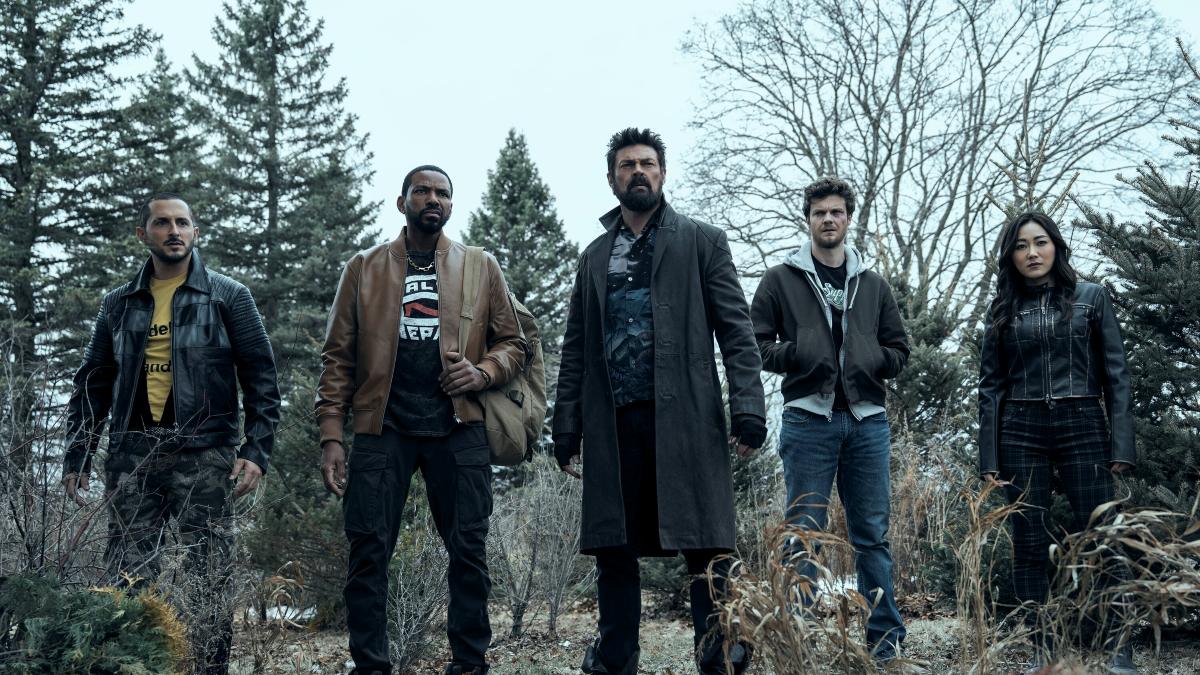
by FilmInk Staff
Colorist Siggy Ferstl uses Depth Map to bring a three dimensional approach to color.
Senior Colorist Siggy Ferstl of Company 3 has been grading “The Boys” since the show’s first season, bringing a distinct visual identity to one of television’s most stylised and visually ambitious series. Based in Los Angeles, Ferstl has built one of the more varied credit lists in the business, with work spanning “Wednesday,” “Narcos,” “Lost in Space” and “Gen V,” “The Boys” spinoff. For the fifth and final season of “The Boys,” Ferstl leaned heavily into DaVinci Resolve Studio editing, photo editing, grading, visual effects (VFX) and audio post production software, and in particular its Depth Map tool, to push the show’s look further than any previous season.
Blackmagic Design sat down with Ferstl to talk about his evolving approach to the grade, how Depth Map has changed the way he thinks about color, and what nearly a decade on one show teaches you.
The Depth Map has become one of your go to tools in DaVinci Resolve Studio. Can you talk about how you use it?
“As colorists, we generally think in terms of the colour and contrast of a 2D image. Depth is more of a secondary consideration. We’ve always had tools that let us separate objects if we want to treat them differently: vignettes, Power Windows, shapes, keys. But no matter how good you are at isolating objects in DaVinci Resolve, or how strong a key is, it can be a time consuming process, and you’re still only separating objects within a two dimensional image.
“What DaVinci Resolve’s Depth Map does is automatically map the entire image and determine each object’s distance from camera. It’s very fast compared with traditional VFX methods, which means entire scenes can be mapped as part of the color grading process. It’s been so successful for me that it really isn’t a secondary correction anymore. I now have it as part of my default node structure. Ever since I started using it to its full potential on “The Boys,” I approach colour in a more three dimensional way, applying it differently to the background versus the foreground.”
Can you name some specific shots from season five where you used this tool, and why it changed your approach?
“There is a scene in a deserted hospital that was meant to feel eerie and unsettling. Depth Map was essential for a couple of reasons. The filmmakers felt the location was a bit dark, and traditionally, lifting an image overall can flatten the look. With the Depth Map, I was able to brighten only the background while leaving the foreground with rich, deep shadows. I also added some volumetric haze and light halation to give the scene a slightly smoky feel. Then I applied what I call depth aware colour, which is like a traditional split of warm highlights and cool shadows, but here I tinted the background with a cool green and kept the foreground characters with warm, natural skin tones.
“That combination of Z depth split colour and volumetric light scattering removed any feeling of the scene being too dark and added to the look that was practically captured.
“The other way I used the Depth Map effectively was to bring down backgrounds in bright, backlit situations, which are often problematic in HDR. It pushes the characters in the foreground forward, so they become the clear focal point of the shot.”
When you’re working with big VFX shots, do you apply the Depth Map before or after the other work?
“Sometimes, I add it to a scene as a placeholder because I know I’ll use it, then dial it in when the final version of the shot is dropped in. Or if I haven’t applied it yet and feel like I need it, it’s very easy to add since it’s already part of my default node setup.”
You’ve been on “The Boys” since the beginning. What evolution in color grading have you seen across the seasons?
“Over the eight or nine years on the show, DaVinci Resolve has expanded its toolset dramatically. Meanwhile, I’m seeing more and more showrunners, cinematographers, and VFX supervisors coming into colour sessions with a real understanding of what we can do beyond traditional colour.
“When everyone involved in prep and production has a firm grasp on what can be achieved in the grade, it affects how they approach the shoot. Depth Map is relatively new, and I’m finding a lot of interest in what’s possible with it.”
Is Depth Map primarily useful on big VFX productions, or would it work for a small indie?
“It could be even more useful for indies. A production might not have time on the day to light the background properly. They might have to concentrate on the actors and the foreground, even if they’d like to treat the distance differently, and just don’t have the resources. Every year, we can offer to do more of that in the grade.”
What should colorists be aware of before pushing this tool hard?
“Like every tool, there are limits to how far you can push it before it breaks. Depth Map is no different. It’s a great way to separate elements in the frame based on depth, but what you do once you’ve separated them is up to the artist. And like anything in color grading, it works well in the hands of someone who has the eye and the experience to know what they’re doing. Without that, it can just as easily make the image look strange or artificial.”
On “The Boys,” how do you work with the director and cinematographer on each episode?
“I’ll do a first pass on my own. Having worked on the show since the beginning, I know the look and the things to watch for. The cinematographer always has an opportunity to review, either with me or separately, depending on schedules. Then the full team comes in: showrunner, executive producers, director, and the VFX team. It’s a full room.”
Are there other DaVinci Resolve Studio tools that were particularly helpful this season?
“Magic Mask is one I’ve used quite a lot to quickly qualify parts of the frame that would previously have taken a long time. I also create a lot of haze, halation and smoke effects by combining different OFX plugins to build those kinds of looks in my own way.”
What do you always hope to bring to a project artistically?
“With the tools available now, I can do so much more than colour correction. At times, it really is post FX, which straddles traditional colour and VFX. I enjoy that space, and it really leverages my skillset. But ultimately, I always want to do everything I can to help realize the filmmakers’ vision and bring the viewer into the story.”
All five seasons of “The Boys” are now streaming exclusively on Prime Video.
