



by Stephen Vagg
Hollywood has a habit of searching for the next version of a big star – the next Tom Cruise/Audrey Hepburn/Julia Roberts, etc. Some lucky next-version stars manage to become stars in their own right – Matthew McConaughey and Ben Affleck for instance, both survived “next Tom Cruise” stamps to carve out their own niches. Sometimes, however, being a comparative star can hurt someone – being dubbed the next Audrey Hepburn probably hurt the careers of Gabrielle Anwar and Julia Ormond. In the mid-1950s, Richard Egan was dubbed the next Clark Gable. He was flattered by the comparison, and certainly Hollywood producers spent around six years trying to turn that label into reality. It never happened, but he made some interesting films.
Egan was born in San Francisco in 1921, to an Irish-Catholic family – so Irish-Catholic that his elder brother became a priest. Egan studied drama at the University of San Francisco, then served in the army for several years, during which time he decided to become an actor. He studied theatre history at Stanford University, then taught public speaking at Northwestern University, also appearing in campus stage shows. This led to an offer for a screen test with a Hollywood studio – Egan didn’t get the gig but decided to stick around in Los Angeles and see how he’d do.
Egan was a rugged, tough type, handsome in a newsreader way, with a strong speaking voice. This made him ideal for playing cops, cowboys and soldiers – and as such, he found employment relatively quickly, playing small roles in films such as The Good Humor Man (1950), The Damned Don’t Cry (1950), Return of the Frontiersman (1950) and The Killer That Stalked New York (1950).
In June 1950, he signed a contract with Universal, who put Egan in support parts in their bread and butter pictures – Westerns, noirs, swashbucklers, melodramas: Wyoming Mail (1950), Undercover Girl (1950), Kansas Raiders (1950), Highway 301 (1950), Bright Victory (1951), Up Front (1951), Hollywood Story (1951), The Golden Horde (1951), Flame of Araby (1951), The Battle at Apache Pass (1952). However, the studio had plenty of other macho types under contract (Jeff Chandler, Rock Hudson etc) and eventually dropped Egan.
He appeared in a play that did not make it to Broadway – Strike a Match with Eva Gabor. His film roles continued to be steady if unexceptional: Cripple Creek (1952) for Edward Small; The Devil Makes Three (1952) at MGM. Egan did a series of films at RKO in its dying days, possibly because he gave off similar vibes to Victor Mature and Robert Mitchum, two of Howard Hughes’ favourite leading men: One Minute to Zero (1952), a war film, with Mitchum; Blackbeard the Pirate (1952), playing a sidekick to heroic pirate Keith Andes (who RKO tried to turn into a star for two seconds); Split Second (1953), also with Andes.
Egan was also effective in a series of movies at Fox: The Glory Brigade (1953), a decent war movie about Greek-American soldiers with Victor Mature; The Kid from Left Field (1953), as a baseball player; and especially Demetrius and the Gladiators (1954), as a gladiator who manhandles Debra Paget, inspiring Mature to become a gladiator.
By this stage, Egan had been cast in his first leads: a noir, Wicked Woman (1953) for Edward Small, who also cast him the lead in Khyber Patrol (1954). He toplined Gog (1954) for Ivan Tors.
RKO was looking for someone cheap to co-star with Jane Russell in Underwater! (1955) and decided to cast Egan. The movie was big budgeted, and somewhat notorious in Hollywood lore (in part because Jayne Mansfield crashed the premiere), but it is disappointingly dull and Egan shows more cleavage than Russell. She wrote in her memoirs that the two of them had an affair during filming – he was a bachelor for a long time before marrying in 1958 and staying married until his death.
Egan’s work – particularly on Demetrius – did not pass unnoticed at Fox. In July 1954, Egan signed a seven-year contract with that studio at two films a year; this was when the “new Clark Gable” publicity really began (Gable was still alive, incidentally). When Victor Mature turned down the second lead in Fox’s veld Western, Untamed (1955), with Tyrone Power and Susan Hayward, Egan took it instead. He did very well in what is actually the best part: the nominal villain who gets all the sympathy (someone in love with Hayward who pines for disinterested Power).
Egan then supported Mature in the heist thriller Violent Saturday (1955); it was one of the actor’s best performances, as a weak drunk – this movie indicated a career for Egan as a character actor that he never really took. It was a minor hit.
Egan fever began. Fox gave him two choice lead roles: Seven Cities of Gold (1955) as a Spanish soldier in California; and The View from Pompey’s Head (1955) – one of those mid ‘50s adaptations of best sellers (stepping up after Gregory Peck turned it down). Neither film did that well, but Fox showed faith in Egan, casting him opposite Jane Russell (in a part rejected by Marilyn Monroe) in The Revolt of Mamie Stover (1956). That was disappointing too.
At RKO, Egan did Tension at Table Rock (1956) then Fox cast him in the lead of a Western, The Reno Brothers (1956). The latter was eventually retitled Love Me Tender to exploit the appeal of Egan’s co-star Elvis Presley. And it was a good move as the movie became a box office sensation. Watching it today, it’s clear that Presley had an electric charisma, which leads Egan (and Debra Paget) simply lacked, but Egan brought a lot of gravitas and heft to the role – he made Elvis’ performance better and it’s a shame that the studio didn’t reunite them. The movie gets a poor wrap, but it’s a solid Western.
At Universal, Egan played the lead in noirs Slaughter on Tenth Avenue (1957) and Voice in the Mirror (1958). He returned to Fox whose enthusiasm for the actor was clearly cooling – the studio put him in support parts, behind Robert Mitchum, Robert Wagner and May Britt in The Hunters (1958); and he was a villain to Don Murray’s hero in the Western These Thousand Hills (1959).
Then, once again, Egan had the lead in two hits powered by young stars. The first was A Summer Place (1959) where his daughter (Sandra Dee) hooks up with the son (Troy Donahue) of Egan’s ex (Dorothy McGuire), just as Egan and McGuire also hook up. The film was a hugely entertaining piece of melodramatic codswallop and Egan was completely fine, although credit to the movie’s success went to Dee and Donahue. This was not entirely fair – the professionalism of he and McGuire is a tonic to the campiness of Constance Ford and Arthur Kennedy and the woodenness of Donahue (Dee is terrific); it’s not Egan’s fault that he has a speech where he talks about the naturalness of sex and his daughter’s delightful figure.
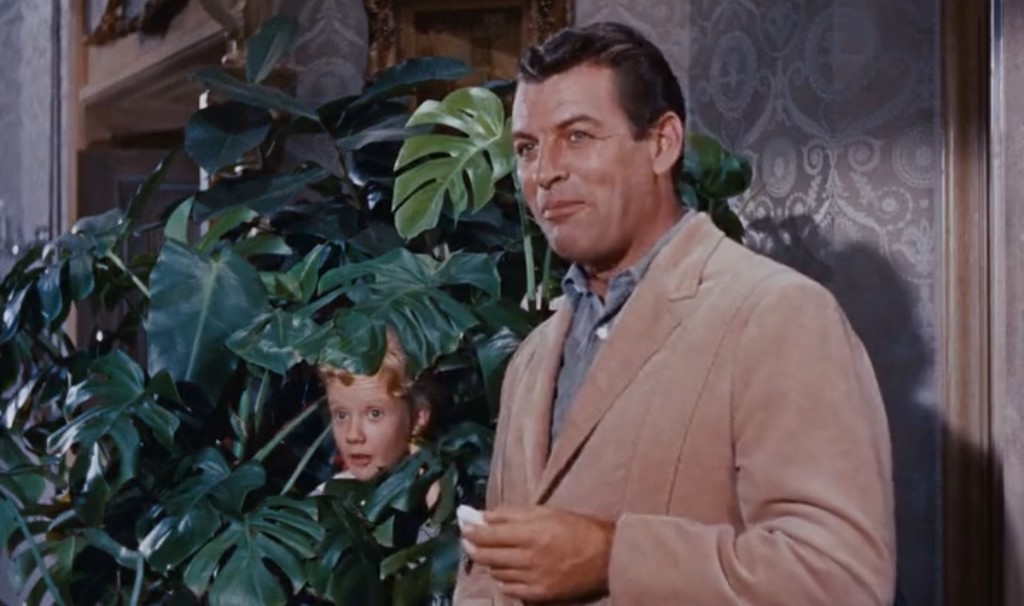
The second was Pollyanna (1960), where Egan played a kindly doctor helping a cute orphan (Hayley Mills); he’s again fine, though more should’ve been done with his character. Egan should’ve played more dad parts – he really suited them.
He was originally announced in From the Terrace (1960), but Fox went with Paul Newman, which proved to be the correct decision – Newman, like Presley, had a warmth and connection with the audience that Egan never matched. However, the studio did put him in two historical epics, Esther and the King (1961) with Joan Collins, and The 300 Spartans (1962). Neither really hit the spot at the box office, although Spartans enjoyed a long life on television and inspired Frank Miller’s 300.
Egan hadn’t done much television, but his run of films made him more amenable to the medium. He played the lead in the series Empire (1962-63) with two future stars, Ryan O’Neal and Charles Bronson. It did not last; the series was reworked as Redigo (1963), but that did not take either.
Then it was TV movies, guest shots on television and the leads in low-budget features like Chubasco (1968), The Destructors (1969), The Big Cube (1969), Moonfire (1970), The House That Would Not Die (1970), The Day of the Wolves (1971). The remainder of Egan’s career was predominantly television and theatre, although he was billed after Robert Mitchum in Golden Harvest’s The Amsterdam Kill (1977). He also had the lead in Throw Out the Anchor! (1974), Mission to Glory (1977) and The Sweet Creek County War (1979) and a long running role on the forgotten Capitol. Egan died quite young, of prostate cancer, in 1987.
Richard Egan had an entirely decent career – he acted steadily for over thirty years and never seemed to lack work. He hit leading roles only a few years into his career and stayed there. He was very easily castable – authoritative, commanding, handsome. He wasn’t really a star though – he lacked a twinkle in the eye, a shared collaboration with the audience that the true stars have. There was something distancing about him.
From a career point of view, Egan probably played too many leading roles; generally these are limiting in scope. He definitely should have tried more character parts – more guest shots on anthology television for instance. He also should have co-starred more against live-wire types, where his Gregory Peck vibes would have been a useful counterpoint.
Still, he had a long career and managed to appear in truly iconic films: Love Me Tender, A Summer Place, The 300 Spartans, Pollyanna, The Glory Brigade, Demetrius and the Gladiators… that’s not bad.
