


by Stephen Vagg
Edmund Purdom was an actor for over sixty years and had a genuine chance of being a movie star for about one of those years. To be fair, that’s more than most actors get – and it’s much to Purdom’s credit that he enjoyed such a long innings. But there’s no doubt that he lived most of it in the shadow of his “hot” period in the mid 1950s, when MGM thought that he was going to be the next big thing.
Purdom was British, born in 1929. He started acting while just a teenager at the Northampton Repertory Company, a place crucial in the early career of Errol Flynn – like Flynn, Purdom was a tall, handsome type with a decent voice, easily castable as soldiers, romantic leads, police and so on. He had to take some time out for military service – which consisted of entertaining the troops – then acted at Stratford-upon-Avon, before he toured with Laurence Olivier and Vivien Leigh in their double bill of Caesar and Cleopatra and Antony and Cleopatra, playing a minor part in each. This brought him to Broadway where Hollywood took notice and Warner Bros offered a screen test. It was the era when tall handsome British leading men were fashionable (Stewart Granger, Richard Burton, etc.) Purdom dumped theatre and went west.
Things didn’t go that well for Purdom at first – Warners didn’t offer a contract, he lost out on roles in Mississippi Gambler and My Cousin Rachel. However, he managed to get a tiny part in MGM’s Julius Caesar (1953) as the Roman who Brutus asks to kill him, a small but flashy role in a superb picture. This led to another small but flashy part in a strong movie: Titanic (1953) playing Lightoller.
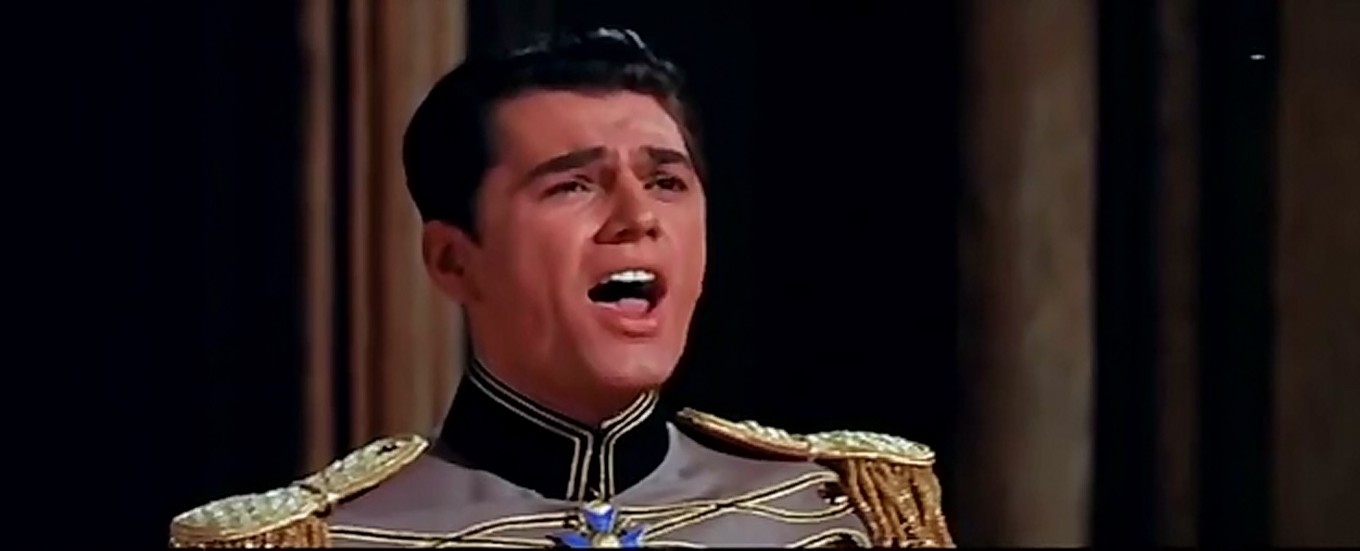
Purdom was going to play Greer Garson’s brother in MGM’s biopic of Aussie opera singer Marjorie Lawrence, Interrupted Melody, but then Garson didn’t want to do it (the project was later made with Eleanor Parker, and Roger Moore as her brother). Then came the big break. Opera singer Mario Lanza, one of MGM’s biggest stars, had been playing up on the set of The Student Prince (1954). If Louis B. Mayer had been around, this likely would have been smoothed over (Mayer was superb at dealing with talent) but mercurial types like Lanza were out of the comfort zone of the studio’s then-head Dore Schary, who wound up firing Lanza and needed a replacement. They picked Purdom, who played the part, lip-synching to Lanza’s songs and the film was a huge hit. This success was, in hindsight, due to the movie’s colour, story, support cast and Mario Lanza versions of the songs rather than Purdom, but hits never hurt, and The Student Prince turned him into the next big thing.
It certainly attracted 20th Century Fox, who also needed a handsome leading man for a big budget film where the lead had dropped out – in their case, it was the $4 million epic The Egyptian (1954), meant to star Marlon Brando as a doctor in Ancient Egypt; Brando dropped out shortly before filming, a desperate Fox contemplated Dirk Bogarde (who would’ve been perfect but turned it down), Farley Granger (ditto), and John Derek before settling on Purdom.
Dore Schary was delighted. All those critics who claimed that he lacked Mayer’s ability as a star builder could go suck it! MGM announced Purdom would appear in carefully curated star vehicles: a musical spoof of the wellness industry, Athena (1954); a Biblical epic based on the prodigal son story, The Prodigal (1955) with Lana Turner; and a swashbuckler about the theft of the Crown Jewels, The King’s Thief (1955).
Then it all went bad. The Egyptian came out and did so-so – one of those films that made some money, particularly overseas, but that no one seemed to like and was generally regarded as a disappointment. Much of the criticism went to the performance of Darryl Zanuck’s mistress, Bella Darvi, who was the female lead, but Purdom’s dull turn didn’t help, nor did the flat story.
Athena was a dreadful musical, perhaps the worst effort from producer Joe Pasternak, with no laughs, no point, and a bad story. Purdom, who couldn’t sing or dance, didn’t help. The movie’s main legacy is that Steve Reeves has a part and his performance led to his casting in 1958’s Hercules which made him a star.
The Prodigal, which should have been a slam dunk, was even poorer – Schary called it the worst film he ever supported at MGM and he deserves a great deal of blame for greenlighting a movie based on the prodigal brother’s parable which hardly has any brother/father stuff in it. The costumes and production design are, however, fabulous.
The King’s Thief also should have been fun and simply wasn’t. Purdom threw more oil on the fire by leaving his wife and kids for Linda Christian, then married to Tyrone Power. MGM dropped him – Dore Schary in his memoirs said success had gone to Purdom’s head, omitting to mention that Schary had cast Purdom in three films that would have been bad whoever starred in them.
When the dust settled, the only firm offer came from Allied Artists, Strange Intruder (1957) with Ida Lupino. This is of interest to Aussies because it was based on an Australian novel, The Shades Will Not Vanish by Helen Fowler. It didn’t turn things around for him, nor did appearing in a Broadway play, Child of Fortune.
Still, Purdom was a handsome man with a nice speaking voice and head of hair, plus an international profile. As such, Europe beckoned: he went to England to play the lead in a TV series, Sword of Freedom, then hot-footed it over to Italy where he turned up in peplums/epics/swashbucklers, including Herod the Great (1959), The Cossacks (1960), The Loves of Salammbo (1960), The Night They Killed Rasputin (1960), Fury of the Pagans (1960), The Last of the Vikings (1961), Suleiman the Conqueror (1961), White Slave Ship (1961), and Queen of the Nile (1961).
Purdom settled in Italy and carved out an entirely respectable career as an actor and a voice dubbing artist. He would occasionally pop up in a British-shot production such as Moment of Danger (1960) or The Comedy Man (1963) but was more likely to be found in European productions, whatever genre was in fashion at the time (spaghetti Westerns, then giallos, Eurocrime, post-apocalyptic actioners, comedies): examples include The Last Ride to Santa Cruz (1964), Heroes of Fort Worth (1965), Chrysanthemums for a Bunch of Swine (1968), The Fifth Cord (1971), Lucifera: Demon Lover (1972), The Big Family (1973), Frankenstein’s Castle of Freaks (1974), The Cursed Medallion (1975), Mister Scarface (1976), Pieces (1981), Ator: the Fighting Eagle (1982), 2019: After the Fall of New York (1983). By the 1970s, he was almost entirely in support roles but some of those were juicy. He played Vittorio de Sica in the mini-series Sophia Loren: Her Own Story, with Loren as Loren, and directed an English slasher, Don’t Open ‘Til Christmas (1984) (although it was a troubled production and Purdom quit the project). He died in Italy in 2009.
Edmund Purdom’s career is an interesting one. He lucked into being a movie star, via genetics, and being in the right place at the right time when not one but two stars dropped out of roles. Against this, it must be said that he took a chance of going to Hollywood when it would’ve been safer to stay in Britain, and he had to battle against the incompetence of Dore Schary. Against that, it must be said that he didn’t have to blow up his private life or take easy money in Europe. Against this, he really made a go of things in Italy, managing to consistently play leading roles until the late 1960s and having a decent career. Good on him.
