


by Cain Noble-Davies
Worth: $13.75
FilmInk rates movies out of $20 — the score indicates the amount we believe a ticket to the movie to be worth
Cast:
Laurie Kynaston, Sian Clifford
Intro:
… a film that viewers are unlikely to forget in a hurry …
When does a documentary stop being presentation, and start being exploitation? Is it even possible to separate the two, and is it worthwhile to try it anyway? Just about every form of documentary-style media, from the genuine article to its myriad of ‘reality TV’ aesthetic offspring, have had to tangle with these questions. Highlighting the lived stories of those who exist outside of the general public’s perceptions can be a noble act, giving a voice to the traditionally voiceless… but those same attributes that make such stories interesting can draw questions about the purpose of the act. If a person under great mental strain and neurosis is filmed for a documentary, whose interests are truly being considered: the subject, or the observer?
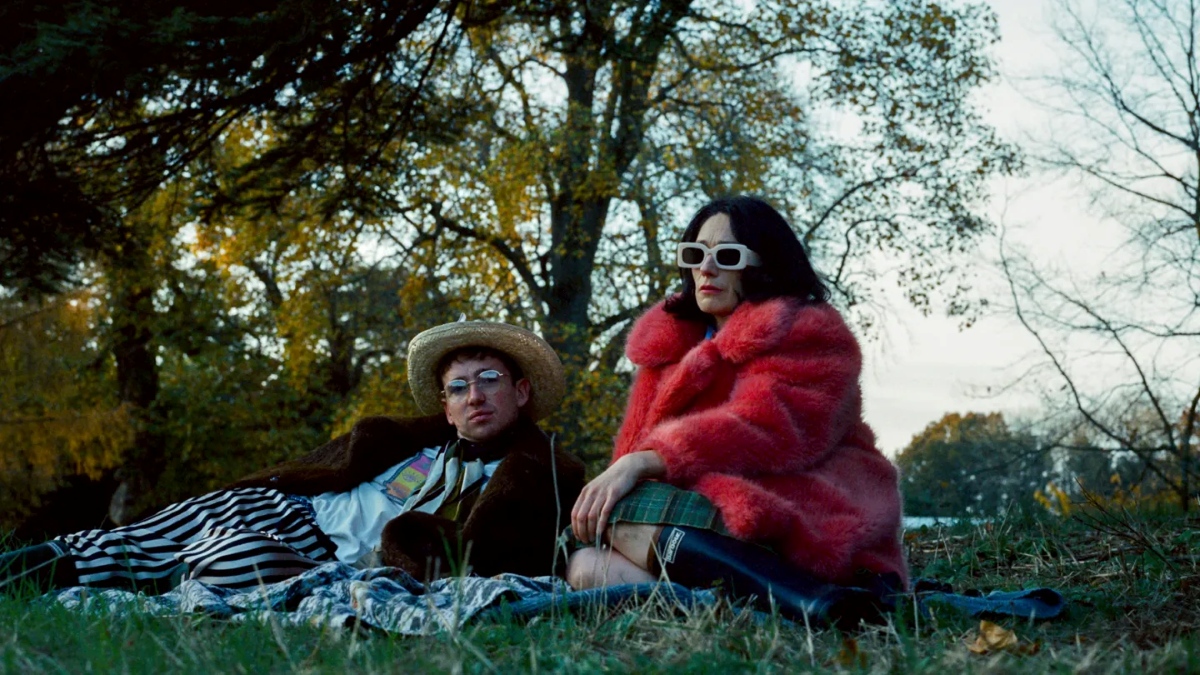
This is the core idea behind Lady, the latest film by British writer/director Samuel Abrahams. It’s a mockumentary featuring a fictionalised version of Abrahams himself (here played by Laurie Kynaston), who is hired by aristocrat Lady Isabella (Sian Clifford) to make a Netflix documentary about her life and her ambitions as an artist. Throughout the film, there’s a constant push-and-pull between the two as to who is actually running the show, with Sam and Isabella regularly competing over who gives direction to the camera crew. And as things go from the merely silly to genuinely surreal, with Isabella beginning to literally disappear from view piece-by-piece, the line between subject and observer blurs harder than Isabella’s own body.
The initial set-up, combining a mockumentary centred on a blow-hard with zero self-awareness a la The Office, and enough pretentious vanity to make Eddy and Patsy from Absolutely Fabulous blush, presents an aura of bonkers energy that the hour-and-a-half to follow often struggles with maintaining. Its structural breakdowns of the trappings and ethics of documentary filmmaking, and the difference between looking and seeing, land on solid enough ground (it often feels like the entire film is the result of compacting every single reaction to Grey Gardens into its own feature). But, with its Saltburn-coding, plucked soundtrack, stately setting, and eerie visuals – with its cutaways to Isabella’s increasingly-desperate attempts at performance art – it’s hard not to think that it should be dishing out a bit more class politique than it actually does. Well, beyond the fascinating redundancy in Isabella’s initial goal of being “the aristocracy’s answer to the Kardashians”; both famous by birthright having a worrying level of societal influence.
Much like Isabella herself, all that focus placed on the surface of things, only what is immediately visible (or not, in Isabella’s case), leaves out what’s really going on underneath; under the artistic affectations, the mutton-dressed-as-lamb mannerisms, and the home measured in square miles. Isabella’s plight and gradual spiralling into solipsistic crisis reveals something viscerally upsetting about the nature of perception, fleshing out what is a rather basic visual metaphor into a searingly honest depiction of how much the loss of self, even just the fear of it, is terrifying.
There’s also Sam’s role in all of this, both as on-screen persona and as the real-world director. In 2015, the real Sam directed a documentary short called Offline Dating, following his friend Tom’s attempts to find a date by asking people on the street. It’s a cute-enough viewing experience at just under six minutes long, but there’s a persistent ick to a lot of the actual content. Not on Tom’s part, but on the possibility that the short itself isn’t really an attempt to humanise the struggles of modern dating as it pertains to be, and instead a cheap opportunity to laugh at someone willing to embarrass themselves on camera.
It’s difficult to watch Lady without thinking that at least some of it is the result of Sam reflecting on his experiences filming it, weighing up the worth of personal truth with the chances that it’s just opening a subject up for ridicule. Seeing the fictionalised Sam have his own artistic merits brought into question, his ethics in participating in any of this, and his conspicuous irritation once the cameras start following him as intently as Isabella, comes across like an act of catharsis; one which brings up something painfully honest about the entire conversation surrounding both him and Isabella: Personal truth is embarrassing, by default. But what’s embarrassment compared to the existential dread of believing, or even knowing, that you simply cannot be perceived as you really are?
Lady manages to be both exactly as strange as it needs to be, and yet not strange enough. Its attempts to be earnestly deconstructive and cheekily satirical give it an exceptionally odd tone, just as difficult to genuinely grasp as it is to see Isabella’s translucent limbs. But for every been-there-done-that jibe at the expense of people too rich to afford taste, there’s just as many striking statements about media objectification and the realities of living with ‘invisible conditions’. For better or worse, it’s a film that viewers are unlikely to forget in a hurry, and it offers not only Sian Clifford being terminally delightful, but also the most photogenic raven ever put to screen.
