



by Samantha Porter
Online gaming has moved far beyond the image of a private hobby played in front of a single screen. Today, games behave more like entertainment platforms: they host live events, support creators, build communities, and compete directly with film, television, streaming, and social media for audience attention.
This shift matters because gaming is changing how people experience stories, follow personalities, join fandoms, and participate in culture. Instead of simply watching entertainment unfold, players can now step inside it, shape parts of it, and share it with others in real time.
The Evolution of Online Gaming and Modern Entertainment
Online gaming has evolved from a niche digital pastime into one of the central forces in modern entertainment. Early online play was mostly about competition, matchmaking, and simple multiplayer interaction. The experience was limited by hardware, connection speeds, and the idea that games were separate from the wider entertainment industry.
That separation has largely disappeared. Modern games now borrow from film, television, music, live performance, social media, and digital publishing. Major titles release seasonal updates, cinematic trailers, story events, character arcs, and virtual concerts. Players do not just finish a game and move on; they return to evolving worlds that keep changing around them.
This has changed the role of the audience. In traditional entertainment, viewers mostly consume what has already been produced. In online gaming, audiences often participate, react, remix, stream, compete, and build communities around the experience. That shift from passive viewing to active participation is one of the biggest reasons gaming now sits at the centre of modern entertainment trends.
Why Gaming Now Competes With Film, TV, and Streaming
Games now compete with film, TV, and streaming because they offer more than gameplay. They offer stories, characters, social spaces, live events, creator content, and a reason to return every week. A popular game can function like a series, a sports league, a social network, and a fan community at the same time.
That competition is visible across the wider media landscape. Deloitte’s 2025 Digital Media Trends report notes that entertainment time is now split across streaming video, user-generated content, social platforms, gaming, music, podcasts, and other digital formats, which means games are fighting for the same attention window as film and television.
This is especially clear in live-service games, where updates operate almost like new episodes. A season can introduce new locations, characters, rules, cosmetics, and story developments. The audience follows the change not only inside the game but also through trailers, reaction videos, streams, podcasts, forums, and social clips.
For entertainment companies, that changes the competitive landscape. The question is no longer whether people prefer games or films. Many audiences now move between both. They watch adaptations, play the games, follow creators, join Discord communities, and discuss the same intellectual property across several formats. Gaming has become part of the same attention economy as cinema and television.
This broader entertainment crossover is also visible in adjacent digital sectors. Audience behaviour, trust, platform choice, and content discovery all matter across online entertainment, from streaming services to review-led gaming platforms, where industry insights from bestaucasinolist can sit within the wider conversation about how users compare entertainment options before committing their time or money.
Key Online Gaming Trends Shaping Entertainment
The most important online gaming trends are not only technical. They are cultural. Games are becoming more social, more watchable, more creator-driven, and more closely connected with the wider entertainment ecosystem.
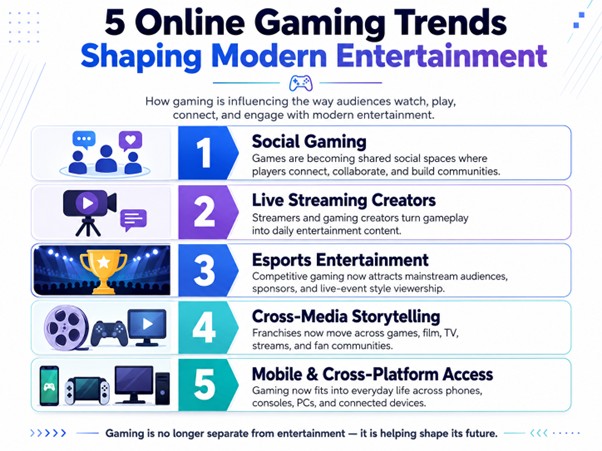
Three trends stand out: the rise of interactive and social gaming, the growth of live streaming and gaming creators, and the mainstreaming of esports as spectator entertainment. Together, they show how gaming has shifted from a product people buy into a cultural space people enter, watch, discuss, and return to.
Interactive and Social Gaming
Interactive and social gaming has changed the meaning of play. For many players, the game itself is only part of the attraction. The real pull is the shared experience: teaming up with friends, joining communities, reacting to live events, creating content, and being part of a world that other people are also shaping.
| Gaming feature | Entertainment impact |
| Multiplayer worlds | Turn games into shared social spaces |
| Live events | Create appointment-style entertainment |
| User-generated content | Lets audiences become creators |
| Community hubs | Extend the experience beyond gameplay |
This is why titles with strong community tools often last longer than games built only around single-player completion. Social interaction gives the audience a reason to stay after the original novelty has faded.
Live Streaming and Gaming Creators
Live streaming has turned gaming into a performance medium. A game no longer needs to be played directly to become entertainment. Millions of viewers follow streamers, esports players, speedrunners, reviewers, modders, and commentators as personalities in their own right.
Platforms such as Twitch, YouTube Gaming, and TikTok have made gameplay part of daily content culture. A stream can feel like a talk show, a sports broadcast, a comedy routine, a tutorial, and a fan hangout all at once. The creator becomes the bridge between the game and the audience.
This has also changed how games are marketed. A trailer still matters, but a memorable stream, viral clip, creator challenge, or reaction video can shape public interest faster than traditional advertising. In that sense, gaming creators now play a similar role to critics, presenters, influencers, and fan communities in film and television.
Esports as Mainstream Spectator Entertainment
Esports has grown from small competitive scenes into a professional spectator format with teams, leagues, sponsors, broadcasts, analysts, venues, and global fan bases. Its appeal is not only the competition itself but the drama around it: rivalries, storylines, underdogs, star players, and high-pressure finals.
In entertainment terms, esports sits somewhere between sport, gaming, streaming, and reality-driven fandom. Viewers follow teams across seasons, watch highlight reels, debate strategy, buy merchandise, and engage with players online. The audience experience is closer to a media ecosystem than a simple tournament bracket.
For younger audiences especially, esports can feel as natural as watching football, Formula 1, or a major film premiere. It is scheduled, social, reactive, and built for live discussion.
How Gaming Is Changing Storytelling and Fan Engagement
Gaming is reshaping storytelling because it gives audiences a different relationship with narrative. Instead of watching characters from a distance, players often inhabit the world, make choices, explore environments, and return to stories as they evolve over time.
This does not replace film or television storytelling. It expands the possibilities around it. A franchise can now introduce a character in a game, develop lore through short videos, continue the story in a streaming series, and keep fans engaged through live events or community challenges.
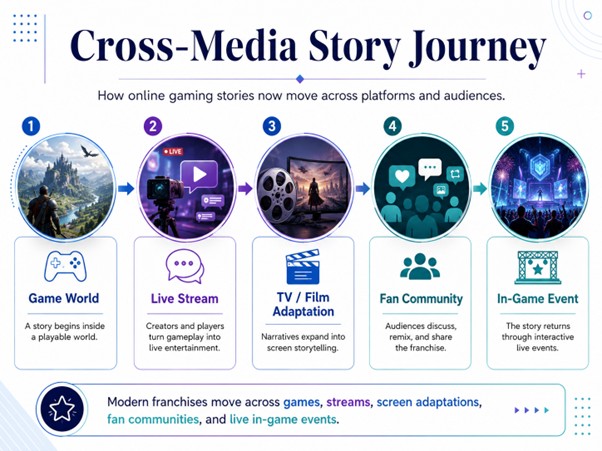
The result is a more fluid entertainment model. Stories can move between screens, formats, platforms, and audience behaviours. A fan may first discover a franchise through a game, then watch the adaptation, follow the cast online, and return to the game for new content tied to the same universe.
Cross-Media Franchises and Shared Audiences
The overlap between film and gaming audiences is now impossible to ignore. Adaptations such as prestige TV series based on games, game-inspired films, and cinematic game releases show that the two industries are feeding each other more directly than before.
Studios increasingly understand that gaming audiences are not separate from film audiences. They are often the same people, moving between formats depending on the story, platform, and social conversation around it. A successful adaptation can bring non-players into a game world, while a beloved game can give film and TV producers an existing fan base with deep emotional investment.
The challenge is consistency. Fans notice when tone, character, lore, or world-building feels careless. The strongest cross-media franchises respect the original material while adapting it intelligently for a different medium.
In-Game Events, Virtual Worlds, and Fan Participation
In-game events have become one of the clearest examples of gaming’s influence on entertainment. A concert, trailer reveal, seasonal finale, or limited-time mission can turn a game into a live cultural moment. The audience does not simply watch the event; it attends, reacts, records, shares, and discusses it.
This gives entertainment brands a new kind of stage. Virtual worlds can host music performances, film promotions, fashion collaborations, and story events that feel more participatory than a standard ad campaign. The value is not only reach but immersion.
Fan participation also changes the emotional weight of these moments. When players feel present inside an event, the memory can become more personal than watching a clip afterwards. That sense of shared presence is one reason gaming is becoming so important to the future of entertainment.
Mobile and Cross-Platform Gaming Trends
Mobile and cross-platform gaming have made games easier to fit into everyday life. A player can start on a console, continue on a phone, watch related content on a tablet, and follow community discussion through social platforms. Entertainment is no longer tied to one device or one room.
Mobile gaming is especially important because it expands access. It reaches people who may never buy a console or gaming PC but still play puzzle games, competitive titles, social games, narrative apps, or mobile versions of major franchises. This has helped gaming become a more universal part of daily entertainment culture.
Cross-platform play adds another layer. Friends can play together even if they use different devices, which makes games more social and less restricted by hardware. For entertainment brands, this matters because the strongest audience experiences are now continuous. People expect access across screens, accounts, formats, and communities.
This trend also mirrors broader media behaviour. Just as viewers move between cinema, streaming apps, YouTube clips, and social feeds, players now move between devices and gaming experiences. The boundaries between platforms are becoming less important than the continuity of the entertainment itself.
Immersive Technologies in Gaming
Immersive technologies are pushing gaming toward experiences that feel more responsive, spatial, and personalised. VR, AR, cloud gaming, and AI are not equally mature, but each points toward a future where games become easier to enter and more adaptive once players are inside.
The most interesting development is not simply better graphics. It is the possibility of entertainment that reacts to the audience in real time. A game can adjust difficulty, generate dialogue, support shared virtual spaces, or make high-end experiences available without expensive local hardware.
VR, AR, and Cloud Gaming
Virtual reality and augmented reality give gaming a stronger sense of physical presence. VR can make players feel surrounded by a world, while AR can layer digital play over real environments. Both formats are still shaped by hardware costs, comfort, content depth, and mainstream adoption, but their entertainment potential is clear.
Cloud gaming takes a different approach. Instead of changing how a game feels physically, it changes how easily people can access it. By streaming games to different devices, cloud services can reduce the need for large downloads or expensive hardware. That could make premium gaming experiences more flexible and more widely available.
Together, these technologies suggest a future where the entry point to gaming becomes less fixed. Players may move between headsets, phones, TVs, and browsers depending on the experience they want.
AI and Personalised Game Experiences
AI is becoming one of the most influential forces in game design and player experience. It can support smarter non-player characters, more responsive worlds, dynamic difficulty, personalised recommendations, automated testing, and faster content production.
Used well, AI can make games feel more alive. Dialogue may become more reactive, tutorials more useful, and worlds more responsive to player behaviour. It can also help developers understand where players struggle, what content keeps them engaged, and how to make experiences more accessible.
The risk is overuse. If AI is used only to maximise retention, push spending, or automate creativity without care, audiences will notice. The strongest use of AI in gaming will likely be the one that improves experience without making players feel manipulated.
What Online Gaming Means for the Future of Entertainment
Online gaming points toward a future where entertainment is more interactive, social, and continuous. Audiences will not only watch stories; they will enter them, discuss them live, shape parts of them, and move between formats more freely.
For film and television, this does not mean replacement. It means competition and collaboration. Games can extend a franchise, deepen world-building, introduce new audiences, and create fan activity between major releases. At the same time, screen adaptations can give gaming stories prestige, emotional reach, and access to viewers who may not play regularly.
The entertainment companies that understand this shift will think less in terms of isolated products and more in terms of ecosystems. A story may live as a game, a series, a stream, a community space, a live event, and a creator-led conversation. The audience will decide where it enters.
That is the real influence of online gaming. It has trained audiences to expect participation, not just consumption.
Conclusion
Online gaming is influencing modern entertainment because it combines story, community, performance, competition, and participation in one evolving format. It competes with film, TV, and streaming not only for time, but for emotional attention and cultural relevance.
The biggest trends are already visible: social gaming, live streaming, esports, cross-media storytelling, mobile access, immersive technology, and AI-driven personalisation. Together, they show that gaming is no longer a separate corner of entertainment. It is one of the engines shaping where entertainment goes next.
For audiences, this means more ways to join the story. For creators and studios, it means the future belongs to experiences that can be watched, played, shared, and lived in.
Main Image Source: Depositphotos
