

by Annette Basile
Worth: $17.00
FilmInk rates movies out of $20 — the score indicates the amount we believe a ticket to the movie to be worth
Cast:
Ciarán McMenamin, Pat Shortt, Judith Roddy, Kathy Kiera Clarke
Intro:
… there’s more talk than action and the language is beautifully and often cleverly crafted.
The title and the Macbeth quote splashed on the screen at the start of the film already give you a pretty good idea what this is going to be about – money, greed, entitlement – and where it’s heading. But the way that Dead Man’s Money unfolds is nothing less than brilliant, darkly amusing and thoroughly entertaining.
The film centres around two Henrys – ‘Old Henry’ (Pat Shortt) and ‘Young Henry’ (Ciarán McMenamin), plus the steely Pauline (Judith Roddy), who’s the younger man’s wife. Old Henry is Young Henry’s uncle, last living relative, and the owner of the pub where the couple work as well as the farm that Young Henry tends.
When Pauline finds out from ‘Peggy the Mouth’ that Old Henry may soon shuffle off this mortal coil, she and Young Henry start worrying about their inheritance. They (especially Pauline) fret even more about the money that they feel is rightfully theirs when they see Old Henry courting Maureen (Kathy Kiera Clarke) – also known as ‘The Widow Tweed’ (almost everyone has a nickname in this unnamed Irish village, in case you didn’t notice) – who has buried three husbands…
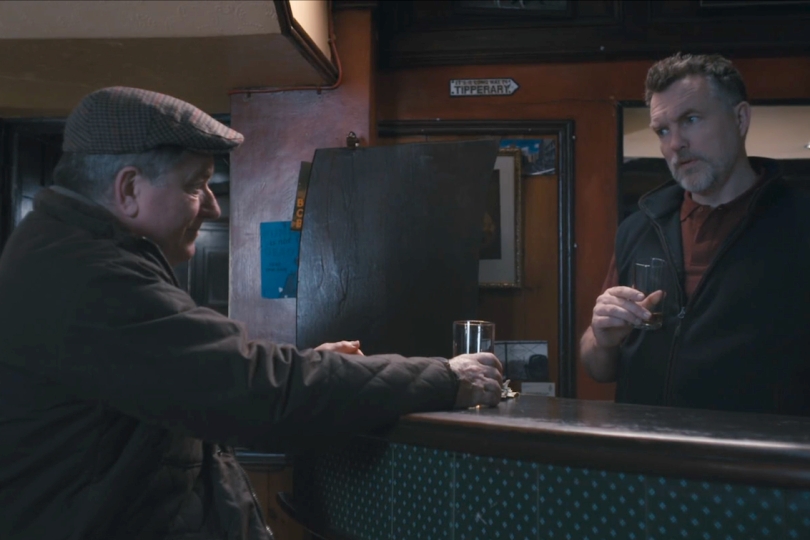
Much of the film takes place in a dimly lit pub, which is actually a real bar that kept trading for the 12 days that the film was shot. There are brief sequences that depict the past, or get inside a character’s head, and these are creatively handled with various filter effects, giving the film some flair amidst the darkness.
Superbly written and directed by actor and filmmaker Paul Kennedy, Dead Man’s Money shifts gears as the story progresses, and the dark humour is toned down as things become serious. The shift is handled so well, you barely realise that it’s happened as Young Henry ropes in ‘Gerry the Wheels’ (Gerard Jordan) – a driver and former IRA man who also wants a piece of the still living man’s money.
All the performances here are flawless, with McMenamin’s Young Henry a subtle standout as a complex character that has a bit going on under his amiable surface.
While this is written for the screen, it feels as though it has been adapted from a stage play – there’s more talk than action and the language is beautifully and often cleverly crafted. Dead Man’s Money is a memorable work, with dialogue worthy of the Bard.
