



by Stephen Vagg
The huge success of The Student Nurses for New World Pictures in 1970 led to Roger Corman to understandably ask for a follow up. After all, few men better appreciated the importance of cashing in on a trend, having made his reputation at AIP from big bug/small budget movies and Edgar Allan Poe adaptations; the early success of his New World Pictures was underpinned by the biker and women in prison cycles as well as nurse movies.
Stephanie Rothman, director of The Student Nurses, turned down the idea of a sequel, keen to try something else (she also didn’t want to do a women in prison movie, which became The Big Doll House). Instead, she made an arty horror movie, The Velvet Vampire for New World, which proved to be a commercial disappointment, contributing to tensions between her and Corman (as did his low pay rates) – she and her husband Charles Swartz ultimately left the company, along with Larry Woolner, one of the founding investors of New World, to form another exploitation company, Dimension Pictures. Rothman directed three films for Dimension – the sex comedy Group Marriage, the prison picture Terminal Island and the three girls movie Working Girls – as well as working on others (Beyond Atlantis, Sweet Sugar) but could never recapture the success of The Student Nurses and her directing career ended far too early.
So, Corman assigned the job of the second nurses film – called Private Duty Nurses – to George Armitage, who’d written Gassss for Corman (on which Rothman and Swartz had worked). Private Duty Nurses used a similar formula to The Student Nurses, with the difference being that there’s three girls as opposed to four: a black nurse (Joyce Williams) romances a black doctor who is facing discrimination (Herb Jefferson Jr – Boomer in the original Battlestar Galactica); a blonde nurse (Katherine Cannon) has a fling with a Vietnam vet (Dennis Redfield); a brunette (Pegi Boucher) helps a doctor (Paul Hampton) fight sea pollution; at the end, they throw in a plot about a drug ring as well. The cast includes Paul Gleason, future baddy of many a great ‘80s movie, and the rock band Sky.
We won’t beat around the bush: Private Duty Nurses is a weak entry in the series. The pace is sluggish, it’s not that sexy, there’s little sense of camaraderie between the women, and the cast is, with a few exceptions, weak. The most unforgivable thing about the movie: all the girls care about is helping men rather than do things themselves. There is decent music and sex scenes. Armitage later made great films (Miami Blues, Gross Pointe Blank), but he was very much on his “L” plates here.
Nonetheless, Private Duty Nurses made money and Corman decided to try a third film – Night Call Nurses. Again, he hired a male director – Jonathan Kaplan, an editor who had been recommended by Martin Scorsese (who’d just directed Boxcar Bertha for Corman) – but at least the movie had a female producer: Corman’s wife Julie, at the beginning of her illustrious and still under-rated career. Armitage wrote the original script, but Kaplan claimed that he rewrote it with Danny Opatoshu (future brother in law of Steven Spielberg) and considering the sharp increase in quality from Private Duty Nurses, we’re inclined to believe him.
According to Kaplan, Corman told him that the movie needed to be about three nurses: “a blonde, a brunette, and a nurse of colour; that the nurse of colour would be involved in a political subplot, the brunette would be involved in the kinky subplot, and the blonde would be the comedy subplot.” Kaplan was to work the term “night call nurses” into the dialogue, and provide frontal nudity from the waist up, total nudity from behind and no pubic hair.
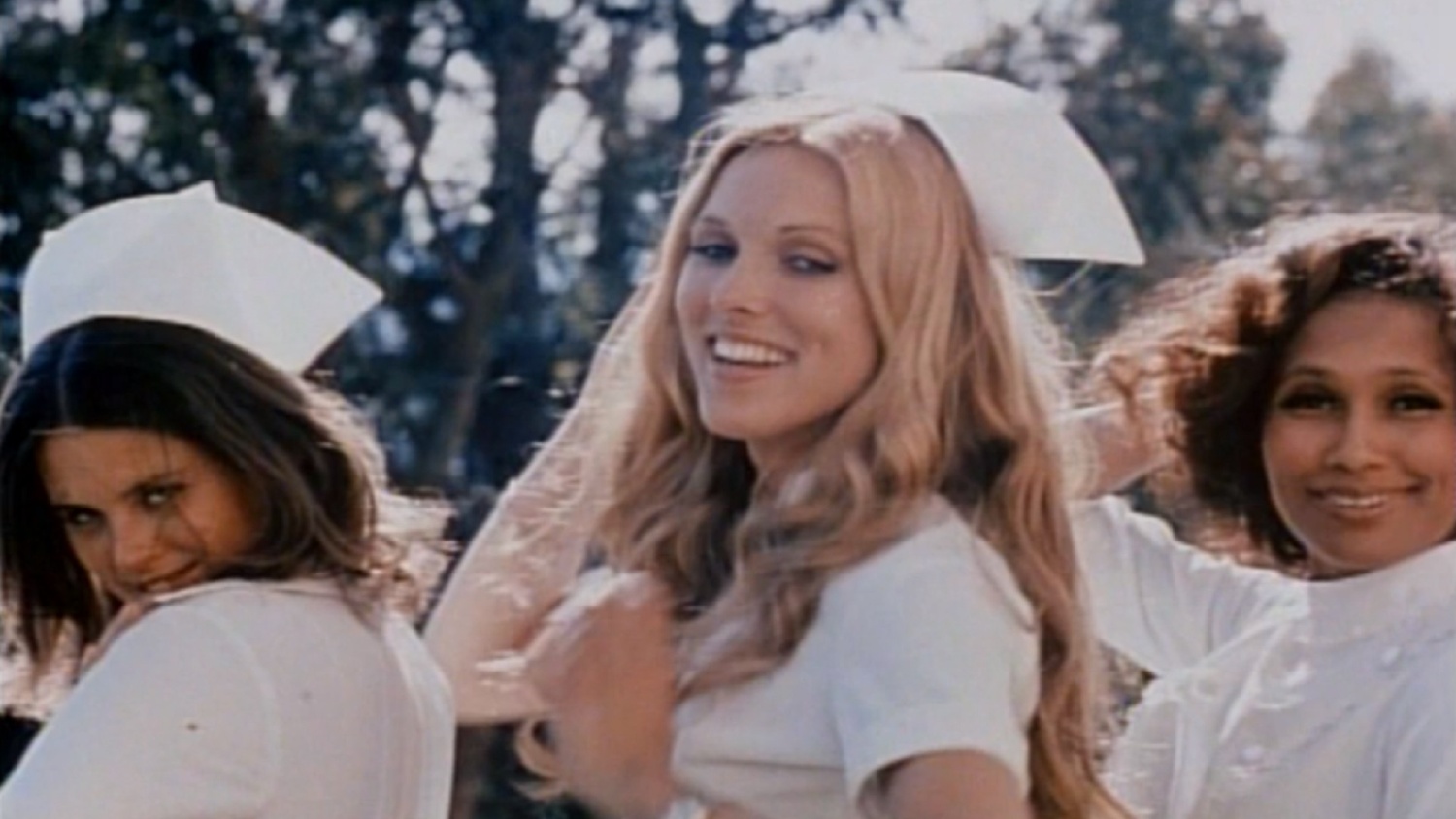
Kaplan and his team (which included friend Jon Davison, who became a major producer) fulfilled the brief. Night Call Nurses is about three nurses: a brunette (Patti Byrne) who gets involved in a sex cult run by a manipulative chap (Clint Kimborough), who accuses her of being a sex deviant (to get her into bed) – this has a lot of creepy overtones, which are quite effective; a black nurse (Mitti Lawrence), who falls for a black revolutionary and ends up going on the lam at the end (the way that the Latina nurse did in The Student Nurses); and a blonde (Alana Collins), who wants to marry a rich doctor but falls for a speed-addicted trucker (who at the end, still seems to be addicted to speed – they don’t do a good job of wrapping up this story). There’s another plotline about a stalker at the hospital, who seems to be after Byrne but also perves on Collins.
Night Call Nurses was a great return to form, and is comfortably the second best in the series. It’s energetic, flashy entertainment, where there’s lots of crazy editing and scenes with non-synchronous dialogue. There are lots of love making scenes and nudity, and the men are more prominent than in The Student Nurses, presumably because of its male director, but the women have real camaraderie, and you get the sense that they are friends. (e.g. Collins and her boyfriend help Lawrence and her guy bust a prisoner/patient out of gaol.) It helps that the cast is very strong – the lead trio are very winning, particularly Patti Byrne who should have had a bigger career; Alana Collins later married George Hamilton and became “Alana Hamilton”; the support cast includes Dennis Dugan and Dick Miller. There are lots of random sports interludes – water skiing, sky diving – which make it seem like a Beach Party movie at times although Beach Party movies admittedly don’t include cross dressing maniacs, breaking militants out of hospital, and brutal shoot outs.
Night Call Nurses was a big hit, launched Kaplan’s career, and encouraged Corman to keep investing in more nurse movies. The best and worst of the series was to follow.
