… a lack of any personality or unique perspective.
Let's fetch that pail of water ...
by Finnlay Dall
Year: 2024
Director: Samuel Van Grinsven
Rated: MA
Release: 11 September 2025
Distributor: Vendetta
Running time: 100 minutes
Worth: $10.00
FilmInk rates movies out of $20 — the score indicates the amount we believe a ticket to the movie to be worth
Cast: Dacre Montgomery, Vicky Krieps, Sarah Peirse
Intro: … a lack of any personality or unique perspective.
How odd is it that two complete strangers can grieve deeply for the same person, without knowing anything about each other? That was the question that kept rattling around director Samuel Van Grinsven’s head as he was beginning to plot out Went Up the Hill. A thought accompanied by a single image: a man and woman either side an ornate coffin, staring at each other like a puzzle to be solved; the third person in both their relationships.
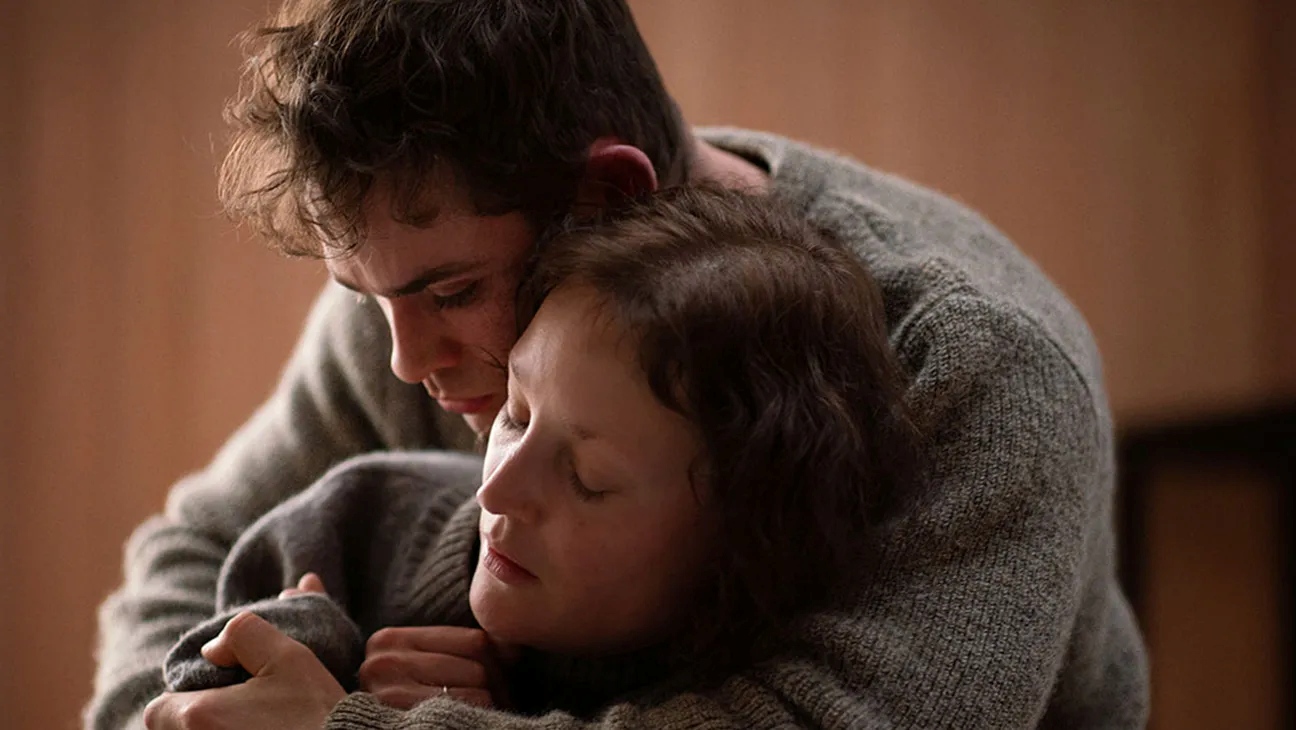
The funeral of Elizabeth is a rather cold affair. A mute and sombre service surrounded by the concrete tomb that was once her and her partner Jill’s (Vicky Krieps) home. But when Elizabeth’s son Jack (Dacre Montgomery) arrives unannounced, and claims to have been invited by Jill herself, something the widow can’t recall, an uncomfortable tension wades into the room. Stranger still, when Jack discovers that Jill can invite the ghost of Elizabeth into her body when she’s asleep, and that he can do the same, a chance for both wife and child to reconnect with their loved one becomes miraculously possible.
Yet, as Jack and Jill begin to corroborate their experiences with Elizabeth and old wounds begin to resurface, the pair begin to wonder if digging up the past was such a good idea after all.
Went Up the Hill, by trying to tackle a subgenre that excels when it shows a lack of restraint, locks the film into a standard Australian/New Zealand Drama format, a baffling decision that feels counterintuitive to the story that the film is trying to tell.
Thankfully, its composition is delightfully beautiful to stare at. That’s thanks in no small part to Tyson Perkins’ dew tinted cinematography. Yet, it is at the same time soured by Grinsven’s visual sensibilities as a director.
As the cold winds billow through curtains or black lace dresses, the house certainly becomes an otherworldly plain of existence, just not a supernatural one.
Again, in what feels like a muddling of genre conventions, the film more resembles Denis Villeneuve’s brutalist vision of Dune or Blade Runner 2049 than a terrifying meditation on grief and trauma.
When Jack is first disturbed by Elizabeth’s presence, he creeps across the sterile and hard-edged hallway over to Jill’s room. Put that side by side with Timothee Chalamet’s Paul waking up to find a Harkonen assassin invading his home, and rather than feeling afraid, your body’s pumped for a laser sword fight instead.
Things finally get frightful when Jack and Jill discover that Elizabeth’s spirit and flesh shared the same abusive streak – as the suicidal woman begins to convince her wife to join her in the afterlife. When that doesn’t work, she tries to use her son as a bargaining chip, threatening Jack’s life unless Jill follows her every whim.
The film’s depiction of both generational and spousal trauma is truly grim. The turning point is when Elizabeth, taking control of her son in a panic, slaps Jill with a reverberating force. Jarring, sudden and unpleasant, we’re left with Jill writhing around on the carpet as she contends with the idea that her wife was lost to her long before her lover’s death.
It’s here where Montgomery and Krieps are refreshingly freed from the suffocating boredom that plagued most of their scenes, utilising their talent as actors to bring everything out of them. Emotions overflow and embody a physical space as Jack trembles while trying to hide his arms in his sleeves or Jill thrashing around on the tile floor in pent-up frustration.
While its closest comparison would be something like Andrzej Zulawski’s cult film Possession, in which Sam Neill and Isabelle Adjani’s unhappy couple often balance two (or in some cases, three) different versions of themselves – Went Up the Hill doesn’t quite get that same chance. Thanks to a rather dry screenplay – which makes the common mistake from craft books where subtext in dialogue equates to empty one word games of Marco Polo – most of the film is surrounded by a lack of any personality or unique perspective. Where Neill and Adjani’s awkward and over the top performances intentionally give way to utter dread, Jack and Jill’s call and response style conversations (regardless of the in-universe explanation) invites no whimsy, wonder or fear – instead stating the obvious when silent emotiveness could have told us much more.
Grinsven wanted the nursery rhyme that Went Up the Hill is named after to feature heavily in every aspect of the story, from the musical stings and plot beats to the names of his characters. For him, generational trauma and spousal abuse were the twisted inverse of these childhood myths. They were beliefs, stories and behaviours passed down from parents to their children and then passed around the playground between friends or crushes. But Jack and Jill’s mission to fetch a pail of water is the rather generic choice. A choice, out of millions of more relevant rhymes, which speaks to the film as a whole.