


by Stephen Vagg
1934 flop starring Roy Rene
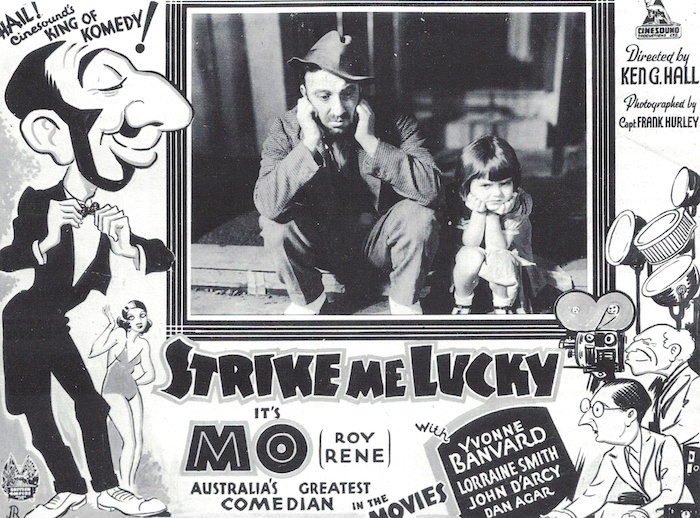
 During his long retirement, Ken G Hall often mentioned that out of the sixteen films that he directed for Cinesound Productions, only one was not financially successful on initial release, Strike Me Lucky (though it apparently went into the black eventually). We haven’t seen any hard accounting data to back up this statement, but we’ll take Hall’s word for it, especially as all circumstantial evidence we’ve read supports this. And there seems little doubt that the flop was heavily traumatising at the time – Hall was coming off three big hits in a row, the movie was given a healthy budget (there are elaborate sets) and starred the most popular comedian in Australia, Roy “Mo” Rene. Hall himself admitted in an interview with Graham Shirley that Strike Me Lucky “scared the daylights out of me, and it frightened me off, back to a treadmill. On this one I was easily scared, because I had such a thin edge between success and failure.”
It just goes to show, nobody knows anything. Still, Strike Me Lucky is a flop definitely worth highlighting.
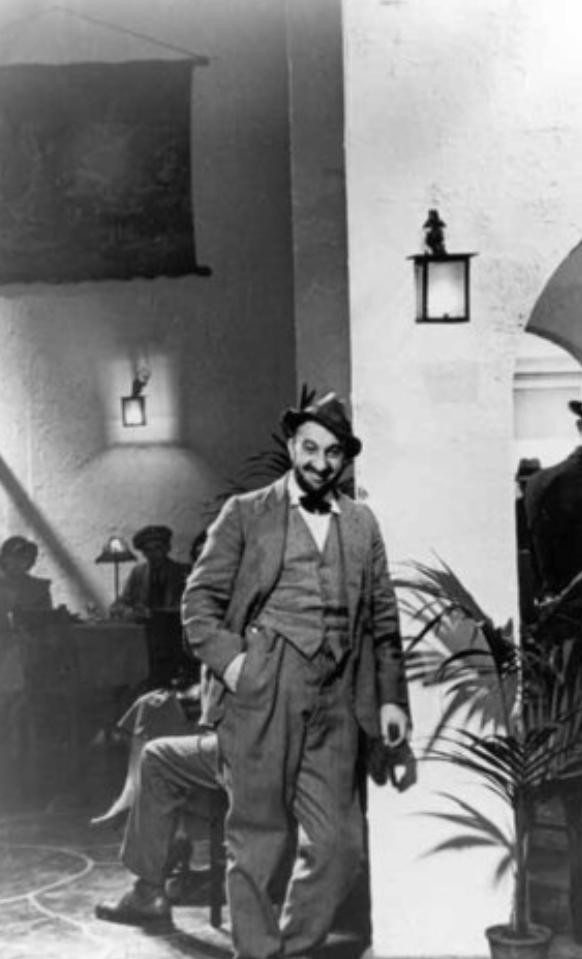
First, some background on Roy Rene. He was born in 1891 under the name Henry van der Sluys, and originally broke into showbiz as a boy soprano before moving into comedy, doing serious hard yards on the vaudeville circuit. By World War One, the young performer had changed his name to “Roy Rene” and become nationally famous as “Mo”, a sort of mischievous Jewish character with a unique visual make up (black beard, white face, hat).
“Mo” was originally part of a duo, Stiffy and Mo, which dominated Australian vaudeville until they broke up in the 1920s, Simon and Garfunkel style, and Mo went solo.
Rene was primarily a vaudeville comic but also appeared in pantomimes, straight plays, musicals and radio. All accounts say that he was a master of live performance, adept at improvisation, innuendo, and pushing a joke as far as it could go. The only medium that he didn’t conquer seems to have been motion pictures (he died in 1954, before television was introduced to Australia), which is one of the many reasons why Strike Me Lucky is so fascinating.
It’s not surprising that Ken Hall and Cinesound Studios wanted to make a movie starring Rene. The studio was a strong believer in pre-existing IP, and deservedly so – its hugely successful first three movies (On Our Selection, The Squatter’s Daughter, The Silence of Dean Maitland) were based on hugely popular plays that had been filmed before. Putting the most popular comedian in the country in his own star vehicle was a natural idea for a follow-up. After all, FW Thring was having success doing just that with George Wallace.
 Problem is, Hall still had to come up with a suitable vehicle for Rene, which is harder than it looks, especially as this was Hall’s first feature not based on thoroughly road-tested material (he had also made the 50-minute musical revue, Cinesound Varieties, which was mostly original and hadn’t been that well received). However, there were standard tropes he could have used which were common at the time – like, say, Mo inheriting a castle, or being stuck on a desert island, or looking after an orphan like Chaplin, or run some stuffy institution like the Marx Brothers would do, or entering the army, or having to spend the night in a haunted house, or go looking for buried treasure.
And indeed, Hall (or rather his writers George Parker and Vic Roberts, the same team responsible for Cinesound Varieties) used some of these tropes in Strike Me Lucky. But the thing is, they weren’t experienced enough to knock the story into a cohesive shape. In defence of these three men, none were that familiar with constructing an original feature length script.
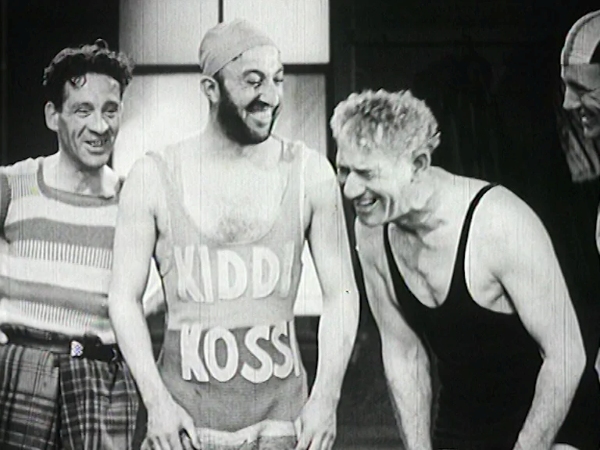 Instead, they came up with the grab bag that is Strike Me Lucky, which is more like a musical revue – a series of sketches with a very loose story and musical numbers (the opening credits call the film “a farce with music” but the plotting of farces is traditionally far stronger than what’s on display here). It’s easier to get away with that sort of thing on stage, because you have the energy of live performers – the comics feed off the audience, the singers and dancers are actually doing their thing right there, and there’s an interval to break it up. On film, there is a risk of it all looking like a hodge-podge, which is the case in Strike Me Lucky.
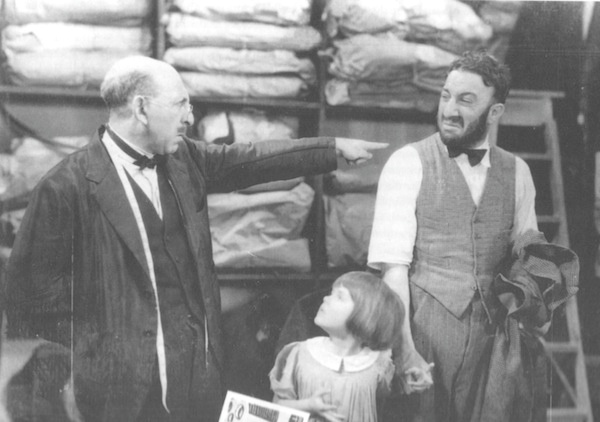
In the film, Mo plays a sort of drifter character, going from job to job in a big city. He’s working at a clothes store when he discovers a little girl on the streets and thinks she’s an orphan, unaware that she’s the missing relative of a wealthy family. Mo looks after her, tries his hand at more jobs including selling vacuum cleaners and a stint as a lifeguard, and deals with “June East”, a Mae West type who is the girlfriend of a gangster.
Around 46 minutes in, the little girl is returned to her family, and the movie’s plot changes gears: it becomes about the search for treasure, Lasseter’s Lost Reef style. This shift reflects, we believe, the stage background of Parker and Roberts, who typically worked on shows where there was a proper interval – halfway through Strike Me Lucky feels like the writers expect the action to stop, the audience to go get refreshments, then come back, ready for a whole new plot.
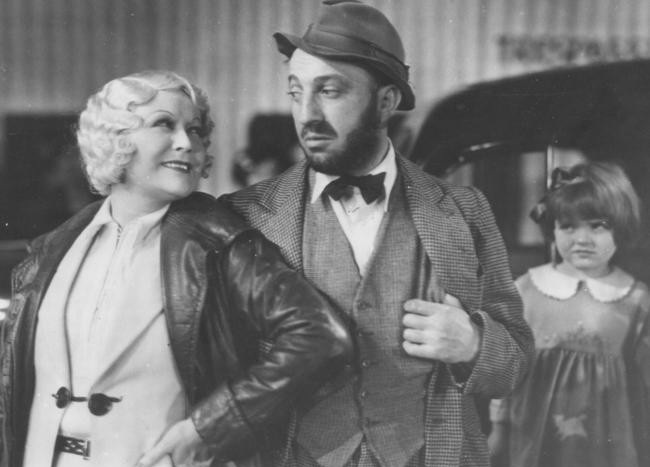 In this second part, Mo is palling around with a mate; they go up in a plane and deal with a lost tribe of Aboriginals, then come back and there are gangsters and another song (a Busby Berkeley type number) and the film ends with Mo marrying June East. There’s also a sappy pair of lovers: some rich girl and her pilot boyfriend.
It’s hard for us to gauge Rene’s skill as a performer off the basis of this film. His character is very broad and prone to laughing at his own jokes. The songs aren’t bad and the quieter moments are more effective, in particularly two-handers, indicating that maybe Rene would’ve worked better in his screen debut as part of a duo. In our opinion, he’s far less effective on screen than George Wallace, but in fairness, Wallace not only had a less broad persona, he also had far more experience in front of the camera.
Hall wrote in his memoirs that he felt Rene did not enjoy working without a live audience, or working “clean”, as his material was best when risqué. We’ve no doubt this is true, but these things can be overcome. So too could Rene’s broad stage persona – Groucho Marx also had a broad persona, it’s just that he operated within a screen universe(s) that was far better constructed than Strike Me Lucky.
The main fault of the movie was the script. Parker and Roberts had strong backgrounds as sketch writers, directors and performers, but were poor screenwriters, with little understanding of construction, their credits also including the heavily flawed Grandad Rudd. Hall soon recognised this, and, unlike many Australian producers and directors, he (a) had the chance to learn from his mistakes and (b) learned from them, later hiring Edmond Seward and Frank Harvey (the latter being the really good writer Cinesound needed). Still, it’s a shame that he couldn’t have enlisted the help of Edmund Barclay, the leading radio writer in Australia, who had worked on the script for The Silence of Dean Maitland, wrote many musicals for radio and would later work on Lovers and Luggers (maybe he was too busy).
Incidentally, Roberts later successfully sued Cinesound in court for payment for an unused story.
An interesting hypothetical: could a more experienced Ken Hall made a second, better Roy Rene movie in the late 1930s? We think so – after all, Rene later proved with his radio success that he was capable of adapting to entirely new mediums. Presumably, the trauma of Strike Me Lucky’s failure was too much for Hall or Rene to seriously consider it, especially when Hall had more surefire screen comics at his disposal, like Bert Bailey, Cecil Kellaway and George Wallace.
In recent years, Strike Me Lucky has experienced a revival in popularity, amongst academics at least, due to the fact that it is Rene’s sole film (apart from newsreel appearances) and in its depiction of 1930s Australian culture: the songs, the portrayal of Jewishness and Aboriginal Australians, the Depression-era setting, the riffs on Hollywood (orphans, Mae West, Busby Berkely, Chaplin, deranged castaways), references to Lasseter’s Reef. As a piece of entertainment, Strike Me Lucky is a bust; as part of our cultural history, it is priceless.
The author would like to thank Graham Shirley and the National Film and Sound Archive for their assistance with this article. Unless otherwise specified, all opinions are those of the author.
