



by Anthony O'Connor
Worth: $18.00
FilmInk rates movies out of $20 — the score indicates the amount we believe a ticket to the movie to be worth
Cast:
Aaron Taylor-Johnson, Alfie Williams, Jodie Comer, Ralph Fiennes, Edvin Ryding
Intro:
Vivid, visceral, poetic, surreal, amusing and beautiful …
It’s hard to overstate just how much of an impact the original 28 Days Later had when it savaged unsuspecting audiences back in 2002. Directed by Danny Boyle (Trainspotting, The Beach, Slumdog Millionaire) and featuring an as yet unknown Cillian Murphy, the film cleverly revitalised the zombie genre (which was all but non-existent then, if you can believe it) and started the new wave of fast moving undead that went on to inspire the Dawn of the Dead remake (2004), [REC] (2007), World War Z (2013), Train to Busan (2016) and about a hundred others. Not bad for a scrappy little flick shot on a miniscule budget in 480p resolution!
A decent sequel, 28 Weeks Later, was released in 2007, sans Boyle, and seemed set to be followed by the inevitable 28 Months Later. Fans waited. And they waited. And then they waited some more, but said film never materialised (for a variety of reasons both logistical and egotistical).
Now, 23 years after the original, the story continues and director Danny Boyle and writer Alex Garland are back at the helm. So, can they make lightning strike twice?
Yes! They can! Holy crap, the mad lads actually did it.
In 28 Years Later, the UK has been quarantined off from the rest of the world as the rage virus continues to run rampant, albeit in different ways to the earlier films. Our story revolves around 12-year-old Spike (Alfie Williams), who is being taken from his well-protected island home by father, Jamie (Aaron Taylor-Johnson), so the lad can experience what it is to hunt on the mainland.
We get to see this transformed UK through the youngster’s eyes and by crikey, it’s grim. Infected are everywhere, both in weird, obese ground-dwelling and fast, angry naked flavours and the uninfected survivors are often an odd, dangerous lot too.
Spike begins to question some of his father’s teachings and eventually must mount a quest of his own to help his ailing mother, Isla (Jodie Comer).
At a glance, you might think that 28 Years Later shares more than a little with the likes of The Last of Us and later seasons of The Walking Dead. However, Danny Boyle and Alex Garland bring us something very different here. This is less a frenetic horror movie (although there’s plenty of suspense and gore) and more the start of an epic hero’s journey through a land rendered almost unrecognisable by disease.
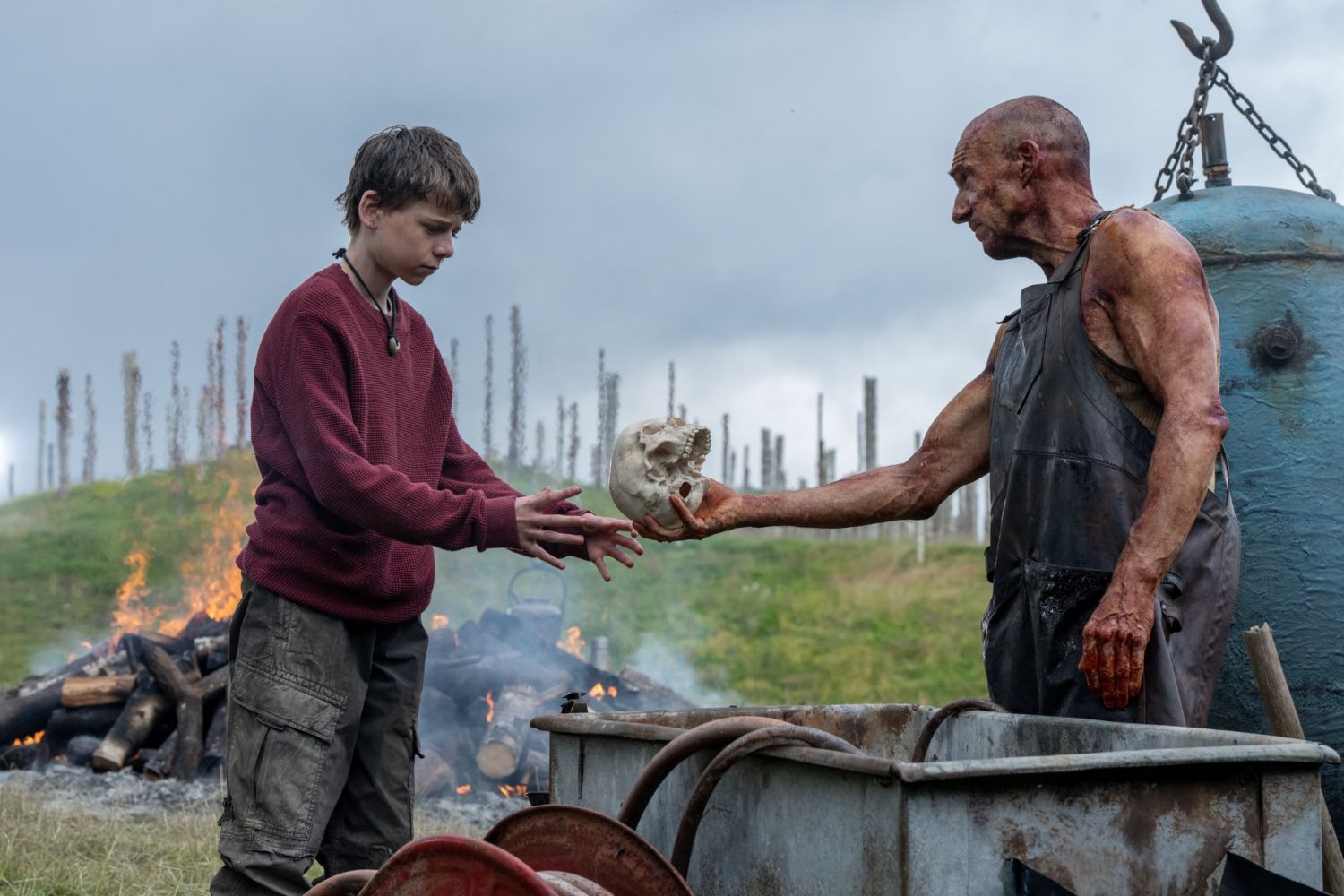
Performances are uniformly excellent with Taylor-Johnson and Comer both doing fine work, and Ralph Fiennes absolutely wonderful as poetic, death-obsessed Doctor Ian Kelson. However, it’s young Alfie Williams who steals the show, giving us a likable and nuanced young tacker to root for and hope that he manages to survive.
The other big feather in the cap is Boyle’s direction which, aside from some overuse of interspliced stock footage in the first fifteen minutes or so, is totally on point. Vivid, visceral, poetic, surreal, amusing and beautiful, the veteran director’s output hasn’t felt this engaged and energetic in years, and one hopes that Nia DaCosta is up to the task of helming the next entry, 28 Years Later: The Bone Temple, releasing in early 2026. Oh yes, we should mention, 28 Years Later is the first part of a trilogy, the first and final entries of which will be directed by Boyle, with DaCosta doing the middle chapter. So, those expecting a complete yarn like the earlier films may be a little disappointed.
However, for those willing to let a creative team run wild and deliver a surreal, messy, exciting, scary, moving and utterly batshit crazy film brimming with naked, stinky, murderous Poms, great performances, superb direction, a rock solid script and a surprising amount of jiggling peen, 28 Years Later will feel like an imperfect but joyously creative reinvention of a genre that Boyle and Garland already revamped 23 years ago.
