


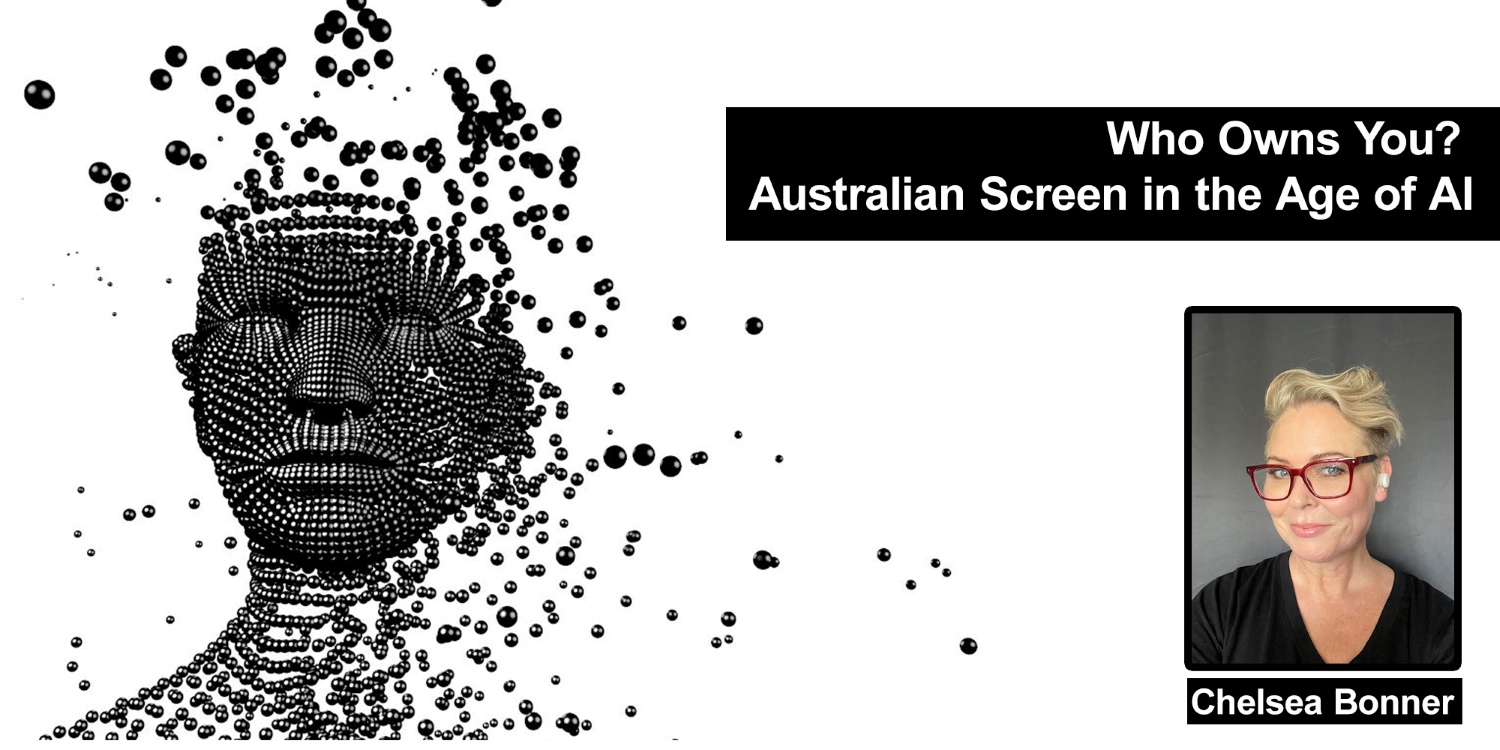
by Chelsea Bonner
How urgent is it? Very urgent. Here’s what Australian actors, directors, crew and casting directors need to know right now and some advice from our own legal counsel to help you understand and protect yourself.
Voices are likely cloned. Faces used for training and datasets to be replicated. Physical performances have already been used to train an AI system – that’s not in question. We know that studios have licensed thousands of films to AI companies for just this purpose. The real question is whether they will eventually replace you. That’s the moral question our industry is reckoning with on an almost daily basis.
Consider what has happened in just the past year. At a summit in late 2024, Ben Affleck publicly declared that movies would be “one of the last things, if everything gets replaced, to be replaced by AI” and told actors and writers not to worry. What we didn’t know at the time was that he had been quietly building his own AI film technology company since 2022. In March this year, he sold it to Netflix for a reported sum of up to $600 million, announcing that he had changed his mind and now viewed AI as a “really meaningful innovation.”
Meanwhile, Matthew McConaughey was making the rounds publicly urging actors to trademark their likeness and own themselves before AI got there first. What he didn’t lead with was that he had already partnered with and invested in AI voice company ElevenLabs, licensing his own voice for replication.
Both men were publicly saying one thing, while privately doing another. The critical point for every Australian actor reading this: being American gave them the legal framework and being famous, the financial resources to protect and profit from their own likeness. Most have neither.
Under current Australian law, there is very little you can do about protecting your likeness, voice, or performance, with or without the funds to fight.
That is not a hypothetical. It is the legal reality that every working actor in this country is operating in right now, whether they know it or not.
I’ve spent the past three years inside these developments, building AI technology myself with international dev teams in order to understand its potential to help or harm our industry. My research led to a formal government petition, a Change.org petition, many submissions to different government departments, and sitting across the table from global tech executives to try to convince them to keep as much humanity in this new technology as possible.
I can now code software in my sleep, a skill I never wanted, but I learned it because I needed to understand exactly what we were dealing with and how to change the legislation to ensure performing and creative artists remain central to artistic works. Between you and me, I also wanted to see if I could find enough flaws to ensure it wasn’t a real workable solution that would take our performers’ work.
What I found was an enormous gap between the speed of the technology and the pace of the law that should gravely and urgently concern every single person who works in this industry.
So, I asked Richard Mitry, entertainment lawyer and legal counsel to ICON Management, to give us the unvarnished picture. What follows is what every Australian actor, casting and crew member needs to know right now.
Q1. What protection does Australian copyright law actually offer performers against AI voice cloning and likeness replication?
“Less than you’d hope,” says Mitry. “Copyright protects things, like a recording, a film, or a song. It doesn’t protect you. Your voice, your face, your accent, the way you time a line, none of that is something you can claim copyright over.
“An AI that sounds like you or looks like you isn’t breaking copyright law just by reminding people of you. Performers’ rights help a little if someone records your live show without permission, but they protect the recording, not your identity.
“The law asks whether something was copied,” Mitry explains. “It never asks whether a person’s identity was taken. A clone slips straight through that gap.”
Q2. How does Australia’s current legal framework hold up in this environment, where the legal system was not designed with this technology in mind?
Not well. The Copyright Act is from 1968 and was written to stop people copying. But AI doesn’t copy in the old sense. It can study thousands of hours of your work and generate something new that competes with you, without ever lifting a single recording.
In October 2025, the Commonwealth Attorney-General Michelle Rowland ruled out letting AI companies train on Australian creators’ work for free, and the government is now working through a reference group on how creators get paid. But Mitry is clear about what that actually addresses. “It is about paying people when their work is used to train a model. It is not a right to your own voice or face. The system is improving, but the part performers need most still doesn’t exist.”
Q3. What should actors and agents actually look for and push back on in contracts right now? What are the red flags?
“With the law this thin, your contract is the only real protection you have,” Mitry says. He identifies five things to watch for:
Watch for rights grabs. Language like “all media now known or later invented,” “in perpetuity,” or “irrevocable” quietly signs away AI uses that didn’t exist when you signed. Any mention of a digital double, digital replica, synthetic performance, voice model or biometric scan without separate consent and a separate fee is a trap. On-set scans are particularly dangerous. Ask what is captured, where it is stored, for how long, and why.
Watch for assignment wording that captures not just the performance, but the underlying data used to generate future performances. Licensing one job is very different from handing over the raw material to replace you in the next ten. Watch for blanket consent instead of specific consent. “Look for consent, compensation and control,” says Mitry. “No replication without prior written approval, fair payment if a replica is used, and the right to decline replication and limit how your image is used.”
Finally, watch your audition and self-tape material. Audition footage can give an AI model the clean, isolated data it needs. There should be clear limits on re-use. “AI should be front of mind in negotiations, not an afterthought,” Mitry says. “The default position should be no AI replica without separate consent and payment. Ideally, use a lawyer to assist with negotiations so your individual circumstances and the drafting of the contract can be taken carefully into account.”
Q4. What does meaningful legal reform in Australia need to look like, and how urgent is it?
Very urgent! “The tech improves daily, the law moves over years, and that gap is where people lose work,” says Mitry.
Two key reforms are needed. First, making AI companies pay when they train on a performer’s work. Australia has chosen that direction and is working out the detail, so performers need a seat at that table. Second, and more urgent for actors, there is currently no law that says you own your own voice and face. Australia has nothing like the US right of publicity.
Other countries are moving. Tennessee has passed a law covering AI voice and likeness clones. The US Congress is debating a national bill, the NO FAKES Act. Some performers are even trademarking catchphrases to fence off part of their identity, though as Mitry notes, “that won’t protect the general sound of your voice and only works if you are famous enough to be recognised.”
Q5. What is the single most important thing an Australian actor should do today to protect themselves?
“Treat your contract as the only fence you have, because right now it is,” Mitry says. “Before you sign anything, read the rights clause, the definitions and any consent schedule, and look for the words AI, digital replica, likeness, scan and future technologies. Get advice before you sign agreements, not after.”
This conversation is happening at the highest levels of the global industry right now. At this year’s Cannes Film Festival, a fully AI-generated 95-minute feature film called Hell Grind was shown to industry buyers, every character, every setting, every prop generated by AI, made in two weeks for $500,000. It wasn’t selected by the festival itself, but it was in the room. Meanwhile, Cannes director Thierry Frémaux came out strongly against AI, standing with actors, screenwriters and voice actors, and suggested films could one day carry labels like organic food, declaring “this film has been made without artificial intelligence.”
I’ve been making exactly that argument for three years. I have a Change.org petition still live that calls for mandatory AI labelling, with over 20,000 signatures. Meta responded personally and promised action. Then, like Disney, Paramount and others, this year they laid off 8,000 people to replace them with AI. Good intentions without legislation are just words.
This is not only an actors’ issue. When the human performer is replaced by an avatar, every single job that exists because that human walked onto a set disappears with them. The casting director has no one to cast. The director and showrunner have no human performance to shape and collaborate with. The cinematographer has no face to light. The camera operator has no movement to follow. The sound recordist, the gaffer, the costume designer, the hair and makeup artist, the dialect coach, the acting teacher, the drama school, the talent agent. Every single profession in this ecosystem exists because a human being stood in front of a camera and performed. Remove that human and you don’t just lose an actor. You lose an entire industry.
The insulation of fame may keep known actors working longer than everyone else. But the next generation of Australian screen talent, the performers working their way up through supporting roles and small parts, deserves the same pipeline that produced the last one. And every crew member, every casting director, every director who has ever built their career around the alchemy of human performance should be asking themselves the same question: who will be the famous actors of the next generation, the best computer prompting expert or the person they hire to explain the facial movements humans make to ensure the AI generations are emoting properly?
So, here is what we can actually do right now. Actors and agents, read every contract and get advice before you sign. Directors and showrunners, push back on the AI replacement pitch when it comes, and it will come. Crew, understand that your jobs are connected to this fight even if your name isn’t on the contract. Casting directors, put limits on how audition material can be used. And everyone, go sign the petition. The link is below.
A petition to stop Raygun from breakdancing at the Olympics got more public support than our call to protect every creative worker in this country from having their identity stolen without consent or compensation. I am not giving up. But the industry as a whole needs to decide it matters too.
The legislation will not change without public pressure. The talent is there. The stories are there. The industry is worth fighting for.
That needs to change. And the conversation needs to be an urgent priority for our government and our legal system.
Sign the petition here: https://www.change.org/p/stop-ai-image-theft
Chelsea Bonner is the Founder and CEO of ICON Management and has been a sustained public voice on AI regulation, creative rights and the future of the Australian screen industry.
Richard Mitry is a founding partner of Mitry Emerson Lewis and a go-to lawyer for leading individuals in business, politics and entertainment.
Image Source: Depositphotos
