


By Pauline Adamek & Erin Free
It features a naked blue guy, child abuse, dysfunctional families, the cold-blooded killing of a pregnant woman, rape, nihilism, and impotence – in short, the epic comic book, Watchmen, is hardly your garden-variety superhero story. Comic fans waited more than twenty years for the big screen adaptation of British writer, Alan Moore, and illustrator, Dave Gibbons’ groundbreaking graphic novel about an array of weird and refreshingly human costumed crime fighters. The series was originally published by DC Comics in single issues over twelve months, during 1986 and 1987, and was later republished in graphic novel format. In 1988, the comic series won a Hugo award, given every year for the best science fiction or fantasy works. It did not receive the Hugo Award for Best Novel, nor any of the other written-fiction category awards, but instead scored a special one-off award in a category called “Other Forms.” In 2006, the reprinted collection of the twelve comics as a trade paperback made it to “The 100 Best English Language Novels From 1923 To The Present”, Time Magazine’s list of the all-time greatest novels.
Alan Moore’s non-linear tale, told from multiple points of view, imagined what the world would be like if costumed heroes had really existed since the forties. Watchmen is set in 1985, but within an alternate reality where Richard Nixon is serving his fifth term as President, Cold War tensions between Russia and America are volatile, and costumed crime fighters – formerly part of the fabric of everyday society – have been outlawed. Zack Snyder’s 2009 adaptation opens with the brutal murder of a beefy ex-hero and former military commando known as The Comedian (Jeffrey Dean Morgan). His inexplicable free-fall through a plate-glass window piques the interest of one of the country’s last remaining vigilantes, the morphing inkblot-masked Rorschach (Jackie Earle Haley). A man alone, the alienated, hard-bitten Rorschach sets out to solve the murder, and soon uncovers a plot to assassinate and discredit all past and present superheroes.
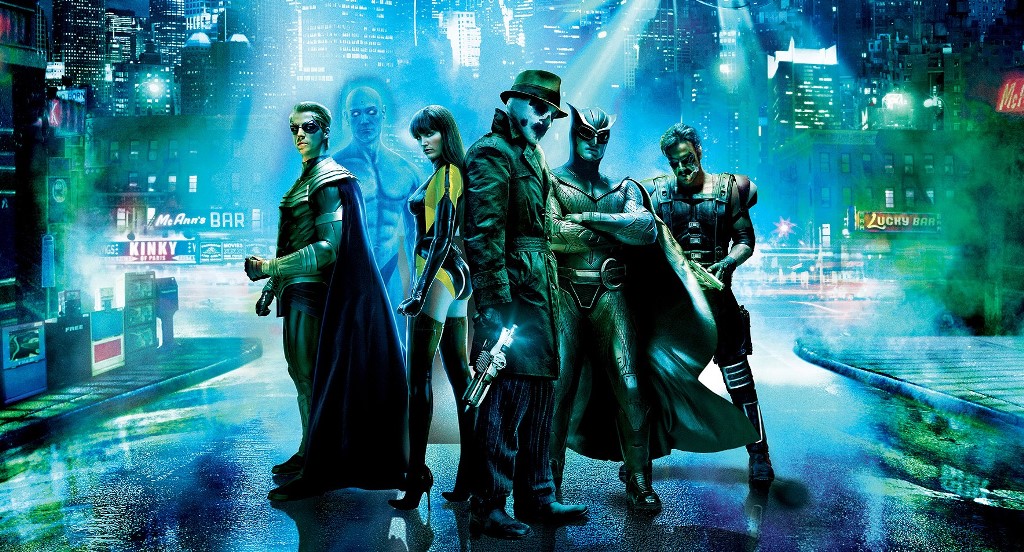
Rorschach’s investigation spurs him to warn his former costumed colleagues, a motley bunch of retired superheroes, only one of whom possesses actual superhuman powers. These include Dr. Manhattan (Billy Crudup), a super-human capable of rearranging matter, duplicating himself, and travelling to the far flung corners of the universe; Nite Owl (Patrick Wilson), a wealthy, Batman-style crime fighter with a lair full of impressive gadgets; Ozymandias (Matthew Goode), “the smartest man in the world” and a super-agile athlete; and The Silk Spectre (Malin Akerman), the tough-minded daughter of Sally Jupiter (Carla Gugino), who fought crime herself in the fifties. As the convoluted story unfolds, and Rorschach reconnects with his former crime-fighting legion, he glimpses a wide-ranging and disturbing conspiracy with links to their shared past and catastrophic consequences for the future.
“Our movie of Watchmen really is about who these guys are – it’s the ‘why’ of a superhero movie,” director, Zack Snyder, told FilmInk. Prior to Watchmen, the young filmmaker had received acclaim and fan-boy worship for another comic book adaptation: the Spartans-on-steroids battle drama, 300. A hotly anticipated release, fan interest in Watchmen was fanned – and virtually went nuclear – when Snyder showed the film’s trailer at the famous fan-fest that is Comic-Con in San Diego. The buzz then boiled continually over whether the near-impossible could be achieved. Watchmen is possibly the most subversive and brilliant masked avenger story ever published. It’s bleaker than Batman, even outgunning Frank Miller’s revisionist masterpiece, The Dark Knight Returns, in terms of intensity, ambition, and topical subject matter. Watchmen delves into unimaginably dark depths of the human psyche with its cast of damaged characters and complex murder mystery/conspiracy plotline. More like a deconstruction of the classic superhero concept than your typical blockbuster, Watchmen was long deemed unfilmable.

Author, Alan Moore, long maintained that his graphic novel was deliberately designed to show off the things that comics could do that cinema and literature couldn’t achieve. Moore has suffered a number of disastrous adaptations of his complex works, and long stood vehemently opposed to a film adaptation of Watchmen. Not that he had any say in the matter: DC Comics owns the copyright. Other adaptations of Moore’s graphic novels include The League Of Extraordinary Gentlemen, From Hell, and V For Vendetta; whether you enjoyed these films or not, they undoubtedly remain dim reflections of the original material. The notoriously prickly writer has long hated the idea of having his works filmed at all. “To paint comic books as childish and illiterate is lazy,” he once said. “A lot of comic books are very literate – unlike most films.”
When asked in an interview with ReelzChannel.com about Alan Moore’s pre-emptive dismissal of his Watchmen movie, Zack Snyder was quoted as saying, “Worst case scenario – Alan puts the movie on his DVD player on a cold Sunday in London, watches it, and says, ‘Yeah, that doesn’t suck too bad.’” When this comment was brought up with Alan Moore himself in a later interview in the British fanzine, Tripwire, the writer commented, “That’s the worst case scenario? He’s underestimated what the worst case scenario would be…that’s never going to happen in my DVD player in ‘London’ [Moore famously lives in Northampton]. I’m never going to watch this fucking thing.” Taking himself out of the equation, Moore refused to have his name associated with the production, and even seems to view the basic concept of adapting his works as essentially immoral. “If I write a crappy comic book, it doesn’t cost the budget of an emergent Third World nation,” he once snarled. “When you’ve got these kinds of sums involved in creating another two hours of entertainment for Western teenagers, I feel that it crosses the line from being merely distasteful to being wrong.”
In short, Alan Moore was always a dark, looming shadow over the Watchmen film. “We knew that Alan had no interest, and all we could do was respect his wishes,” Deborah Snyder – the film’s producer, chief collaborator, and wife of Zack Snyder – told FilmInk. “It’s hard because your natural instinct is to reach out. If you think about it too much, you can get paralysed. The film can’t just be a regurgitation of the graphic novel though, because it’s a film and it’s different. It has Zack’s point of view, but it also has reverence to the source material. You have to be confident that you’re respecting the material, but you have to move forward.”
There were numerous attempts to make a film version of Watchmen since 1986, when producers, Larry Gordon and Joel Silver, acquired the film rights to the series for Twentieth Century Fox. Failed film adaptations include versions by Terry Gilliam (Brazil), Darren Aronofsky (The Wrestler), and Paul Greengrass (The Bourne Ultimatum) – the latter two collaborating with screenwriter, David Hayter (X-Men) – with numerous script revisions along the way. No fewer than four major studios worked on the movie over the decades, including Twentieth Century Fox, Warner Bros., Paramount, and Universal. In 2005, Paul Greengrass was deep into pre-production on Hayter’s present-day, war-on-terror-themed adaptation, when a regime change at Paramount led to its demise. Enter Warner Bros., which acquired the rights in late 2005.
Zack Snyder’s 300 had not yet been released when he was approached to helm Watchmen. Recalls Snyder: “When they called me and said, ‘Hey, do you wanna make the movie?’ I was like, ‘I dunno… I dunno how you do that.’ It felt daunting. They’d brought a script over from Paramount, saying that this was where they were at.” The script for Watchmen had been evolving – going through something like eight or ten drafts – before Snyder was brought on board. All those screenplay drafts had slowly moved further and further away from the edgy source material. Snyder confessed to FilmInk that he didn’t read any of the other drafts. “I just read the last one. There were interesting ideas, but it had gone too far. And it was PG-13! I was like, ‘Yeah – no.’”
In Snyder’s first meeting with the studio heads, there was talk of keeping it as a modern day story, focusing on The War On Terror. “People love the war on terror,” Snyder laughed. “That’s really popular, apparently!” So just how exactly were they going to shoehorn the story of Watchmen to fit this concept? “In the room, I was all, ‘Yeah, sure – that sounds cool! Let’s do that’. Then I went home and was like, ‘Nah, I’m not gonna do that.’” Snyder and screenwriter, Alex Tse, put their heads together and got to work on a new draft. The first draft that Tse turned in was also set in the modern day. Snyder decided that that was not going to work. “I said, ‘It needs to be set in 1985. We need to have President Nixon in the movie. I need to put the book back into the movie as much as I can.’ So that became the process: putting the graphic novel back into the script.”

Over many months, and many meetings, Snyder persuaded Warner Bros. to abandon the Greengrass/Hayter script. In order to make the story feel contemporary and relevant, Snyder wanted to go back to the heart of the graphic novel. The key battles: gaining approval for an R-rating, retaining the eighties milieu, keeping Richard Nixon, and preserving the morally ambiguous climax. It was ultimately decided to retain the 1985 Cold War setting, as the film’s producers felt that there were already enough eerie parallels between the world of the graphic novel and our own. It didn’t hurt Snyder’s case that by then, 300 – an R-rated movie based on a hardcore graphic novel – was a box office smash hit. “Little by little, we got the studio on board,” Deborah Snyder told FilmInk. “300 really helped. It created a level of trust in Zack’s vision.”
The rights to Watchmen were mired in legal troubles dating as far back as the late eighties, when the original series was first published by DC Comics. Initially, Twentieth Century Fox had picked up the rights for producer, Lawrence Gordon (Die Hard, Predator), but after the project stalled under Fox, Gordon began looking for a new studio. Watchmen landed first at Universal and then Paramount. After numerous starts and stops, Watchmen finally arrived at Warner Bros. – the most obvious choice considering that they also own DC Comics – and production began in 2007 with a reported budget of $120 million. It was at this point that Twentieth Century Fox stepped back into the picture, saying that Gordon never exercised his option to acquire its remaining interest in Watchmen, thus leaving distribution rights with the studio.
An eventual court verdict stated that Fox did indeed control the rights to Watchmen. The judge left it up to lawyers for both sides to negotiate if the film should proceed with its planned release date. According to The LA Times, the court fight over Watchmen cost Warner Bros. and 20th Century Fox hundreds of thousands of dollars in legal fees. In the midst of the legal battle, Snyder – then deep in production on the film – admitted that he was a little worried. “I’m not a lawyer – I don’t even really understand what the heck is happening. They haven’t stopped us from making the movie, and we’re almost done, so…”
As predicted, the copyright battle was resolved, with Fox getting paid off, thereby freeing the film to open as scheduled on March 6, 2009. Although a joint statement did not specify the terms of the settlement, published reports, citing sources close to the negotiations, said that Warner Bros. had agreed to pay Fox about $10 million to cover the costs of its original development efforts plus legal fees connected with the lawsuit. More importantly, Fox received what Daily Variety described as “the equivalent of a movie star’s gross participation”, which amounted to 5-8 percent of the film’s revenue.
Despite all these fevered legal battles, Watchmen was never anything close to a guaranteed success. It was US R-rated (way before Deadpool made that a badge of honour); it had a running time of 165 minutes; and a budget – before publicity costs – rumoured to be around $US120 million. “We struggled, but it wasn’t crazy,” Snyder said of the budget. “It was more than 300.” Meaning more than 300 million?! Snyder is appalled. “No! More than the making of 300!”
There was also the marked absence of big name stars. “There were two philosophies,” Snyder told FilmInk. “We started with the stunt-cast version of Watchmen, with every movie star on the planet. But this really is my dream cast. The studio’s dream cast was different to mine. It worked out that because there’s a cost associated with a name cast, and with an R-rated movie, it becomes prohibitive to have all the biggest movie stars. Like, with Oceans Eleven, they were all buddies, so they were happy to do that. With this movie – unless you were a Watchmen fanatic…which there are a few, trust me – that can work for and against you. The casting worked out really well for me. Patrick Wilson was the first one who we locked in and said, ‘He’s gonna be Nite Owl.’” Added Deborah Snyder: “Because 300 was successful with virtually an unknown cast, it helped the studio to embrace that. Our point, when we made 300, was the same point here: the casting didn’t take you out of the movie.” Operating on that ethos, Snyder says that he purposely went for actors whose faces are not burned into the public consciousness. “If you have Tom Cruise, or someone of that stature of fame, it makes it harder to present this other world and keep the viewer right there in it.”

One of the little-known actors chosen was Matthew Goode, then best recognised for his performances in Woody Allen’s Match Point. His is a key role, playing multimillionaire Adrian Veidt, alias Ozymandias, the smartest man in the world. “Suspend your disbelief,” laughed Goode while being interviewed by FilmInk for Brideshead Revisited. “I didn’t know anything about Watchmen, which is going to be sacrilegious to some people. I auditioned for it sitting on a toilet in a New York hotel because I had no time during the filming of Brideshead Revisited. So yes, I did it sitting on the shitter. We hung a towel behind me – trousers on by the way – and I read these two scenes. I sent it off and Zack said, ‘Yeah, we’d like to take you.’ That was utterly remarkable, but I think it was because of my work in The Lookout [in which the British actor convincingly essayed an American thug]. I don’t think that people thought I was an actor before, and I’m still not sure they do now, but I’m really looking forward to it.”
The success of 300 granted Snyder a lot more freedom with key battles, such as the casting of the likes of Matthew Goode, but it certainly didn’t make the director bullet-proof. “A lot of comic book fans have said that it’s sacrilegious that I’m directing Watchmen,” Snyder laughed to FilmInk before the film’s release. “[Affecting a disgruntled tone] ‘He’s, like, an action geek – he doesn’t understand the subtleties of Watchmen! I don’t understand how they gave him that movie.’ Here’s the thing – there’s no Watchmen like this without 300. There’s no way that the studio is gonna let anyone make…I mean, you could be super cool and a frickin’ genius filmmaker, but there’s no way that they are gonna green light an R-rated, 163-page script about a naked blue guy on Mars with all these heroes raping and killing each other – it’s just not gonna happen! It’s set in 1985 with Nixon as President, okay? Every additional wacked-out element is like, ‘No! That’s more no! You’re not making us feel better!’ The cool thing about 300 was that whether you liked it or not, or whether you like me or not, if you’re a Watchmen purist, 300 helped Watchmen get made. You can say anything you want about the movie when it’s done, but it’s as close to the Watchmen graphic novel as it would ever have been. Maybe I’m crazy, but that’s my feeling.”
Indeed, Zack and Deborah Snyder went above and beyond the call of duty when it came to remaining faithful to Alan Moore’s graphic novel. Because the novel is so dense with material, the duo immediately started looking at the DVD format as a home for material that wouldn’t fit into the film. Released around the time of the film’s theatrical release, the Watchmen Animated DVD release included “Tales Of Black Freighter”, a cartoon adaptation of one of the graphic novel’s metafiction subplot strands, as well as “Under The Hood”, a mockumentary providing insight into a number of secondary characters. “As soon as the film got the green light, we started talking to the home entertainment division,” Deborah Snyder told FilmInk upon the release of Watchmen. “We said, ‘Listen, these are things that are really important to us. We feel that there’s a market for this, and that it adds to the whole Watchmen experience.’ We really started pitching and selling hard, because we needed to start thinking about it while we were in production. We really felt like there was a short window of time for these projects. It had to be triggered and done.”
Still, the movie’s ending famously and controversially differed from the catastrophic, apocalyptic and wholly fanciful one of the novel, but Snyder insisted that he stayed true to his source material. “The thing that I wouldn’t change, that was in the original script, was that – if you know anything about Watchmen – right at the end is a moral issue that lies at the heart of what the story is really about. Our characters are put in a ‘checkmate’ over an incident that occurs. In a superhero movie, normally the bad guy gets killed by the good guys or is put into some plexi-glass prison or on a desert island or another dimension. The awesome thing about the Watchmen graphic novel is that the apparent bad guy in the movie – the way the graphic novel approaches the convention of the bad guy, and how that bad guy is then dealt with – is very deconstructivist. That’s what the movie was all about.”
Though so many hailed Watchmen impossible to film, Zack Snyder proved those doubters wrong. With his big, bold, beautifully realised movie adaptation, Snyder showed that Watchmen was indeed gloriously filmable. Though the long-in-development epic was far from a megahit (despite this, rumours started to buzz in October 2015 that cable network, HBO, was considering reinventing the property as a TV series, though not much more has come of that), the film will hopefully be seen in future years as a work dangerously ahead of its time. Watchmen is about the psychology of superheroes and crime fighting, and the lacerating knife’s edge on which the world constantly sits. It’s a big film filled with big ideas, and it makes a mockery of those who think superhero movies are a lower art form.
