



by Stephen Vagg
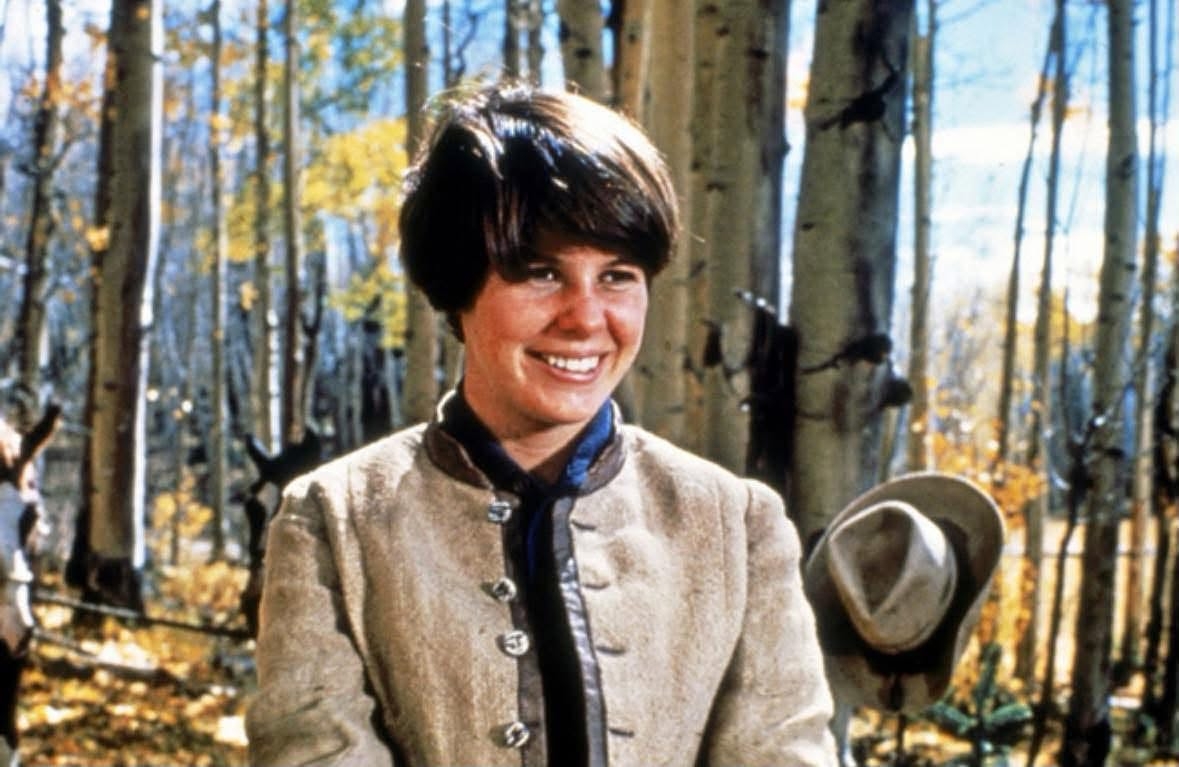
John Wayne’s performance as Rooster Cogburn in the 1969 True Grit was so fabulous and iconic that at times one forgets the actual protagonist in that film was Mattie Ross, played by Kim Darby.
Darby enjoyed the fruits of the film’s success, which turned her into one of the most in-demand young actresses in Hollywood. However, this was the time of New Hollywood, even more blokey-blokey than Golden Era Hollywood: a period when male geniuses were routinely propped up by first wives, and women who weren’t Barbra Streisand got left by the wayside. Kim Darby was such a case.
Darby was born in 1947 under the name “Deborah Zerby”. Her parents were dancers and she started off as a dancer herself before changing her name to “Kim Darby” when deciding to move into acting as she thought it sounded more serious. Darby’s upbringing (we’ll use her stage name for this piece) was not easy: her parents struggled to take care of her, she was put into the foster system then raised by her grandparents; she was also dyslexic and had learning disabilities.
But she could act. Darby’s film debut was in Bye Bye Birdie (1963) – a blink-and-you-miss-it part – and her career took off not long afterwards. She was hugely in demand for guest spots on TV shows such as Gunsmoke, Bonanza, Wagon Train, The Fugitive, and Star Trek, along with films such as Bus Riley’s Back in Town (1965), Billy Graham’s The Restless Ones (1965), The Karate Killers (1967) (from two Man from UNCLE episodes) and the TV play Flesh and Blood (1968). Watching these performances today, it’s not hard to see why – Darby was a complete natural, with a winning, slightly otherworldly, “quirky” presence. She was not a stereotypical Hollywood girl, something that would be both her blessing and curse; rather, Darby was a terrific character actor who exemplified the “new girl” look of the sixties as much as, say, Mia Farrow.
Then came True Grit, which Hal Wallis cast her in off the back of a TV appearance. Darby was not in the best headspace at the time, having just given birth, and her marriage to actor James Stacy (more below) was breaking up. Darby turned down the movie but says Stacy accepted the part for her and badgered his wife into it. Wallis later wrote in his memoirs that he couldn’t believe that he had to beg for Darby to be in the film (Mia Farrow had already turned it down; Tuesday Weld, too, reportedly).
True Grit wasn’t an easy shoot – Henry Hathaway (a notorious actor hater) clashed with Darby on the first day. Hathaway later said “The only trouble I ever had with an actress, outside of Dumb Novak [Kim Novak, with whom he briefly worked on Of Human Bondage], was that little girl, Kim Darby. She went on the [Johnny] Carson show and said she’d rather be a prostitute than work with me again, which I thought was a bit rash. Later, she cried and apologised. My problem with her was simple. She’s not a very attractive girl and she’s not a particularly well-coordinated girl, so her book of tricks consisted mostly of being a little cute. All through the film I had to stop her from acting funny, doing bits of business and so forth.” (Hathaway also said “Glen Campbell was so damn lazy, he wanted to sit up all night and play the guitar with all the teenie-boppers and then sleep on the set. He was too successful too soon.”)
Wallis wrote in his memoirs that Hathaway “was very hard on Kim. But she was a spunky girl, every bit as spunky as Mattie Ross, and she fought back. When Hathaway saw that she could hold her own, he respected her and we had no further problems.”
Darby later admitted, “there are places in the film where I’m not quite focused. I wasn’t expecting to go. I wish I had it to do over again because I would be a lot more focused.”
Darby got along well with Wayne who, as always, was incredibly professional. Her presence was perfect for True Grit – not a traditional pretty girl, genuinely different, and her on-screen chemistry with Wayne is entirely fresh. Wallis called Darby’s performance “remarkable. She played Mattie Ross like a gadfly irritating Rooster’s hide.”
True Grit was a blockbuster and Darby was red hot. She later said “There was a lot of pressure on me from True Grit that no matter what I did next, I was supposed to be the leading lady. I am not the leading lady. I don’t get the guy. I am a character actress and if they had left me alone, and if I had told them to leave me alone, I would not have been so conscious of my weight. They were self-conscious of it – my manager and my agent.”
In fairness to Darby’s reps, all her post-True Grit projects must have looked ideal on paper. Generation (1969) cast her as the pregnant daughter of David Janssen and girlfriend of Peter Duel. Darby loved making the movie but “it just didn’t do any business. It was a Broadway play for a long time and I think that it just didn’t move.” Darby had a long romantic relationship with Duel, who later became a star on Alias Smith and Jones and committed suicide.
Her marriage to Stacy broke up; he later lost an arm and a leg in an accident, was arrested on charges of child molestation, tried to kill himself in Hawaii by throwing himself off a cliff, but hit a ledge on the way down and lived. Her second husband was James Westmoreland, a jobbing actor from the Henry Willson stable also known as Rad Fulton; he and Darby knew each other for three weeks, then got married for 47 days.
Darby went into The Strawberry Statement (1970) with Bruce Davison, with whom she also had an affair. Her fee was $250,000 (she got $150,000 for True Grit). This was MGM’s big attempt to make something about the student protests movement and flopped.
She was reunited with Glen Campbell and Hal Wallis for Norwood (1970), a film no-one liked. She turned down roles in Panic in Needle Park and Diary of a Mad Housewife.
Darby was cast as the female lead in A Glimpse of Tiger starring Elliott Gould and directed by Tony Harvey. She won the role over other alternatives such as Susan Sarandon (who tested), Blythe Danner and Jennifer O’Neill. It was a difficult shoot with Gould, then at the height of his movie stardom, going through an unstable period; his erratic behaviour reportedly included turning up wearing a football helmet, and smashing a glass table. Darby was terrified of him and was even given security. The film was shut down and never finished; Gould didn’t work for two years. His career recovered with The Long Goodbye (1973) – Darby was never given the same chance.
Darby turned down Red Sky at Morning to play the lead in The Grissom Gang (1971), which must have seemed like a decent bet – directed by Robert Aldrich, and co-starring Scott Wilson coming off In Cold Blood – but it flopped. Darby later said “I was not right for it at all. That girl was supposed to be Drop. Dead. Gorgeous. She was supposed to be stunning. Well, that’s not me.”
After four flop features and one that was abandoned, Darby fever had cooled. She went into TV movies such as The People (1972), Don’t Be Afraid of the Dark (1973), and The Story of Pretty Boy Floyd (1974). She did some prestige television such as Police Story and Love Story, as well as the pilot of The Streets of San Francisco. Around this time Darby got hooked on methamphetamines to control her weight; when she shook the addiction, her weight ballooned.
Darby had another chance at screen stardom with The One and Only (1978), Henry Winkler’s second attempt at screen fame after Heroes. In Darby’s words the film “tanked, very badly. And I was getting older and the business was starting to change, and I was getting fewer roles. I had to read for everything, and it just started to diminish.”
Darby kept super busy as an actor, though, and constantly turned up on television as well as TV movies like Enola Gay: The Men, the Mission, the Atomic Bomb (1980) and features such as Better Off Dead (1985) and Teen Wolf Too (1987). In 1986, Darby married producer William Tennant and stopped working for ten years. She tried to reactivate her career but has found it tough. In 2014, she commented “The women in my peer group are struggling terribly” naming specifically herself, Meg Foster and Veronica Cartwright, adding “The men are soaring. Bruce Davison, Scott Wilson, they’re all soaring.” She hasn’t had a huge amount of credits since. We hope she’s happy. She’s made millions of cinemagoers and television viewers happy.
