


by FilmInk Staff
Coming Home in the Dark is the debut feature from James Ashcroft, a former actor and long-time CEO and Artistic director of the prestigious Māori Theatre Company Taki Rua Productions. He told us that “I’ve always had filmmaking in mind,” and for more than a decade, he’s been working at that ambition, producing a string of excellent shorts.
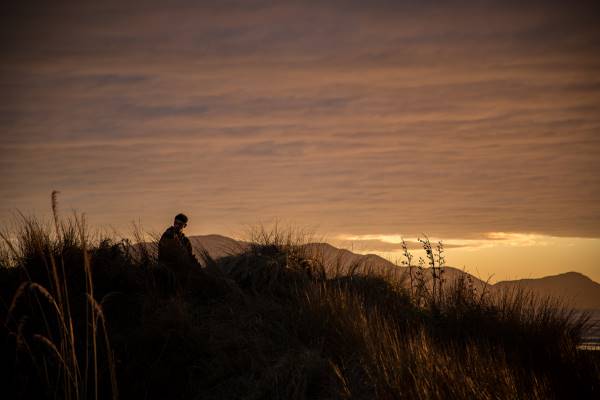
Set in the bleak but beautiful terrain on the south coast of the north island of Aotearoa (Greater Wellington), Dark features Erik Thomson and Miriama McDowell (Waru) as married school teachers on holiday menaced by a pair of homicidal drifters, Daniel Gillies (The Vampire Diaries) and Matthias Luafutu (Ghost in the Shell).
Ashcroft and his talented team, many of whom he’s worked with before, including gifted first-time feature cinematographer Matt Henley, create a you-are-there immediacy of white-knuckle dread. In the best tradition of Deliverance, its characters strive to survive in the ‘court of natural justice’. In the face of institutional violence and racism, Coming Home in the Dark throws a challenge to what passes for civilisation.
We spoke to Ashcroft via video chat from his home in Aotearoa on the eve of the film’s Australian debut at the Melbourne International Film Festival.
The film has an extraordinary intensity. Did shooting ‘rugged’ somehow leak into the onscreen action?
“It does bring about an economy, a sharpness and focus to cast and crew. It gave a reality to the performances – that breath [hanging in the air] is real, you can see the exhaustion and fatigue. The things that made the shoot challenging became strengths; we were shooting in the middle of winter, we were shooting at night, and we were shooting outdoors which obviously doesn’t make for an overtly pleasant experience. It meant we had to be well prepared because you don’t want to be mucking around in those conditions.”
 The film is pretty strong stuff…. But it’s the atmosphere that is gut-wrenching, not so much the on-screen violence.
“That’s my personal taste. It might come from my background in theatre. Part of the strength of theatre is that it does require its audience to do at least 50% of the work; you rely on suggestion. I like the violence visceral, but I like it sudden, cut-off. I hate watching movies when a gun goes off and no one is blinking! I was adamant I wanted blanks. The actors react to the report of the shot itself. A lot of the film is set inside this car with the four principals, and we removed the word ‘car’ when we spoke about it and replaced it with ‘pressure cooker’.
The shoot was only seventeen nights and three days and it’s very sharp, tight and polished cinema…
“It was a light set. Small crew. We travelled with post-production led by Annie Collins (Return of the King), a great editor, so we had her feedback looping in every day because there was no way we could do reshoots on our budget! [Laughs]”
You and co-writer Eli Kent adapted famed NZ author Owen Marshall’s short story which was first published in 1995.
“Yeah. I got the rights to it ten years ago. Eli and I, we’ve written about seven screenplays since. I thought it was cinematic and I loved the idea of the landscape as this living, breathing entity. As a first-time filmmaker I knew I would be thought of as the weakest link in the room, but this was [material with gravitas] and we had a great team and because it was genre, we thought it might be easier to find market partners. The budget was NZ $1.4 million dollars.”
 It’s been characterised as a horror film. Was that how you pitched it?
“We haven’t been able to shake that! I think the ‘horror’ tag might have come as an offshoot of appearing in the midnight program at Sundance. But the response was great! [Laughs]. But it’s a psychological thriller.”
Marshall’s story bares a strong resemblance to Flannery O’Connor’s short story A Good Man is Hard to Find published in 1951; nice family confronted by criminal drifters in remote setting. In the end, it’s archetypal, the sort of yarn bigger than its plot details.
“Exactly. The short story is only the first twenty minutes of the film. Eli and I wanted to get underneath it…”
You’ve incorporated into the plot a real-world history of violence in NZ that wasn’t in the short story. Were you influenced by your experience producing Little Criminals, a documentary about Epuni Boys’ Home, a notorious site of abuse?
“Yes! I met some pretty loathsome men [guardians and such] who can’t now be tried in court for what they have done [because too much time has passed]. Now, they are fathers, like me…and I started thinking about the kind of contradictions that presents and [I introduced those elements into the script]. I also met and interviewed many of the men who had been [inmates]. A lot of them had ended up on that conveyor belt from Boys Home to prison to gang life and back to prison…”
 You told us that the Maori population in these homes is over-represented?
“Yes. I got a lot of criticism initially because people said: ‘if this is a Maori story why isn’t Mandrake [the ring-leader who menaces the family] Maori?’ But I didn’t see it that way. I’m Maori. I’m Maori everything. I don’t identify as a ‘Maori filmmaker’ I’m a filmmaker who happens to be Maori. [During development] I was adamant that if there was going to be a Maori actor in it, it would be the wife because we don’t get cast in those roles. [Ultimately played by McDowell].”
A lot of thrillers require a suspension of disbelief, and your film involves a coincidence, but it all seems so authentic…
“I’m glad to hear it. I don’t want to say anything gauche about the ‘smallness’ of NZ but here’s a story: a guy that I knew who was in a home had just been released from prison. He was dropped off by his parole officer at the bus stop. He has an hour to kill. He wanders into the shop opposite and who is it behind the counter? The guy that used to beat the shit out of him in the Boys Home! He walks up to the shopkeeper and says: ‘you don’t recognise me, but I recognise you’. The shopkeeper finally clocked onto what was going on and walked out of his own shop and stood across the road while my friend watched from the store window.”
At the core of the drama is this idea about morality. The ‘goodies’ here have to confront a past of violence, and guilt, ask themselves ‘who am I’? They don’t like the answer. This is the basis of a lot genre cinema.
“I love genre; genre literature, genre film especially American cinema of the ‘70s.”
Coming Home in the Dark has the brutal efficiency of Don Siegel; Dirty Harry, Charley Varrick. It’s also a mythic space, like a Western.
“That’s music to my ears! [Laughs]. Straw Dogs was an influence, too. Within the form of a thriller, you can approach tricky subject matter and unpack it in way where you avoid getting on a soapbox; I think what I drew most from those ‘70s thrillers is that they exist in a space of moral ambiguity. That’s not about the plot. What you take away from them is a question about ‘where do I stand’? What I wanted to do is best expressed in a Maori word: porangi which can mean ‘crazy’. But I was drawn to the metaphorical definition: (Po) night and (Rangi) meaning day. I wanted to explore what it means to ‘walk that line between night and day’.”
Coming Home in the Dark is streaming at MIFF Play and is in cinemas from September 9, 2021
