




by Julian Wood
The Blue Trail is an intriguing film from the Brazilian writer/director Gabriel Mascaro. Arthouse movie buffs may recall his 2015 film Neon Bull. Mascaro has not made a lot of films since – a situation he ascribes to the fact that he has been busy parenting – but he has had the idea for The Blue Trail in in his head for many years. It tells of an older Brazilian woman, Tereza (a luminous performance by Denise Weinberg), who resists being shelved by her society and goes on a life-changing journey.
We spoke with Gabriel Mascaro when he was in Australia for the film’s screening at Sydney Film Festival.
What was the main wellspring for you in making this film?
“I started investigating elderly people and this one came to me. But there were not many ways in, in which the older body is represented in cinema. There are a few works that I like that come to mind – Amour by Haneke and Ozu’s Tokyo Story. In those, we see a very specific understanding. For example, in Amour it is about the very end of their lives, when the couple is close to their final act. And in Tokyo Story, it is more about the passage of time and how the old are being left behind by modern Japanese society, so it is about a body that doesn’t fit in a sense. There is also some sort of nostalgia for something that has gone.
“When cinema talks about the elderly, there is this nostalgia around them as some sort of repository of time or of the memories of the family. I tried to make a break from that and put this elderly body in the present and deal with the contradictions of the present, not just the idea of old age and death.”
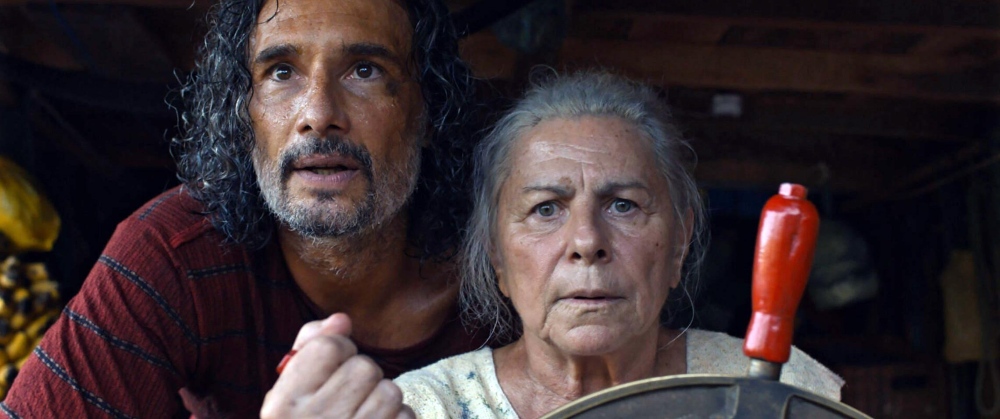
So, we can agree that society – perhaps especially today – defines people by how productive they are in an economic sense. So, the unproductive body is a waste in a way. But that is not necessarily what is at stake in your film.
“My movie does not actually reference a specific time. It could be past or present or future. It could be now also. It’s funny when people see it, who don’t know Brazil, they say to me, ‘wow, is this happening in Brazil now?’ So, it is possible to make the story work as if it could be actually happening now.
“[In relation to] the idea of genre – it’s as if the elderly body is not allowed to be the body of a rebel. I wanted to explore the idea of an elderly body that goes against this prohibition. Why do we only allow teenage bodies to be free and physical in our society? But when we talk about the elderly, it’s as if we want them to be ‘domesticated’. In my early version of the script, it did not work so well because I had more of the family life of [the central character Tereza]. And then, when in the film she has to leave her family, everybody was judging her and saying she was bad. But, when I removed that aspect from the story, everybody was suddenly going with her on the adventure. So, again, this suggests there is some sort of unconscious expectation that elderly people should be domestic and should just safeguard the family values, while the young are able to go out and really experience life. So, as I said, I wanted to do something against that.”
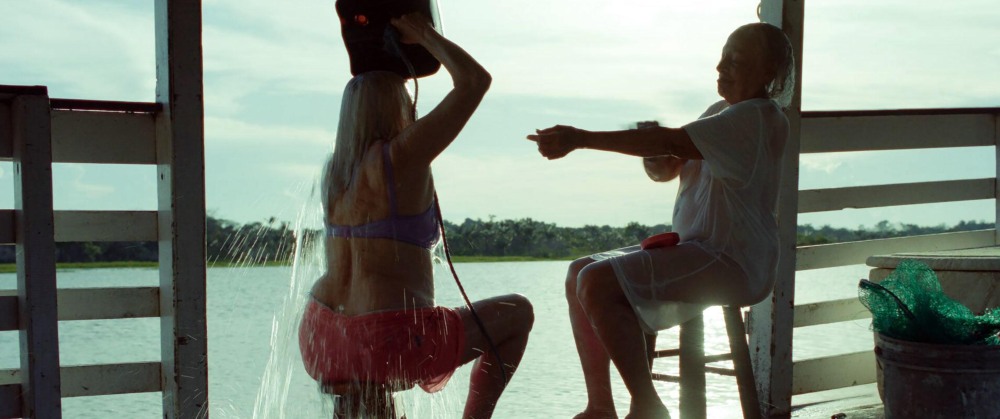
You represent a very ‘low tech’ version of dystopia. Usually, we see a highly technologically evolved society with clean blank walls and evolved gadgets and so on, but with you, it is little rickety cages and old fashioned machines. And the other thing is that you don’t seem to show us much of how people might fight back against the oppressive rules of this society.
“I actually like to shoot it so that the mechanisms [of the state] are not very sophisticated, as it makes it more timeless, and, also, that way you can be more allegorical and not literal. Also, there is a playful soundtrack which affects the tone. It is serious in one way but there is also humour, so you do not know quite how to react. And this is nice for me in how this steers the audience; they are likely to laugh a lot but also feel for her emotionally.”
Are you a fan of the idea of ‘magical realism’, which is often associated with Latin or South American storytelling? Or is that idea now so old as to be no longer useful?
“I do not agree with a dogmatic or strict definition of that idea, but there is a way in which you can speak instead of the idea of a fable or allegory in order to read things. Here, for example, the whole idea of how the elderly are treated by society is a fable. There are a few hints of how you can make people feel that the whole society here is just that few clicks different from ours. It can make you feel that it is not really the present or the past, but it could be real in its way too. The idea is that there is a different set of cultural mores. In the film, elderly people are also being celebrated and given praise and awards but at the same time they are marked out by acts of symbolic violence and are made visible but not in a wholly good way. Also, there is a violent intrusive state that can reach right into your private life.”
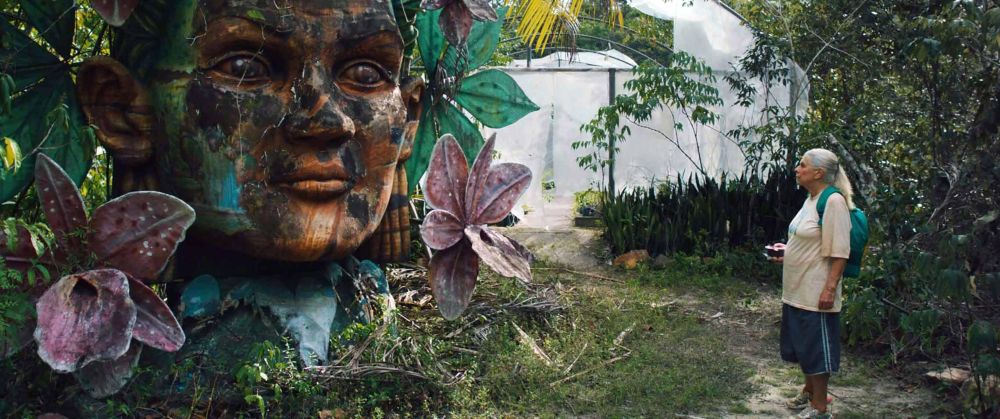
In the film, there is this strange mechanism by which the central character ingests a potion and goes on a sort of ‘trip’. Did you think about how you would actually represent that, for example trying to show that hallucinatory experience directly?
“There are actually two ‘trips’ in the movie. With the first one, she sees it from the outside as it were – she is just observing the guy doing it. But in the second one, the cinematography changes a little bit. There, you are more ‘with her’. I used distorted lenses to make the visuals more intense and so you are closer to her actual experience. More generally, with the cinematography, the temptation when filming something like the Amazon [where the river trip part of the movie is set], you can show it more panoramically. But we did not want to fall into that traditional way of showing the big landscape etc. Instead, we want to focus on the characters, so I cut the wide shots down a lot and go in on the marks on her face and so on.”
Picking up on how she is shot as an older woman, there is also the issue of the way you depict the intimate friendship between two older women in the film. You don’t label or specify the nature of their relationship in any explicit way. Can you comment on that choice?
“I tried to create a character that does not belong under any label. She is just an ‘ordinary woman’ in a way. In the beginning, she is not someone who would like drugs for example. But I wanted the audience to experience her transformation from someone who is initially quite conservative. For example, about the way the state enforces order, she is initially prepared to see that as a good thing. But in the end, it is totally different. And she is generally more open to all kinds of experiences. And when the society is trying to control her body, she finds safety in the close company of a woman who is even older than her. There is more than one way to rebel. In the film, she wants to literally fly [the character dreams of going in a plane] but she actually flies even higher in another sense.”
The Blue Trail screens at the Melbourne International Film Festival on 13, 15 and 24 August 2025. For more information, click here.
