



by Dov Kornits
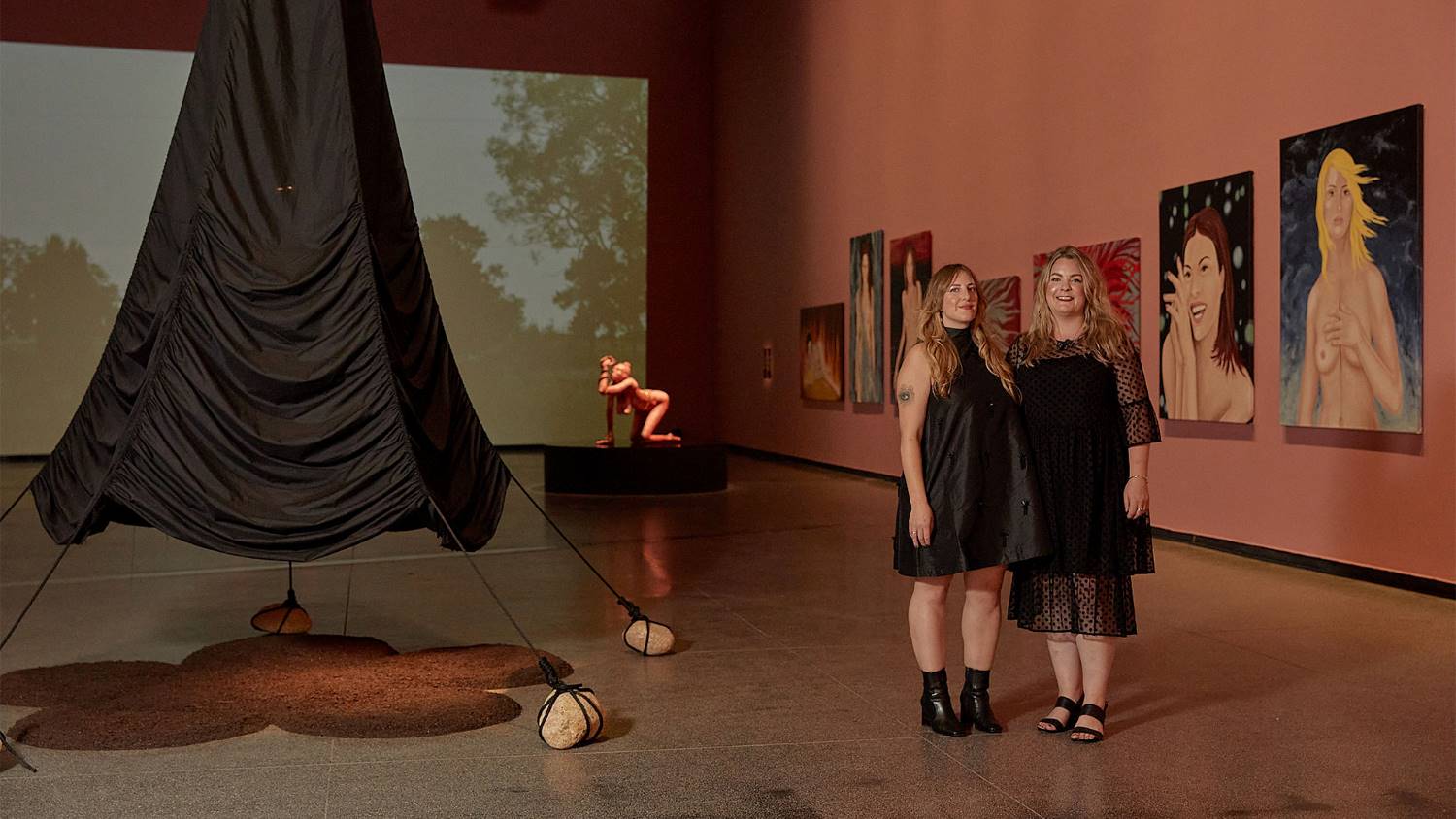
“We have painted all of Gallery 1 a colour that we’ve called ‘Tongue’,” says Elyse Goldfinch about transforming Melbourne’s ACCA for the horror film genre inspired exhibition From the Other Side. “We were really interested in trying to think about the internal space of the body. The room itself isn’t a body, it’s the womb or the organs. We’ve been calling it organ pink. It’s this disgusting pink colour that we love. So, the entrance to the show will be very much thinking about being in this internalised, imaginary space where you are in this cacophony of work.”
A self-confessed lifelong horror movie fan, Goldfinch has teamed up with Dr Jessica Clark to co-curate an exhibition featuring 19 artists’ response to the genre.
“We had a list of 600 people at some point,” admits Goldfinch. “What we ended up doing is really refining the project and thinking about the things that felt most relevant and at stake in the current moment; the horror genre that we are seeing in film, but also in artistic practice. And the voices that we’re interested in exploring are female storytellers, people from marginalised backgrounds, people who are really embracing and reclaiming the horror genre, having been othered or considered outsiders in the space for a very long time. When we narrowed down the list of artists, it became really relevant to us to think about those voices and perspectives that haven’t necessarily been included in the context of horror historically.
“It’s about the Monstrous-Feminine, these intersectional representations and how the voices of the artists are at the forefront of the exhibition. The curatorial framework’s been really inspired by Barbara Creed’s seminal publication, Monstrous-Feminine. The idea of monstrous as a force for change and the feminine speaking for women’s rights and social minorities giving voice….”
“It’s been a big year of watching a whole range of horror films and going down lots of rabbit holes,” adds Dr Jessica Clark. “Elyse and I have been talking about horror as a cathartic release and a really needed thing in this moment, but also how historically horror has thrived in times of crisis, which is especially pertinent to the now.”
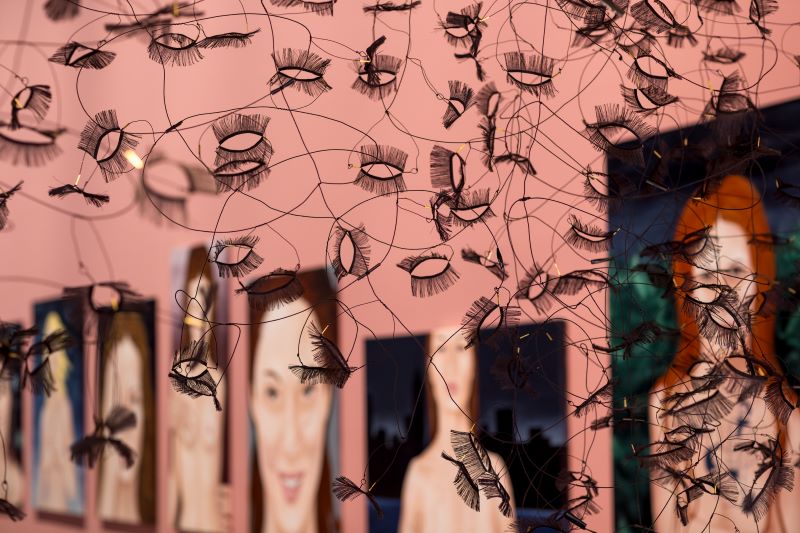
“In terms of the new commissions, there are five new commissions by artists such as Mia Boe and Kellie Wells,” says Goldfinch. “Heather B Swann, an amazing artist based in Hobart, made this incredible monstrous entrance piece made up of hundreds of small eyelashes. The gaze is really relevant to the way that you enter into the space, and it’s really about crossing a threshold from the everyday space of the foyer, into this imaginary space of the exhibition. We are really interested in how cinema does that.
“Obviously, when you’re in the cinema, it’s like a full body experience, and when you watch horror, it’s a full-bodied experience. We’ve been trying to think about ways that the exhibition creates that affect.”
Other highlights of the exhibition include filmmaker/artist Tracey Moffat’s video work A Haunting. “Which is speculating on hauntings in the home and the domestic space, but also the land,” says Goldfinch. “The closer you get to it, the more you hear the sound of the landscape itself, which is really evocative. And we also have Naomi Blacklock, who is an amazing young artist in Brisbane who has been working on a body of work that deals with the sound of horror, the soundtracks of horror.
“There’s this visceral female scream that interrupts the space, which is really amazing. And then, we have the full suite of Maria Kozic’s 1999 series Calendar Girls, and we kind of see them as these amazing survival characters. They’re like the Final Girls at our exhibition. And obviously that’s a well-trodden trope, but I think she was really interested in painting these women who might have gone through horrific incidences and their bodies might retain the scars of those instances, but they all look defiant. They look back at you from the canvas.
“It was really important in the exhibition to make sure that there’s this sense of liberation, of reclamation, of rage and revenge, but also how you come through the other side and really reclaim your power.”
“One of Maria’s favourite horror films is The Giant Claw (1957),” chimes in Clark, which is a perfect segue to mention Screams on Screen, a two day program of screenings and speakers at The Capitol, inspired by the exhibition.
“There are films that have been formative to the exhibition. Possession (1981) is a really important film for us. Also, The Blood on Satan’s Claw (1971) – there’s quite a bit of folk horror in the exhibition. Carrie (1976) is a really important film. The exhibition is really about centralizing and shifting the perspective on how women and minorities are seen in horror, and I think they’re all about reclaiming power.”
The curators also want to make sure to mention that you don’t necessarily have to be a horror movie fan to appreciate From the Other Side. “It’s also about beauty and tenderness, and particularly a sensory experience. It’s a very multidisciplinary show, from sculpture, painting, photography, projection and installation, as well as several soundscapes that are interwoven and bleed through the space to connect and interact with,” Goldfinch finishes, making sure to leave us with a shining horror metaphor to savour.
From the Other Side is on until 3 March 2024 at Australian Centre for Contemporary Art, 111 Sturt Street, Southbank. Opening hours: Tuesday – Friday 10am–5pm, Weekends 11am–5pm, Free entry. More information here: https://acca.melbourne/exhibition/from-the-other-side/
