


by FilmInk Staff
How have the rules of a Scream movie changed over the years?
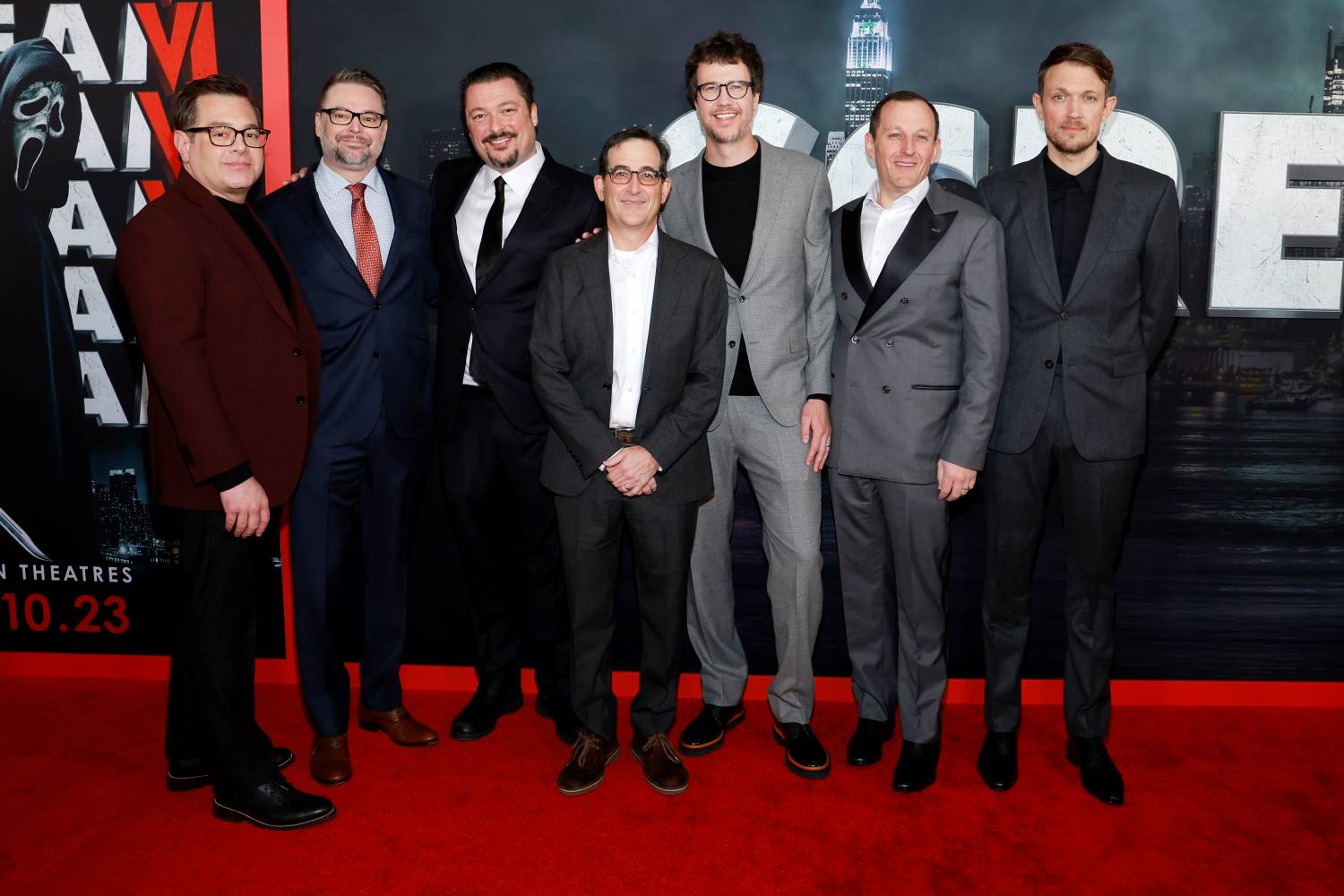
Tyler Gillett [co-director, fifth from left]: “There are ingredients that just have to be present for a movie to be a Scream movie. But one of the truly exciting things creatively is that maybe the Number One rule of a Scream movie is that it has to not play by the rules! When you watch this franchise from film to film, you can really see Wes [Craven] and Kevin [Williamson] challenging even their understanding of not only what the movies within this franchise can be, but what a horror movie can be. They’re always conscious of subverting expectation, so they’ve created a sandbox to play in that’s limitless. There has to be some form of whodunit. And you have to have Ghostface. But within that, there is room to play and take risks. We are such huge Scream fans and love this thing so much, but there was also a real chance for us to put our stamp on this.”
Matt Bettinelli-Olpin [co-director, far right]: “The Scream movies have always been right up there for us. And these movies have always been such a great snapshot of the time they were made. So, for us, getting to have a new conversation about genre, movies, fandom and all of that, meant we had a lot of freedom to really cut loose.”
This new movie is set in New York. What does that location give you?
James Vanderbilt [writer, third from left]: “For the last Scream, coming back to Woodsboro was a big deal. But for this, we immediately wanted to do something different. We got really excited very early on about what a city would bring to the franchise; how you could build different scary sequences within it. The last movie was what we called a ‘requel’. And when you make one of those, it’s a little bit of playing the hits, getting back to the core of what Wes Craven and Kevin Williamson did in their brilliant originals. On this, it was, ‘Okay, we’ve done that. Now, how do we tell a great continuing story for our characters?’”
William Sherak [producer, second from right]: “The city gives you a bunch of opportunities that a small town doesn’t. It gives you scale and scope, without changing the model. You can make a great Scream movie but execute it bigger.”
James Vanderbilt: “We talked a lot about Ghostface in the previous movie, who was very much a ‘pop up and surprise you’ kind of Ghostface. There weren’t a lot of chase scenes. And that had to do with who the villains were. In this one, Ghostface is a little bit more aggressive. And it’s Halloween. With it being Halloween, anyone can be Ghostface, anywhere in public. The first thing Guy [Busick] and I came up with conceptually was the subway sequence. In a lot of the Scream movies, you’re alone in a house and you get a phone call. The set-up is, ‘Who’s behind that door?’ So, the question was, ‘What’s the inverse of that? What’s it like if you’re trapped somewhere with 100 people, any one of whom might want to kill you?’”
These movies have always captured the zeitgeist. What is it in pop-culture that you’re skewering with this one?
Matt Bettinelli-Olpin: “The last one was so specifically about a thing, and that thing – fandom – is revealed in the end. In this one, it is also specifically about a thing. But, without giving anything away, what that is, in the motive, is flipped on its head. So, even the way it is revealed is a subversion. And it cuts to the core.”
What did you learn from killing Dewey in the last movie, and how audiences reacted to that?
Matt Bettinelli-Olpin: “What we learned from doing that is to not read your DMs! [Laughs] No, what we honestly learned is that people do care about the franchise. They keep it so close to their heart. So, every choice we make, we can’t be flippant with it. We have to battle-test it, debate it creatively, and make sure we’re making the right choice for the franchise as a whole, so we can carry on the legacy of Wes Craven and Kevin Williamson. It’s about making sure we stay true to that. And, you know, they created that idea, that every now and then a character you love might not be in the next movie! And that’s very important, to have those stakes, so you really care about these characters. At the end of the day, life is vulnerable; there’s a preciousness to it. We want to make sure we capture that in every scene. It’s not just about the kills and the action, although we have plenty of all that! That’s what makes a Scream movie – all those elements, but also that level of care.”
Tyler Gillett: “It’s an interesting distinction because it should hurt. If it doesn’t hurt, then it doesn’t matter. But there are degrees. In Screams 1 through 4, death is handled with a little bit of cynicism. And, obviously, that’s part of the Scream world, right? You have to be able to kill a character but then for the movie to continue to be fun. So, you have to find ways to get that tone back on the rails. But us and Guy [Busick] and Jamie [Vanderbilt] really wanted to deal with that stuff. Like, Tatum [Rose McGowan, Dewey’s murdered sister from the first movie] is not spoken about in any of the other movies. So, we wanted her death to be a part of Dewey’s story in Part Five. It was important to us that the characters matter, that we’re dealing with the loss of them in a way that has real gravity. Dewey’s death is a part of this movie, insofar as we’re all still dealing with the grief of that choice. Not only is that valuable emotionally, you honour those characters by letting them continue to exist in the way other characters deal with their loss.”
There’s a real Scream family of actors and filmmakers that has built up over the years. What’s it like, having to kill off some of those family members?
William Sherak: “I think everyone understands that these are the rules of these movies. Whether you end up being the killer or a survivor, it’s all wonderful. There’s also a real honour to being killed in one of these movies…”
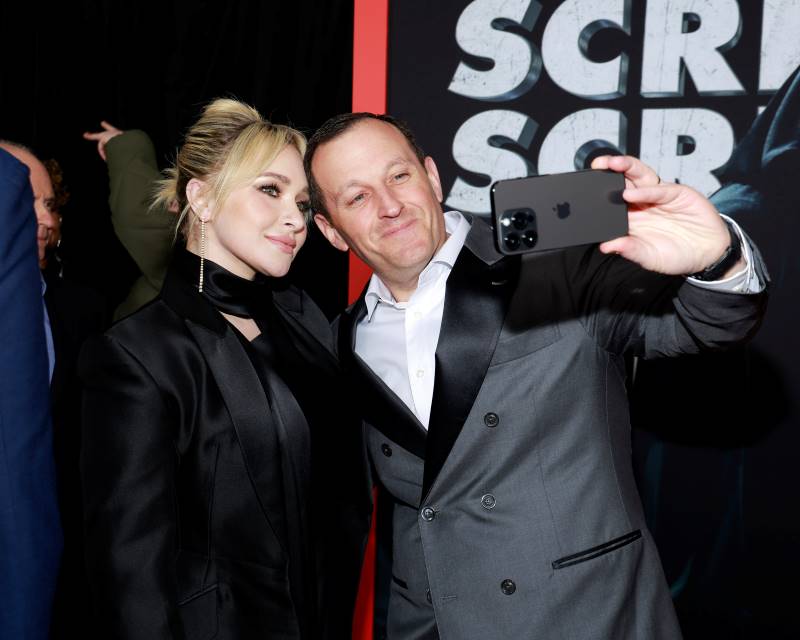
Someone who very nearly got killed in Scream 4 was Kirby. When did you decide you wanted to bring her back?
Tyler Gillett: “We thought it would be really fun to put Kirby in Scream 5. So, we talked to Hayden [Panettiere] three years ago. But then, we collectively felt that because we were already in pre-production [on that movie], to do that would make it more just a, ‘Hey, look, it’s Kirby!’ – just a fun cameo. We decided that, as tempting as that was, we should wait, hope that movie worked and that we got to make another one and could bring her back as a full character. So, we put the little Easter egg in Scream [Kirby’s name on Dewey’s phone], letting the audience know she’s still alive.”
Matt Bettinelli-Olpin: “The way Kirby has been developed is central to our main theme, which is how you deal with traumatic situations. Kirby is now 10 years removed from what happened in Woodsboro, so she’s a little bit further along in the way she’s processed it compared to the returning characters from our last movie. We have a great scene with her in this that kind of states explicitly what she was thinking after what happened to her. And that’s at the core of what we wanted to explore with this movie: how do people overcome these horrific situations and go on with their lives? Kirby is a perfect example of that theme.”
Tyler Gillett: “Also, it was the chance to work with Hayden. She’s incredible. The Scream franchise is responsible for so many amazing young actors and characters. But Kirby is one of those that sticks out because Hayden is just so magnetic. She delivered that monologue [in Scream 4] in just two takes. Two takes. Obviously, Mindy, played by Jasmin Savoy Brown, is our encyclopaedia. So, there’s this wonderful scene with the two of them in this where you get that old Kirby flavour in a really fun, amazing interaction.”
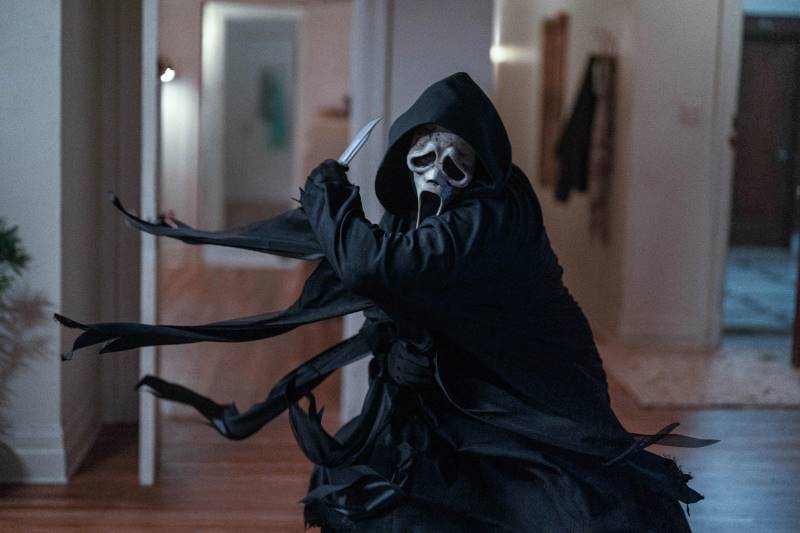
Ghostface has been a huge horror icon for nearly 30 years. What did you learn about the character when you were making this movie?
Matt Bettinelli-Olpin: “We’re really leaning into the mythologising of Ghostface in this one. That idea of how movies are modern-day myths, and how we self-perpetuate this idea of almost an otherworldly being from something so human. Ghostface is human, always. But there is something about that character that’s sort of mythical. It’s not someone wearing the costume – it’s something more. I know some people watch these movies like, ‘This is so-and-so and that is so-and-so in the mask’ at certain points, in certain scenes. And that’s a fun way to watch them. But when you just sit down and have the experience, Ghostface is a singular character, causing mayhem and wreaking havoc. And how that has evolved into Scream VI is kind of a nod to Scream 2, which is this idea that now Ghostface has permeated our pop culture and is part of the fabric of our everyday life. That’s so interesting because that’s something we do, with people good and bad, in culture in general. So, to do that with a villain and turn the dial all the way up, was really fun.”
Chad Villella [executive producer, far left]: “What’s special about Ghostface being a villain who exists within the world of the movie is that it really lets you show that it could be anybody out there. This is not like other movies. Ghostface isn’t like Freddy Krueger, where there’s only one of them and they don’t exist anywhere else. Ghostface costumes are prevalent. The character is everywhere.”
Matt Bettinelli-Olpin: “For Ghostface on the last movie, it was about the physical stuff. On this, the way we and Max [Laferriere, the stunt performer and actor in the mask] approached it was more like a performance. It was less technical, about having to hit this place and stab here, and more about the emotion of it. Why it’s happening.”
Tyler Gillett: “In all these movies, Ghostface is a vehicle for whatever the contemporary fear of the moment is. With Max, there was something so fearless and confident about how he moved in that costume. What ultimately ends up emerging is a character who is so brazen and relentless, so physical and imposing that they make public spaces terrifying. That’s part of us setting it in New York. Our public spaces are scary spaces now. This Ghostface is a representation of that – a force that feels unstoppable and can show up at any moment. As much as the ‘Ghostface-isms’ are a thing – like the head tilts and the knife wipes – there’s also room for it to be distinct. In this movie, Ghostface feels scary in a way that’s unique to the franchise.”
At what point do you reveal to the cast who Ghostface is in the movie?
James Vanderbilt: “We played it differently this time. On the last movie, nobody got the third act except for the legacy characters until almost halfway through shooting. On this, the legacy characters are all the ones returning from the last one. So, they got it. And then, right before shooting, we let everybody else in on it. And we did so in a pretty amazing way. For the actor or actors who ended up being the killer, during costume fittings we brought out their different looks to try on. And then we said, ‘We’ve got one more costume that we need to make sure you fit into…’ And we would walk in with the Ghostface costume!”
William Sherak: “It helps that the people in these movies really love these movies. Mason Gooding [who plays Chad] wrote his college senior thesis on Scream! There is an actual term paper of his on it. Jack Champion [who plays Ethan] is another massive fan. As a 17-year-old kid, he called his reps saying he wanted to be part of a Scream movie.”
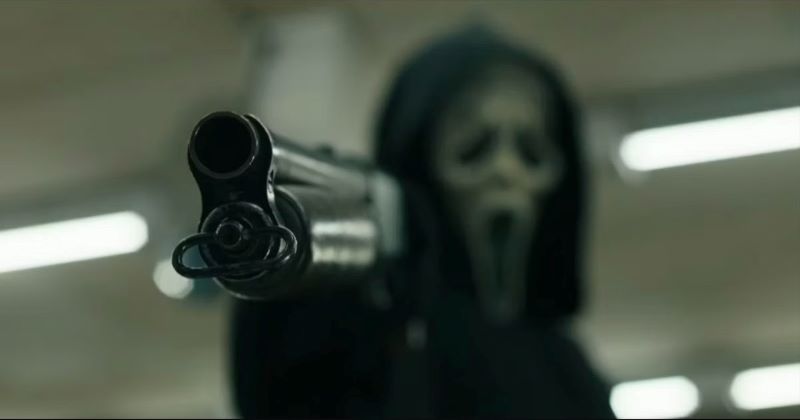
There’s been a lot of talk about Ghostface using a shotgun, not just a knife, in the trailer. What can we infer from that?
Chad Villella: “That conversation is interesting. Ghostface has always been crafty with what he kills people with. He’s killed people with a garage door, and a fax machine. He uses what’s around! We’ve stayed true to that tradition.”
Tyler Gillett: “That scene is a perfect example of everything we’ve said. As much as this is still the old Ghostface and the knife is the weapon used throughout, this Ghostface kind of doesn’t [care]. It’s less about playing the Greatest Hits and more about getting the job done.”
Matt Bettinelli-Olpin: “Like the other Scream movies, this one also exists in a heightened reality. But within that reality, this Ghostface is going to take every opportunity. There is always a level of gamesmanship to Ghostface, playing three-dimensional chess with all these characters. They’re always ahead of everyone. But this Ghostface is also prepared to go into any situation and do whatever it is that needs to be done. This Ghostface is not afraid to break eggs.”
William Sherak: “What I will also tell you about that trailer is that when it dropped, all the kids we killed in the last movie were back on the Scream WhatsApp group, saying: ‘Can I come back? I’ll be my character’s evil twin!’”
Kevin Williamson has described Scream VI as ‘a reinvention’. Why?
James Vanderbilt: “First of all, I want to say that on a personal level, there’s nothing more awesome and surreal than Kevin Williamson loving your Scream movie. As soon as he said that, I was like, ‘Yeah, I’m good!’”
William Sherak: “Kevin is wonderful and this franchise is such a big piece of his life. And he’s excited about where we’ve gone with it. He’s been so supportive; put wind in our sails.”
Paul Neinstein [producer, fourth from left]: “I think in the last movie, we kept all that organic DNA, to make sure we were doing right by this franchise, doing it justice. And now, in this one, we can take a little bit of liberty. Not a lot. But you can take some swings that you’re never going to take on the first one. We are true fans. And Kevin has been a true fan and supporter.”
James Vanderbilt: “We are 100% Scream fans. And this movie really is what I would want to see in a Scream VI, as a fan. That’s how Guy [Busick] and I literally started. We wrote down a bunch of things – from character moments to inventive kills – of what would be the coolest and most awesome things to see in Scream VI.”
Paul Neinstein: “These guys have an encyclopaedic knowledge of these movies, which is what makes what they create so fun to read and watch. When they first pitch it, you’re like, ‘Oh, my God… they’re going down this road?’ And then it just blows you away.”
James Vanderbilt: “This movie harkens back to all the other movies. It has that totality and collected history. But it also does something totally new.”
Last question. Is this the end?
Tyler Gillett: “You’ve got to leave it all on the field. There’s no point holding anything back. And we really haven’t held anything back.”
Matt Bettinelli-Olpin: “We treat all our movies as a singular movie experience, to stand on their own as a complete thought. We are firm believers that movies should be movies. They should finish a story.”
SCREAM VI: BUY OR RENT NOW ON DIGITAL
