



by Gill Pringle
With Nightmare Alley, visionary storyteller Guillermo del Toro journeys into the most arrestingly dark, sweeping and realistic world – the cinematic world of film noir. The film moves from the inner circle of a 1930s traveling carnival, a realm of shocks and wonders, to the halls of wealth and power where seduction and treachery reside. At its core lies a man who sells his soul to the art of the con. This is Stanton Carlisle (Bradley Cooper), a drifting hustler who transforms himself into a dazzling showman and manipulator so masterful he comes to believe he can outwit fate.
The film’s all-star cast also includes Cate Blanchett, Toni Collette, Willem Dafoe, Richard Jenkins, Rooney Mara, Ron Perlman, Mary Steenburgen, and David Strathairn.
FilmInk chats to four-time Oscar nominee Dafoe, 66, whose varied career has seen him feature in Platoon, The Last Temptation of Christ, the Spider-Man franchise, John Wick, The Florida Project and The Lighthouse.
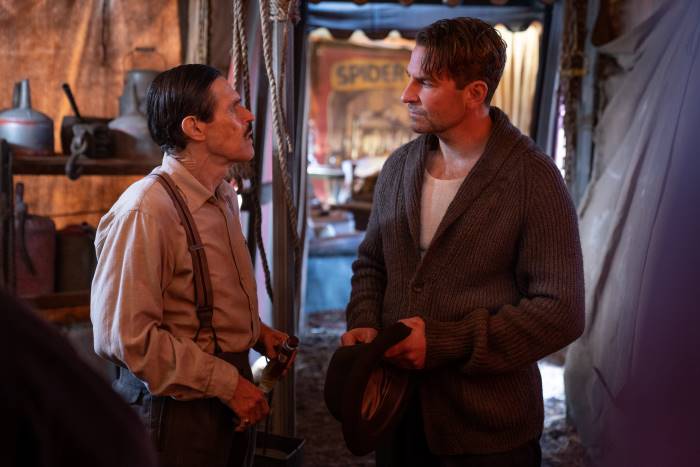
Nightmare Alley sees him play the pivotal role of Clem Hoately, a carnival barker who takes Stanton under his wing, introducing him to the world of “geeks” – opium junkies or alcoholics deprived of their fix, willing to do anything to avoid withdrawal. In the carnival hierarchy, the geek was the lowest in their societal pecking order, reviled and pitied even by carnies.
Dafoe’s Clem Hoately sees it as all part of the job.
What are you earliest memories of the circus?
“I have very strong, memories as a child going to sideshows. They still were around when I was a kid. And those carnival people, particularly the people at the sideshows, were kind of darkly romantic figures. They were a little scary, but they were also sort of charming. At least to my young kid growing up in Wisconsin, they seemed worldly because they were travelers, and they could spin a story. I have a pretty strong imagination from that experience of what it would be like to be a carnival barker.”
What did you enjoy about working with Guillermo del Toro and this amazing cast?
“It was a very strong script. Guillermo trusted me to find my way, not a lot of hand holding, but when we get there, we really start to mix it up. There will always be some sort of open-ended tweaks here and there. But I think what was really principal was my memories from when I was a kid. I had a very formed idea of carnivals, and then the reality that was created by the production design was this beautiful, very complete, almost truly functional, carnival, with essentially everything working. It was a beautiful world to enter, even though it’s a little dark.”
Clem is such a versatile character. He’s both warm and horrific when the occasion calls for, like the geek show and how he treats the geek. How do you think he reconciles his brutality and his humanity? And how did that inform your performance?
“Well, you can’t judge the character, you can just give him opportunities. He’s pragmatic. And you appreciate that he does take care of his own. But he’s also a guy that probably came of age during the depression. He’s probably maybe even been in prison? He’s a guy that pragmatically sees the world as winners and losers, prey and predators. He’s got this dark fatalistic view of the world but, at the same time, he cares about the people around him. He tries to circle the wagons and expresses how to turn a man into a geek, which is a cruel story, but you also have the sense that he doesn’t enjoy this, he’s just getting on. That doesn’t justify it, but to his mind, the onus is on the nature of the people. And then there’s human nature, and the nature of desire, and the nature of addiction, and the nature of fate. That’s all in the mix. He is a dark character, but he’s not out to destroy people, and he’s not unthinking. He’s compassionate towards certain people. He’’ human, but he’s a very flawed character, if you judge him morally. But of course, that’s not my job as an actor. My job as an actor is to try to imagine him as a full person capable of many contradictory behaviours.”
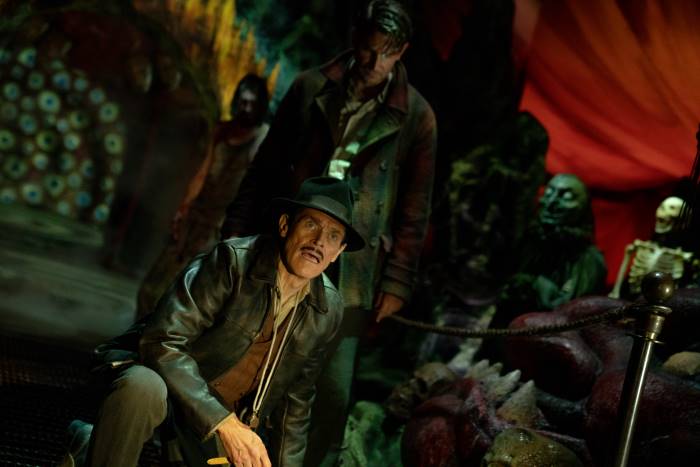
How did the production design help immerse you in Clem’s world? What was it like stepping onto that carnival set and did you concoct stories for all of the little jars in the tent to help you build the foundation of the character? I know Guillermo was especially fond of those little jars.
“He was and the production design was beautiful and very important because of the detail. As far as the so-called pickled punks, that is so ingrained in my brain because I was so traumatised by seeing those kinds of sideshows when I was a kid so, no, I didn’t make up stories for all of them. But I made up stories for a few.”
And the carnival set was out in the countryside?
“Yes, and when you’d drive to the set and as you’d approach it, particularly at night, you’d see the lights coming on. And you’d enter this world, that was waking up as you entered it. And people would start to move, and the organisation of the production itself kind of becomes the organisation of the carnival. And then you see people that you know, the characters you know. So, there are all these mirroring of functions and worlds, but it feels actual. You start your day, and the life of the movie is paralleled by the life of the carnival. It’’ a world that’s easy to enter. And, you have your job, and always you have your function. So that’s a wonderful position to start in.”
You can have any role you want and work with anyone you want. Obviously, Guillermo is a great director, but how do you decide which great roles you’ll take; like this one?
“I kind of look at the whole thing. I don’t think of roles, so much as I think of situations. I’m very drawn to strong directors, because the truth is sometimes you don’t know a role until you do it. And usually, if you do know the role, that probably means there isn’t the kind of room for adventure, or discovery, or surprise that I usually like. So, you look for a situation to learn something, a situation to be transformed, a situation to be useful, and a situation to maybe fulfill a fantasy or something that you’re curious about. I think that’s what you look for. But I don’t think in terms of roles, I think in terms of the whole story, and the whole idea of the movie. And I think a little bit, ‘Would I want to see that movie?’ I think a little bit, ‘Do I want to be around those people?’ And ultimately not so much about interpreting a role, but you look at what happens in that story, and you say, ‘Do I want to do those things?’ A lot of it is intuitive, but it’s simple, you know? You think, ‘Do I want to do these things? Is this resonant for me? Does this challenge me? Does this interest me? Can I contribute something? Is it right for me? Is it so far away from me, it’s interesting? Is it so close to me, it’s interesting?’ You weigh all those things.”
What sets Guillermo del Toro’s vision apart in modern Hollywood?
“Modern Hollywood? That’s tough. Like, what’s that? But I know what you mean. I think, one thing that’s interesting about him, maybe it’s not so true in Nightmare Alley, but I like how he mixes genres. He takes things that really don’t go together and marries them, does a cross with them, like a hybrid. And that’s very particular to him. Also, I appreciate his interest in creatures and misfits and monsters and people that are outside of our society because he humanises those people and pushes our understanding and our compassion in all his movies. Like you look at something like Devil’s Backbone, and it’s a period historical movie with political overtones, and it’s a horror movie – it’s a mix. And that’s pretty interesting. I think only a guy that’s well-versed in cinema history and passionate about symbolism and different ways of storytelling can do that. That’s not everybody. He’s got a special talent.”
Guillermo’s previous movie, The Shape of Water, was a fable about racism and xenophobia in today’s society. Do you think Nightmare Alley also has something to say about what’s going on today?
“Of course. I mean, if it’s a human story, and I think it is, you can look at it lots of ways. It’s also an indictment, a little bit, on a certain kind of ambition, or a certain kind of capitalism, or certain kind of exploitation of other people for your happiness. That’s always something we gotta talk about.”
What do you think it is that drives people to always be wanting more, always seeking something that they don’t have?
“This may sound vaguely like a Buddhist track, but if you’re chasing after desire, you can almost say pleasure is found in restraint. Because we know it in the simplest terms, in terms of food, or sex or ambition, or whatever. The more you have, the more you want. It’s something that’s built into us. We don’t know when to stop. I think that’s also true with political ambition or business ambition, we see it all the time. In that respect, it’s a story that we can relate to. And it is about desire and also, in the case of my character, it’s about understanding the nature of desire and addiction, and the relationship one has to the other; this kind of unsatisfactoriness that is a human trait. We’re never happy with what we have. We want more, we want more, we want more.”
Do you prefer playing villainous characters versus morally good ones?
“Morally good ones can be a real pain in the ass, let’s face it? And villains at least have some sort of delicious taboo, like we’re trained all through life not to be a bad person. Well, sometimes we’re trained so much to not be a bad person that you end up being a bad person. In imagining, if you can play a villain, it addresses you to a different kind of orientation that can free you from certain kind of fears. I think to play villainous characters, ironically, turns you into an angel. I’m sorry, but I gotta make a joke about it. But really, I don’t want to say flat out villains are more fun, because you’re talking about function in a story. And sometimes villains can be flat, and they can be a device. That’s not what you want. You want to play human beings, you want to play something with contradiction, with dimension. And whether it’s good or bad, that’s really so subjective. That’s kind of how those labels help us to tell stories. But for example, people sometimes say, ‘Oh, you play so many villains.’ If I went through my filmography, I bet you, I would fight you to say I play many more moral, good people than villains. It’s just how you label things, and how you identify certain characters.”
Guillermo says that this film is all about the characters discovering themselves and it’s ultimately Stan finding out who he is by the end of the film, and what his fate is. What was the biggest point of self-discovery in your own life? Did you have that moment of clarity?
“Oh, boy, no. That’s coming. That’s next week! No, that’s what all this pretending and all this making stuff is for. It’s to arrive at some better understanding somewhere down the line. But no, I haven’t arrived at it, and that’s probably why I still like doing what I do because I’m still reaching; I’m still trying to figure it out. If I knew; if I was an enlightened person, I probably wouldn’t be performing.”
Nightmare Alley is in cinemas January 20, 2022
