



by Helen Barlow
Toni Servillo, 62, who founded his first avant-garde theatre troupe at the age of 18, is one of the most famous and respected Italian theatre actors. He is known internationally for his six movies with Paolo Sorrentino where his performances are unforgettable. In the 2013 Best Foreign Film Oscar winner, The Great Beauty, he was adept at reflecting the decadence of his writer Jep Gambardella which paralleled that of Rome, while he disappeared into the identity of flawed Italian political leader Giulio Andreotti in Il Divo and brought his usual panache to former Italian Prime Minister Silvio Berlusconi in Loro.
Now with Sorrentino’s Netflix film The Hand of God, Servillo plays Saverio Schisa, a character based on the director’s father in a story that is largely biographical. It starts out as a light-hearted coming-of-age yarn with newcomer Filippo Scotti playing Fabietto, a younger version of Sorrentino having a largely fun time with his not imperfect father – until his parents’ tragic death. At the time of the accident, Fabietto was at a soccer game watching Maradona.
In Venice when we spoke, Servillo, like his director was smoking a cigar. In many ways, they are two of a kind. They both hail from Naples where The Hand of God is set.

You’re smiling and a happy man in this movie unlike some of your other roles.
“Yes yes.”
You go back a long way with Paolo.
“Actually, I remember being in Venice exactly 20 years ago with Paulo’s first movie, One Man Up, where I was the main protagonist. At the end of the movie, there was a caption saying, “Dedicated to my parents”, and it took him 20 years to get the right distance from the story that he has always wanted to tell. It’s a story laden with dramatic and emotional aspects.”
How did your participation in The Hand of God come about?
“One day, Paolo told me that he wanted to write a film which would include his parents and asked if I would play his father. I’ve always been considered by him; he’s always saying that I’m kind of his elder brother. So, I was raised to the rank of being his father! The idea for him was to tell a kind of universal story based on autobiographical elements describing before and after the tragic events and showing how life somehow deprives you at a certain point of your youth and your carefree attitude.”
So, how was it playing Sorrentino’s father?
“We had a lot of fun making this movie. The portrayal of his father is something many male members of the audience can identify with; that is, playing a father who is trying to dodge his responsibilities and feeling inadequate as a father. I think this is what makes him likeable. It was very important to show him as careless and joyful and funny in the first part, before the tragic events, because then you feel the pain more. You feel the weight of that terrible loss, which left him vulnerable. Paolo wanted to describe the doubts, the troubles, the problems and the confusion of Fabietto, as all of a sudden he is trying to make a decision regarding what to make of his life. He does not know what to do, but then he makes this unconventional choice to follow the path of creativity and imagination.”

Naples is very important in the story. What makes this a typical Neapolitan story?
“I do hope that the story is universal, but it’s a very Neapolitan story in terms of the habits and the behaviour of this family and the education of the kids, which is certainly freer. There is a lot of joy. The city is also seen for its love of soccer through Maradona. It’s a kind of concentrated world and it can be extremely attractive in the imagination of a young person. There is also a lot of water, so there are many images of the sea in the film. The most fascinating adventures Fabietto experiences, are either connected to the sea or at sea, in particular in terms of the transition from being a teenager to a young adult.”
You have made six films with Paolo and have played very important historical figures in his films. Do you feel more pressure to play his father than Andreotti or Berlusconi?
“There was more pressure playing Andreotti and Berlusconi since they were still alive and I needed to fight against the image that the audience had of these people.”
Has doing such an intimate project with Paolo changed your relationship?
“It didn’t change it, it strengthened it. I’m not excluding the possibility of us making other films. I don’t know whether this is going to happen soon or not, but we do have projects that we want to work on and develop together.”
You star in another Venice competition movie, Mario Martone’s comedy The King of Laughter, where you play the famous turn-of-the-century Neapolitan actor Eduardo Scarpetta.
“Yes, now I’m the one who’s laughing! The film is set when Naples was the capital of culture and Scarpetta inspired a lot of joy and enthusiasm. I think that as an actor you must have all the tools both for drama and comedy. Jep Gambardella, of course, was an ironical character and I act in many plays where I am funny and ironical.”
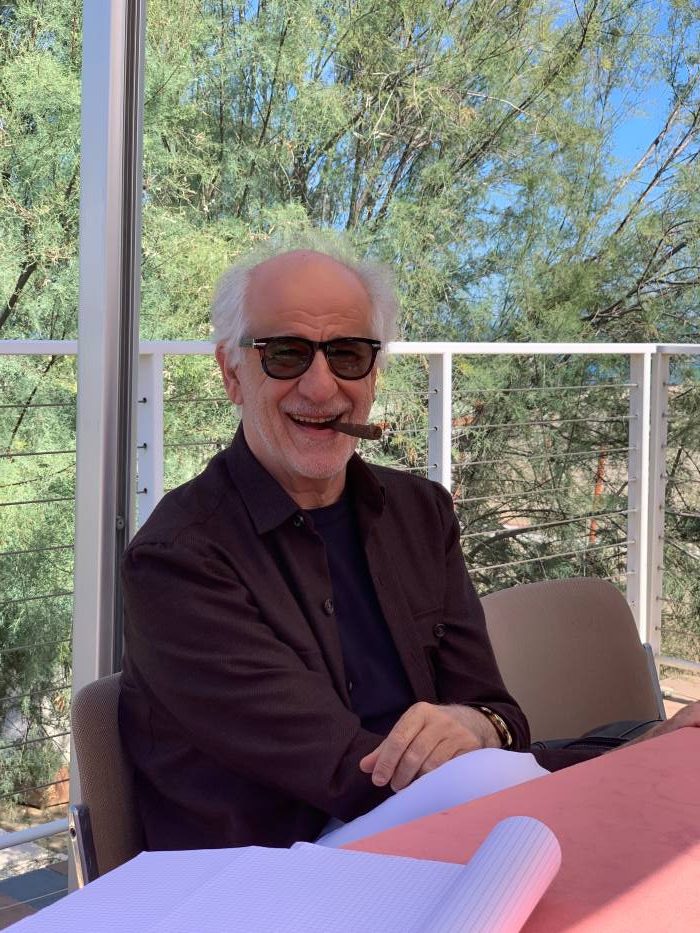
As if to prove the point, Servillo places his cigar into his mouth with great aplomb and has a long drag.
Are you a gangster?
“Yes! (chuckles) I smoke many cigars.”
The Hand of God is in cinemas now and will premiere on Netflix on 15 December 2021
