


by Travis Johnson
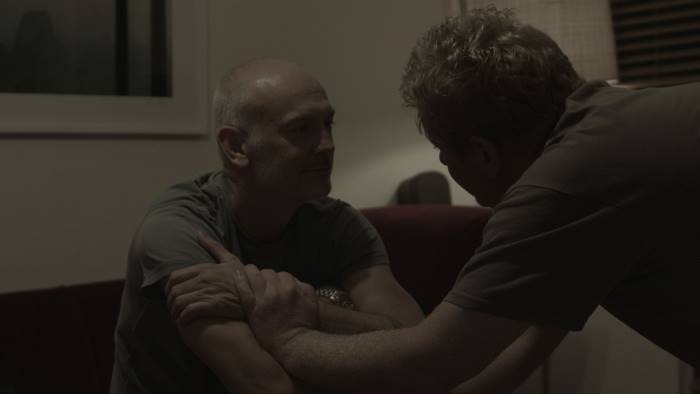
The lives of suburban couple Jeremy and Neets (Steve Rodgers and Anna Lise Phillips) are thrown into disarray with the return of an old friend, Simon (Cameron Stewart), who they haven’t seen for years. Simon is ready to grapple with a secret sin he shares with Jeremy, but Jeremy does not want to dig up the past, leading to a tense few days on the old bush block.
Closely observed and packed with strong, nuanced performances, The Land is a masterful piece of lo-fi drama.
We caught up with director Ingvar Kenne, and actors and co-writers Steve Rodgers and Cameron Stewart in order to explore The Land a little more closely.
How do you all know each other? What is your professional and artistic relationship?
Cameron Stewart (CS): I have known Greg [Ferris, producer] and Steve for over thirty years and Ingvar for twenty years now. Steve and I went through uni together and have acted in numerous plays and short films. I have also worked with Greg on many different film and art projects over the years. What binds us in an artistic sense is stories with an inclination to dark or challenging material. Our long experience of working together provided a good framework and shorthand to work unconventionally – fast, without funding and in challenging circumstances.
Steve Rogers (SR): Cam and I trained at Theatre Nepean in the late ‘80s and early ‘90s. We had known Greg for many years, working on various short film projects, before our kids went to primary school together. We met Ingvar through various theatre and film friends stemming back to Theatre Nepean in Sydney in the early 2000s. But primarily, our artistic relationships have been driven by being friends first.
What was the inception of The Land? How did this project start to come together?
Ingvar Kenne (IK): In 2004, I purchased a 75 acre property of forest surrounded by the Wollemi National Park. With our kids, we have always referred to it as The Land. Over about ten years I slowly built the caravan, roof, deck, and structures around it that became the ‘accidental’ film set. I had been friends with Steve and Cameron for years, and one weekend, I think as far back as 2011, we decided to head up to a bush block for dads’ time out.
Unbeknownst to me, they had been tinkering on a script for a couple of years prior and about three months after that weekend they came to me with a rewrite of their script without a title. Unofficially, we referred to it as “the land script”, and it kind of stuck.
A lot of the experiences from that weekend were written into the script. Some scenes made it, like the bush Olympics, and a lot fell away during script development or while shooting. Still, that weekend was undoubtedly a catalyst for Cameron and Steve.
Initially, as exciting as it was to start the process, I never really thought it would ever happen. For me, it felt like such a pipe dream with a massive “how?” attached to it. Coming from a photography background, I had no real prior experience in moving image, so I was way out of my depth. Six months later, Greg came on board. With his all-encompassing knowledge of filmmaking plus teaching and developing micro-budget projects with his students at UTS, I think we all could see that it could actually happen somehow. He was able to break it down as a realistic undertaking and pass on the know-how.
What dictated your approach in terms of using improvisation and the long shooting schedule?
IK: The script was written as scene breakdowns sans dialogue, either clarifying which part of the story needed progression or specific information we needed to part with. Sometimes, it only described character traits that we wanted to subtly flesh out over the course of the film’s narrative. We never really rehearsed any dialogue prior, wanting the first take to be as intuitive as possible, believing that would add to the realism.
We decided early on that we had to shoot this chronologically, which we ended up doing in most parts. At least we knew wardrobe, hair length and other continuity issues that could be referred back to. Being Swedish, I have always liked the light during those endless long summer nights when you lose track of time. Greg and I wanted to apply that look and use only available light, whether indoors or outdoors. It was a visual approach that, by chance, proved very useful in the editing suite.
What were the biggest challenges?
IK: Life dictated the pace we could move forward. This was a pet project outside other work and family life. We shot around 40 days over a year and a half or so. As taxing as it was to find time, those spaces in between became another blessing. The additional time to reflect, I think, improved the overall result for us.
On a practical level, a big challenge on the land was just the really harsh exposed conditions. There is no running water and no electricity. Locations we could often only reach by foot; each minute on screen took a long time to get out that way. And we didn’t have instant playback to hear crisp dialogue and see that all was in focus and whatnot; instead, we had to trust that what we just experienced could work. It was such a tremendous team effort.
Did the overall storyline change or grow over the course of production?
CS: The overarching storyline didn’t really change*, however many ideas and shot scenes ended up being scrapped or added to, something we wouldn’t have had the luxury of doing with a locked-off script and funded film.
SR: More details in the characters’ backstories probably didn’t make it into production, but the basic story arc is still in place, mirroring the initial treatment we imagined. The film’s end was constantly in flux. The story is mainly shaped by what you leave out, and we’re big fans of not saying everything or spelling out precisely what’s going on for a character. It means the audience must meet the work. In an age where drama increasingly makes the audience passive, we ask for reciprocity. The viewer gets to imagine and fill in the grey bits.
The performances are extremely naturalistic, convincing, and consistent. How did you approach performance and character, and how did you stay on track over the length of the production?
CS: We did a lot of backstory work on our characters, some shared and some not. Living in the moment and surprising each other, reacting instead of crafting or anticipating, was an essential part of our approach. The work of directors such as Susan Bier and Michael Winterbottom provided good examples in storytelling and the sort of performances that excited us.
SR: It was a long process of conversations and questions and building solid histories for each character, developed in conjunction with the story, so that we were able to get as close to the emotional life of the character before we’d even said a word. I guess the next trick was not seeing the characters as ‘other’ from ourselves, but rather extensions of who we were.
What are you hoping audiences take away from The Land?
CS: We never made The Land to provide answers, but we hope it throws up a lot of questions for people, not just of oneself, but on a broader level.
SR: It is a complex, nuanced adult excavation of people at odds with themselves and their environment, told with stunning cinematography.
What projects do you have coming up, either collaboratively or separately?
CS: Speaking for myself here, I’m about two-thirds of the way through my first novel. If I squint hard enough, I can just glimpse the end of it!
IK: This film is still consuming our time since we have to keep working on its journey as producers. Personally, it has probably been the hardest bit. The creative process of shooting it was the juice, cast and crew together doing exciting stuff.
There is nothing immediate ahead in regard to shooting a film for me. I have a lot of long form personal photographic art projects that I dedicate time to at the moment.
No funding is, of course, tough in so many ways; having cast, crew and post-production talent passionately helping out with their expertise and devotion. But looking back, it was a seriously unique ride. Friends with an idea collaborating, not answering to anyone but ourselves made it possible to make a film we wanted to do. I have realised how lucky we were to do a film in the way we did. Hard to believe the next film project will ever be on that level, uncompromising and free.
SR: I have a commission for a play I’ve just completed writing for Belvoir St Theatre and a feature film I co-wrote with Jub Clerc called Sweet As and produced by Arena Film who did The Dry, just finished shooting in the Pilbara in W.A.
Greg Ferris: Teaching, Research and my own creative practice. There are a couple projects I post-produced that are coming up at film festivals very soon. There’s a major new Immersive project premiering post lockdown that features performances by a number of the cast members of The Land.
The Land is playing online at the Sydney Underground Film Festival until Sunday, September 26. 2021. Go to the official site for details.
