



by Christine Westwood
Our first glimpse of Linda Radlett (Lily James) is of her pregnant body, naked except for a fur coat, sunbathing on a London rooftop. The scene is shockingly interrupted by the house being bombed. It’s World War Two and Linda and her lapdog escape unscathed in the rubble.
Linda is no stranger to living on the edge. Her very nature constantly puts her there.
In contrast, her cousin and best friend Fanny (Emily Beecham) lives cautiously, creating a stable life for her children and academic husband. The two women are opposite sides of the coin.
“She was a wild and nervous creature full of passion and longing,” comments Fanny, watching enviously from the sidelines.
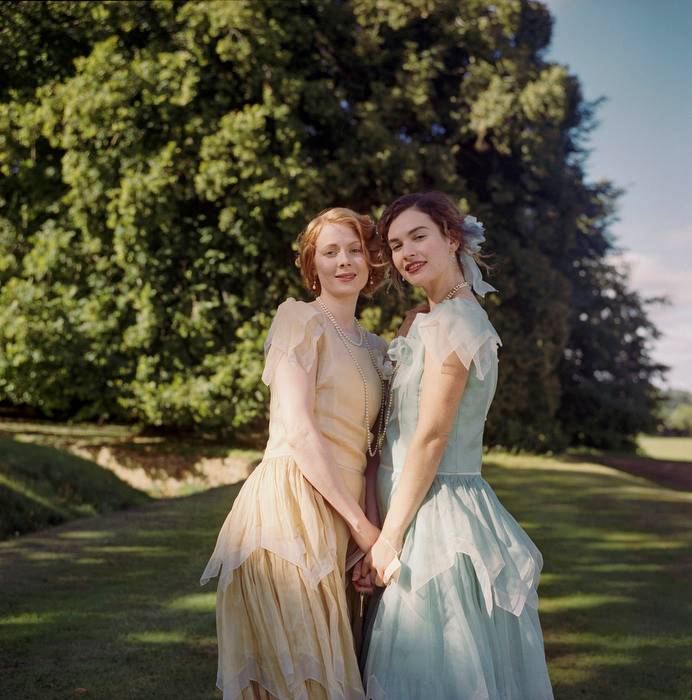
Nancy Mitford wrote a series of hugely successful novels, the most well-known being Love in a Cold Climate, from her own experiences growing up in 1930s and 1940s England. The Pursuit of Love was published in 1945, and is loosely based on her own experiences as the daughter of an eccentric English lord.
It was the era of emerging communism and the Spanish civil war and World War II, and she puts the wild passionate Linda front and centre in every scenario.
Underpinning the story is the feminist issue of how women can live and express themselves in a repressive culture that wants them to be reliable wives and mothers.
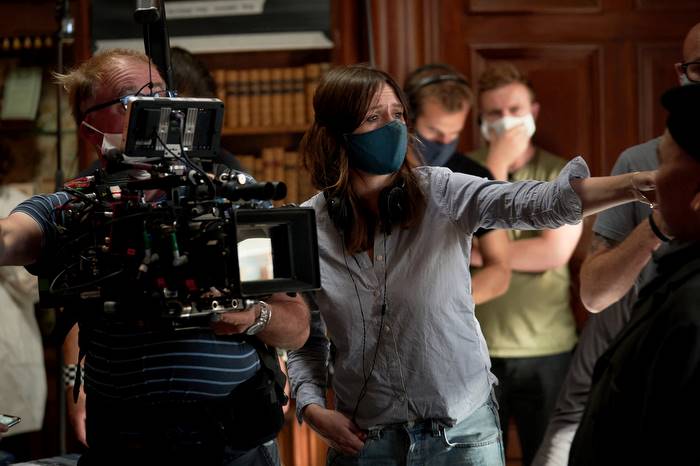
Emily Mortimer directs and writes with humour and intelligence. She also casts herself in the key role of Fanny’s mother, labelled a notorious ‘bolter’, as she leaps from one marriage to the next in her own pursuit of love.
The cinematic style has a touch of Wes Anderson, with captioned freeze frames of characters as they are introduced, and tableaux shots, often staged in front of the Radlett stately home, which highlight some of the more eccentric habits of the upper class family at the heart of the story.
Mortimer follows Sofia Coppola’s Marie Antoinette and the more recent steam punk romp Cruella, to add a rock soundtrack that reflects pop culture from a later era, including songs from TRex, Nina Simone and, as background to Linda’s society girl phase, Brian Ferry’s ‘In with the In Crowd’.
Restricted by her own nature and social roles, Fanny lives vicariously through Linda and it’s a great narrative device that she is the commentator on Linda’s wild, spirited life.
It would be easy for Linda to be deeply annoying. She lives in a world of superlatives and as Fanny records, “Nobody cried so much or so often”, but Lily James nails a totally convincing performance by throwing herself into every moment of every scene. No response, no emotion is held back or watered down.
The conservative Fanny is the perfect foil, and stands in for us, the viewer, as we watch Linda’s often mesmerising, sometimes frustrating crash course through life.
A point is made around the Radlett dining table that Fanny is educated while Linda isn’t, and what’s the point of educating girls anyway? The mouthpiece for the most extreme misogynist and racist comments is the patriarchal Uncle Matthew played to the red faced bombastic hilt by Dominic West. His ranting and blustering gives voice to the worst extremes of upper class mores that are being threatened by communism and all those ‘damn foreigners’. His bullying and periodic imprisonment of his daughter are chilling.
“An adulterous woman is the single most disgusting thing there is,” is one of his remarks.
It takes every bit of Linda’s wildness to fight back, though she ends up with no checks and balances in her bid for freedom at all costs.
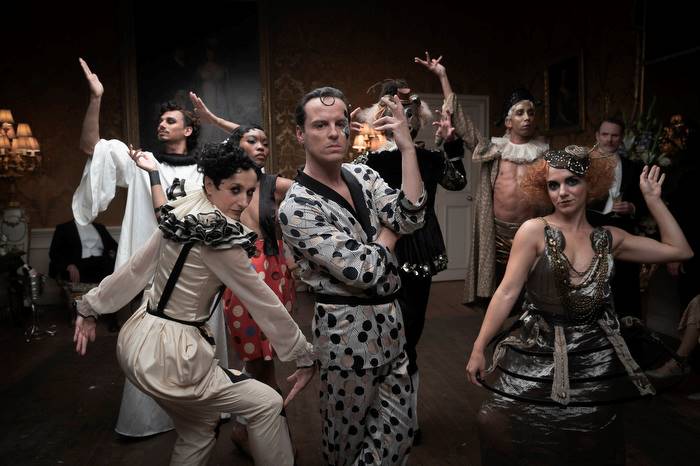
One ally is the cultured, gay neighbour Lord Merlin (who we first see in a risqué Dada (avant garde for the era) performance), whose own stately home has horses and whisky drinking dogs roaming around. Played by the ever charismatic Andrew Scott (Sherlock, Fleabag), Merlin is a scene stealer every time he turns up at key points in the story to comment and highlight.
Mortimer directs all her characters in a way that pushes them close to caricature, but relies on her actors to fill the roles with such energy that they become larger than life and with a few unforgettable moments.
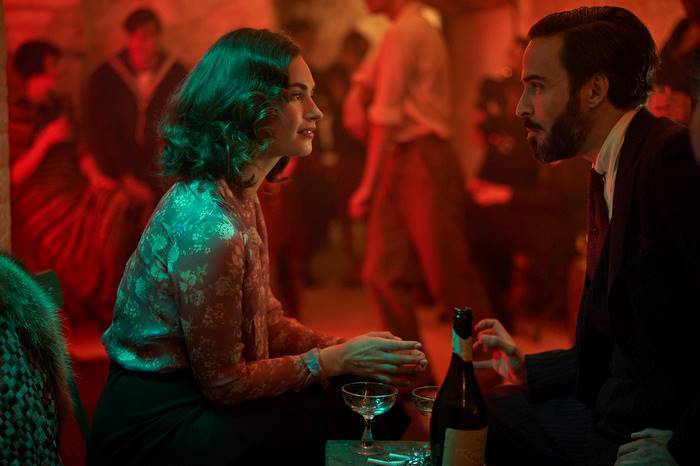
Australian James Frecheville is chiselled communist fanatic Christian Talbot who Linda gets caught up with as a complete contrast to her society girl phase, while Assaad Bouab (Call my Agent) is storybook European aristocrat Fabrice de Sauveterre, so charming and romantic as to make Linda’s Pursuit almost feasible.
Mortimer also saves some of the best lines for her own character, blending childlike and world weariness, turning up between marriages to utter Mitford style acid comments such as
“You shouldn’t let your children get in the way of your life.”
The costumes and sets are fabulous, the pace and editing impeccable. You have to hand it to the Brits to do full justice to costume drama, especially when adapted so intelligently from a great English classic. The BBC coproduced with Amazon Studios to make this smart three-part series and there is plenty of substance under the fun and games.
Mortimer told Vogue Australia she was initially wary of taking the project on. “I really love that book, but I’m not sure that the world needs another period drama right now about rich people.”
Luckily for us, she found the project was too good to resist.
“I read it again and I was like, ‘wow.’ Even more than I’d remembered, it just felt so fresh, and honest, and brave. And courageous in its honesty about the thorny business of what it is to be a woman, and how to make choices, and how to live your life.”
Apart from the social themes of women’s roles in society, the story’s heart is the deep friendship between women. It’s a particular passion for Mortimer. She created and co-starred in 12 episode HBO sitcom Doll and Em, where she plays herself as an actress trying her luck in Hollywood, closely followed by best friend Dolly Wells as her assistant.
Her skill in drawing the maximum characterisation and nuances from the two besties in Pursuit of Love is rich viewing. You can’t help empathising with both and appreciate their frustration and betrayals, decisions often resulting from struggling with the pressures placed on them.
As one of the relatives wisely comments on the generation of girls coming after, “perhaps women can be more than a Fanny or a Linda and be just who they are.”
The Pursuit of Love streams on Prime Video from July 30, 2021
