


by Gill Pringle
Out of six films released in cinemas this week, only one has a female director. The Darkest Minds, based on Alexandra Bracken’s YA novels and featuring a strong female lead played by Amandla Stenberg, it should be a no-brainer to hire a female filmmaker to lead the charge, however, that isn’t often the case.
“If there isn’t action nothing really changes,” says Jennifer Yuh Nelson, who comes to the film after making a name for herself as the director of Kung Fu Panda 2 and 3. “The source of that action, the people hiring the people, that’s where the action comes from. It’s not about people storming in, kicking down doors and demanding things, although that has its place too. You can only get so far. The attitude of ‘I’m going to be open, I’m going to think about considering candidates that are maybe not the first thing I thought of a second ago’, that opens the door that allows people to have a chance. And if they can have a chance they can at least prove they can do the job.”
How is animation different to film?
Definitely more physical. The pre-production is pretty much the same. But the actual production, where you’re out shooting is a totally different animal. I was very fortunate I had a great team to help me to understand what was happening. And my DP [Kramer Morgenthau] is fantastic. He and I communicated so well, my first AD [H. H. Cooper] was so very helpful; we basically had this team that were so good at helping me understand what’s going on and reading what I wanted. One of the examples was – one thing I was really worried about, I always see the director walking around and yelling and pointing and doing things really loud. And I literally am physically unable to yell that loud for more than a couple yells. Because it blows my voice. So, I’m never going to be the one that yells action across set. And the first AD figured out this hand signal system. I mean, even animation… I don’t know how to animate. There are many, many great artists who know how to animate very, very well. And I’m not going to sit there and say, animate with this button. My job is to get people who are very good at their job to do their job the best they can. So, that’s the same thing and onset, I quickly had to understand what everybody did and what everybody needed from me at that moment. And then I had to give it to them. It was daunting and very physical.
And from that process, what surprised you?
How organised everything was. When you see sets, usually it’s chaos and everybody’s running around, and things are moving, and wires are flying and stuff like that. But to see just how militantly organised every moment is, it’s like some crazy choreographed parade, it’s amazing. And again, how physical it was. The first AD told me before we started, to work out. He said, just work out hard during prep because you’re going to be on your feet running up and down hills all day for months; you’re just going to collapse if you’re not fit. And so, I was working out like crazy. And when it was like three or four in the morning, and you’re standing in the rain with mud boots on and out in the field, and there’s flames flying everywhere, and you’ve been standing for 10 hours, I thought, I’m so glad I worked out my abs.
What was it like for you to come on board something that could potentially be a franchise?
I’m used to working in a franchise. But no matter whether it’s a franchise or not, I always focus on making one movie at a time. That movie has to be the one in front of you right now and has to be satisfying. There’s four [books] now, so there’s an ongoing thing of these characters that are alive in the world, but I only focus on one movie at a time.
What is the message that you hope the audiences will take away from the film?
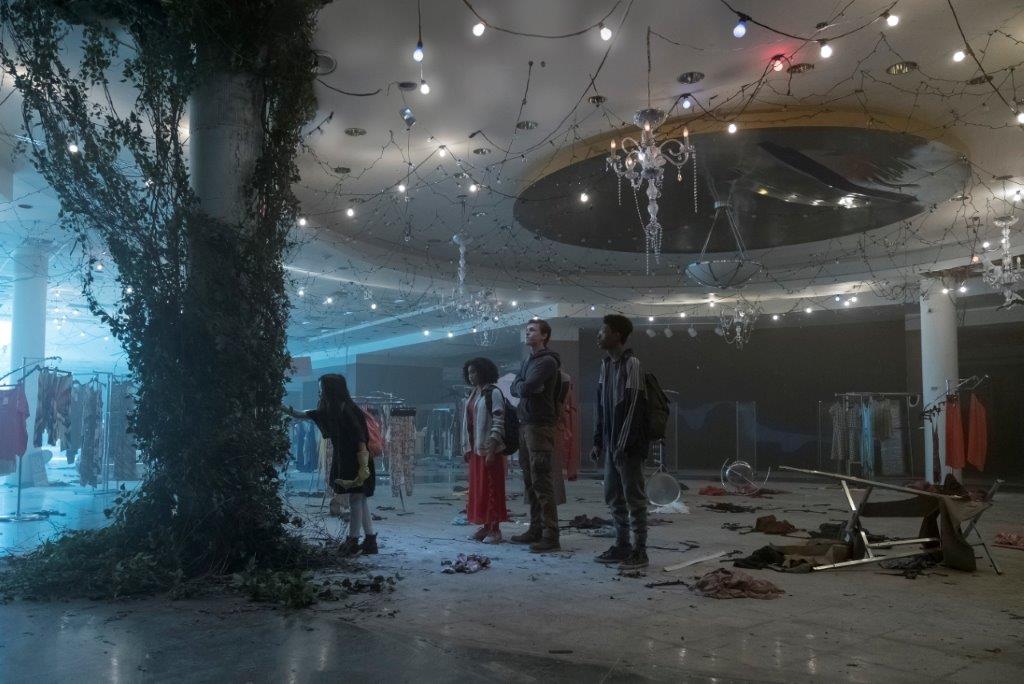
I want them to feel empowered to affect their own destiny. I think that a lot of these movies are kind of depressing in some ways. And I think that I want people to leave the film feeling like they’re empowered to do something, that no matter what/who/where they are and what they find negative about themselves, that stepping forward and being confident and powerful is something that I want people to come away feeling.
Why are these types of films so powerful?
I think because in some ways, these books and these stories focus on them solving their own problems. In real life I think people feel very disempowered. They feel like they don’t have a voice. They don’t have money, they don’t have a driver’s license, they don’t have the means, and to see a way for them to feel like they are the captains of their own ship, I think that is something that would really resonate to anyone in that particular case. It shows them being the captains of their own ship.
Was Gwendoline Christie someone you really wanted for this?
Yeah, Lady Jane’s on briefly, but powerfully. She has to have an immediate presence of danger and threat. She’s such an amazing presence. And I love the idea that she was so tall. And yet she’s on her knees in front of Amandla. I love that moment. And I was thinking that when I first read those pages, and then seeing them actually portray it that way, I thought that’s cool. Gwendoline’s just such a sweet human being. And she was amazing onset, always game to do anything. Oh, she laughs like crazy. She’s really, really giddy and upbeat, super open. You think that character in Game of Thrones is just very stoic and just a robot kind of thing. But in real life, she’s super bubbly and wonderful.
What difference in your opinion does it make having a female presence on a set?
I think that one of the nice things that happened was there are several senior folks on the crew. People that have been working for 40 years. And they said to me, they had maybe worked with one woman director the entire time, which was TV, it wasn’t a feature. Basically, these are good guys working on a lot of great stuff. And they report to the woman and they tell me that they are surprised and heartened by the fact that it made no difference. They said they thought it would be a different situation. It wasn’t. If anything, they said it was perfectly nice and organised. And, they had a good time. So, I think that’s a good positive thing. The more people realise it’s not earth shatteringly different on set, it’s just someone doing their job, is a good thing.
The Darkest Minds is in cinemas August 16, 2018
Read our interview with The Darkest Minds star Amandla Stenberg.
