



By Jarrod Walker & Erin Free
“You usually find your personal changes reflected in the choices that you make,” Mel Gibson told FilmInk in 2009. “In some ways, I’m a lot better, because maturity brings things out. But in some ways, I just wish that I had that youthful spring again…but it’s a trade-off, right?” After all the negative publicity that he’s been blitzed by over the years, Mel Gibson is justified in longing for the high-gloss finish of his glory days. From 1980-2000, Gibson really shone in the likes of Gallipoli, Mad Max 2, Ransom and the Lethal Weapon films, but his greatest, most controversy-free triumph remains 1995’s Braveheart, his second directorial effort. Sure, 2004’s The Passion Of The Christ made more money and got a lot more attention, but it also brought a storm of protest. Yes, some quibbled with the historical accuracy of Braveheart, but the film’s five Oscar wins (including gongs for Best Film and Best Director) and impressive box office haul more than made up for that.
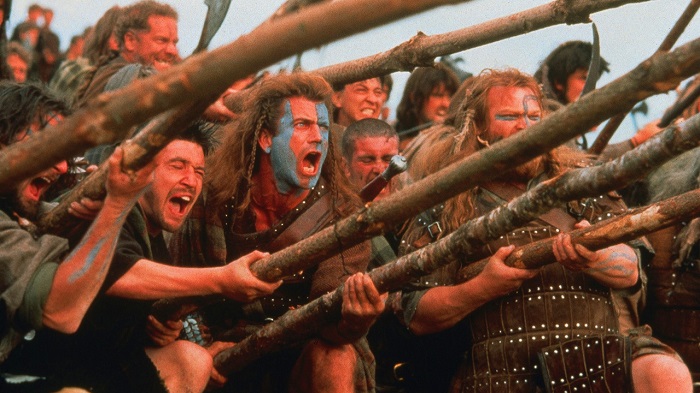
Back when his name wasn’t synonymous with drunken roadside rants, Mel Gibson proved how great he could be with this alternately brutal and sentimental historical epic. The much-loved classic is set in thirteenth century Scotland, where the occupying English King, Edward The Longshanks, (Patrick McGoohan), dominates the land. It’s into this oppressive atmosphere that William Wallace (Mel Gibson) returns to his highland home and his roots; he’s a man who hopes to marry and raise a family, but it isn’t to be. After violent provocation, Wallace is compelled to rise up against a cadre of English soldiers in a brutal skirmish, and then as more Scots join his uprising, he becomes a living legend, leading his countrymen to victory in a battle for their independence. With more than a slight nod to Spartacus, Gibson improves upon Randall Wallace’s straightforward script with flare, even-handed sentimentality, and a predilection for brutal violence. “We couldn’t put a lot of the stuff that we filmed on the screen because you’d look at it and go, ‘Arrrggh, that’s too much,’” Gibson told FilmInk in 2009.
What is most remarkable is the film’s emotive, strident heart. It’s a testament to Gibson’s skill as an actor and director that the film successfully carries off its dark violence as well as its romance without missing a beat. “It wasn’t necessarily authentic,” Gibson said. “We romanticised it to make it cinematically acceptable. The real William Wallace certainly had his faults, but we shifted the balance of it, because somebody’s got to be the good guy and the bad guy. We’re talking about big things here: love, hate, passion, death…Braveheart really took a lot out of me. It just about killed me. I couldn’t even talk for about a month afterwards.”
Blood Father is in cinemas now. Braveheart is available now on DVD and Blu-ray.
