



by Nataliia Serebriakova
Worth: $18.40
FilmInk rates movies out of $20 — the score indicates the amount we believe a ticket to the movie to be worth
Cast:
Swann Arlaud, Sandrine Blancke, Mathieu Perotto, Jean-Baptiste Marre
Intro:
Marre constructs the film out of light, almost weightless moments that repeatedly collide with the dead end of history.
It must be particularly difficult to make a biographical film when the protagonist is your own great-grandfather. Yet Emmanuel Marre manages to do exactly that in A Man of His Time (Notre Salut), which won the Best Screenplay award at Cannes. What makes the achievement even more remarkable is that Henri Marre is hardly an unambiguous or heroic figure. On the contrary, he is a morally compromised man whose political convictions gradually led him into collaboration with the Vichy regime.
The film opens in September 1940, when Henri (Swann Arlaud) arrives in Vichy with his self-published political treatise Notre Salut (Our Salvation), convinced that he can contribute to France’s recovery after its defeat. He moves from one group of people to another at a party, making small talk and occasionally trying to enter political discussions. Women laugh and drink champagne; but advise him to keep his opinions to himself. At the end of the evening, Henri wraps a piece of meat in a handkerchief and disappears into the night.
His ambition is to find a place in the new administration. A supporter of Philippe Pétain, he sees the Vichy government as an opportunity to put his ideas about efficiency and national renewal into practice. He eventually obtains a position within the administration responsible for unemployment, the census and the placement of foreign workers.
Over its two and a half hours, A Man of His Time follows Henri’s gradual rise through the bureaucratic hierarchy. But Marre’s film is much more complicated than a conventional historical biography. Its structure and visual language constantly undermine the expectations of a period drama.
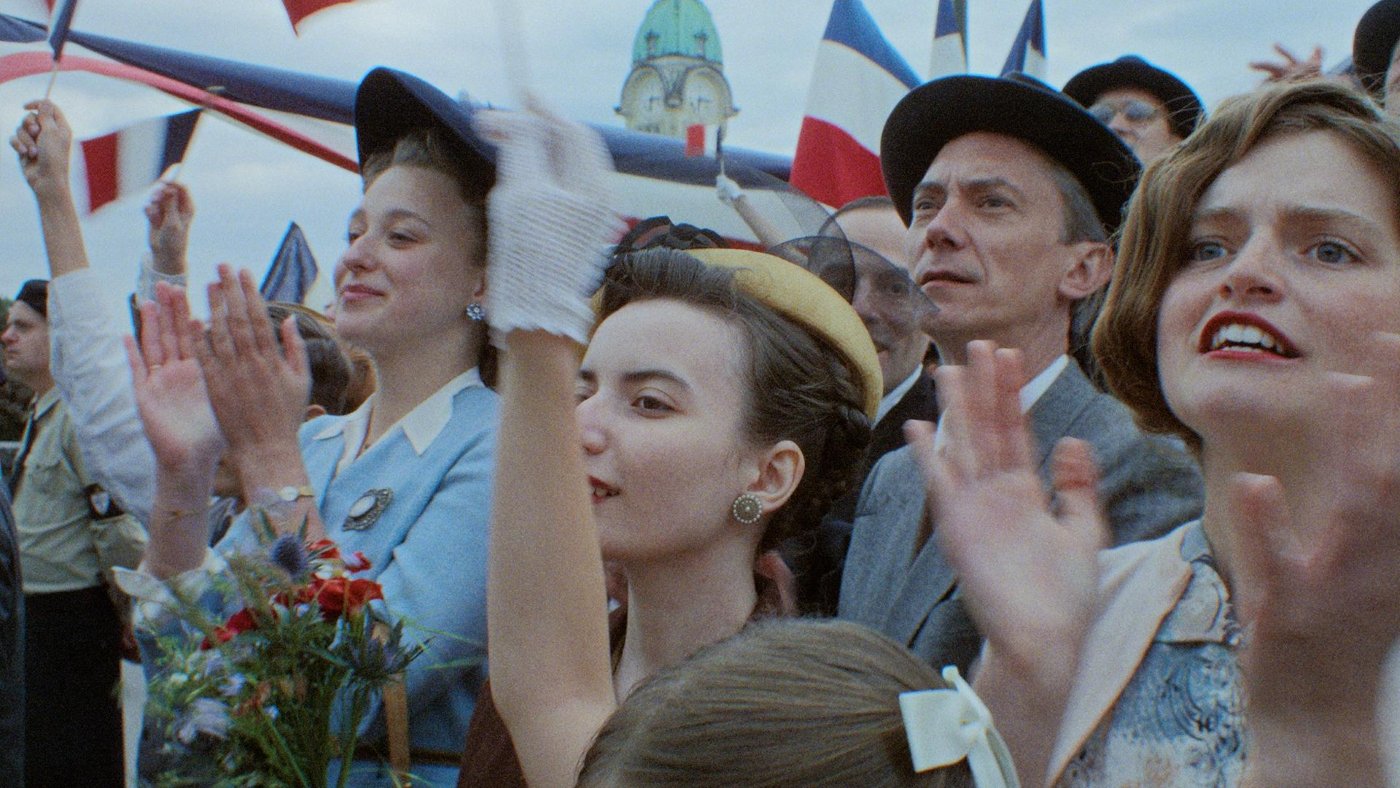
The opening party, for instance, is filmed with a restless handheld camera and sudden zooms, at times resembling a mockumentary rather than a historical reconstruction. There is almost nothing conventionally “period” about the way the scene feels. The sets, costumes and interiors have clearly been meticulously recreated, but they are presented with such elegance and immediacy that the film initially seems to belong to the present rather than the 1940s. The image itself has a documentary quality, with an almost hyper-real texture.
Marre also occasionally interrupts the reconstruction with archival footage and deliberately anachronistic pop music. One sequence pairs historical images with Opus’s “Live Is Life”; elsewhere we hear Alphaville’s “Sounds Like a Melody” and “Popcorn”. The effect is disorienting but purposeful. Marre has explained that he wanted contemporary audiences to feel the energy of the period rather than simply hear music that would have been popular at the time.
The film’s real surprise, however, lies in the space it gives to Henri’s private life. The story is inspired by the correspondence between Marre’s great-grandparents, Henri and Paulette, whose wartime letters became one of the film’s central sources.
Paulette, played by Sandrine Blancke, eventually joins Henri with their three children once he has managed to establish himself professionally. Before that, the film periodically lets their letters take over the soundtrack. A male and female voice read their correspondence, creating an intimate counterpoint to what we see on screen. Paulette is frustrated by the choices she has made and admits that she cannot simply fall in love with somebody else, even though that might be more practical. Henri, meanwhile, keeps his distance, insisting that he does not yet earn enough to support his family.
Even when the family finally comes to live with him, their difficulties do not disappear. Paulette is not merely the dutiful wife of a politically ambitious man. She has her own personality, opinions and history. At one point, she refuses to wear a dress that Henri has chosen for an important reception, a small act of resistance that reveals how little control he actually has over his private life.
This parallel story makes the film considerably richer. Henri’s professional ascent is not simply the story of a man gaining power. It is also the story of a husband becoming increasingly absorbed in his political and professional ambitions while his family remains at a distance. The letters allow Marre to place the historical figure beside the private man – and to show that the two are not necessarily the same person.
What makes A Man of His Time particularly unsettling is that Marre does not turn his great-grandfather into a monster. Nor does he excuse him. Henri is a collaborator, and his work within the Vichy administration eventually becomes connected to the machinery of persecution and deportation. The film is interested instead in the gradual process through which an ordinary, ambitious bureaucrat becomes implicated in a criminal political system.
In this sense, Henri is presented almost as an adventurer – a man obsessed with the political idea that he can make himself useful, important and respected. The film’s final credits add another layer to this personal history, reminding us that what we have just witnessed is not simply a historical reconstruction but an encounter with the director’s own family past.
And yet A Man of His Time is not relentlessly dark. Marre constructs the film out of light, almost weightless moments that repeatedly collide with the dead end of history. There is the absurd episode in which Henri secretly transports a Persian cat for a minister. There are moments of tenderness between Henri and Paulette, including a late scene in which they eat peaches by the river, almost as if they were meeting for the first time. These fleeting moments of pleasure coexist with hunger, rationing, political violence, fascist marches and the persecution of Jews.
A Man of His Time is not a conventional biopic, and not really an attempt to rehabilitate its protagonist. Its most disturbing idea is also its simplest one: the people who sustain a destructive political system do not necessarily look like villains. Sometimes they look like ordinary men trying to find a place for themselves in a changing world.
