


by Shahran Morshed
Worth: $13.00
FilmInk rates movies out of $20 — the score indicates the amount we believe a ticket to the movie to be worth
Intro:
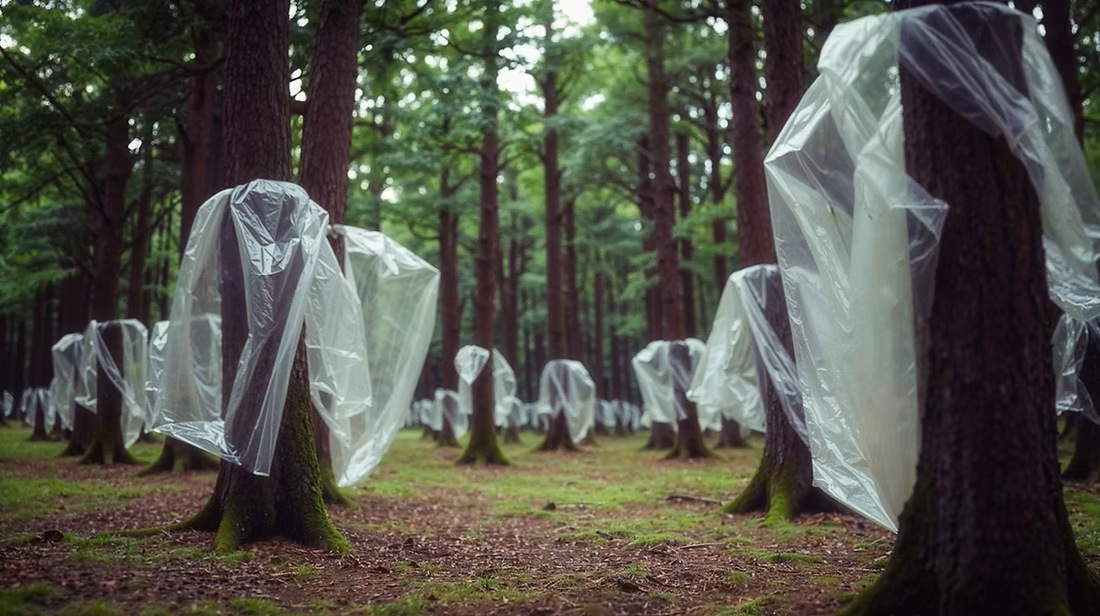
Its images can be beautiful, uncanny or disturbing, but that beauty often feels slightly suspicious.
There may be no form in cinema as open and versatile as the documentary. It can observe, investigate, remember, reconstruct, manipulate, question and even invent. It can move between journalism, poetry, archival work, fiction and essay without fully belonging to any of them. Alkan Avcıoğlu’s Post Truth understands this freedom and pushes it into unfamiliar territory.
The film begins with a line from Elias Canetti: “Without noticing it, all mankind suddenly left reality.” It is a fitting beginning for a film made entirely with AI-generated images, because the question that slowly emerges is not simply whether we have left reality, but whether we still know what reality looks like.
Post Truth is a documentary about the world we live in, yet almost everything that traditionally gives a documentary its authority has been made uncertain. There are no conventional interviews, no archive that can simply be trusted, and no photographic image that arrives as unquestionable evidence. Avcıoğlu creates every frame through artificial intelligence, building a world that constantly shifts between the familiar and the impossible.
This could easily have been nothing more than a technical exercise, a showcase of what AI can produce. Instead, the method becomes inseparable from the subject. The film uses artificial images to look at a world already full of artificial images, where politics, advertising, social media, war and entertainment increasingly compete for our attention through the same visual language.
What makes Post Truth interesting is the way it puts the viewer inside that uncertainty. We see images that look like evidence, although we know they may have never existed. A face can belong to nobody. A crowd may never have gathered. A photograph can document an event that happened only inside a machine.
Photography once carried a particular kind of authority because something had to stand in front of the camera. That assumption has become much harder to hold. Avcıoğlu connects this problem to a longer history of images and ideas, drawing on the essay-film traditions of Chris Marker and Adam Curtis, while the movement of images and sound sometimes recalls the sensory cinema of Godfrey Reggio. But the technological moment here is different. The archive is no longer only something we discover. It can now be generated. This gives the film a strange Baudrillardian quality, where the copy can become more convincing than the original.
The problem, however, is not only that machines can fabricate images. Human beings have already created a culture where fabricated images are easy to believe. On social media, news, propaganda, advertising, entertainment and personal memories often appear in the same stream, carrying almost the same visual authority. Post Truth captures this through its own excess. Its images can be beautiful, uncanny or disturbing, but that beauty often feels slightly suspicious. We have become used to images that look too perfect.
The film is strongest when it leaves this uncertainty open. AI can reproduce the surface of an image with remarkable speed, but reproduction is not the same as understanding. Some of the film’s ideas, particularly around misinformation, deepfakes and alternative facts, can feel familiar because these subjects have already become part of everyday conversation. At times, the film also gives us so many references and ideas that its abundance becomes part of the problem.
A documentary about information overload can itself become overloaded. Still, that is also where the experiment becomes most convincing. Avcıoğlu is not simply asking what AI can do to cinema; he is asking what happens to documentary cinema when the camera no longer needs something to stand in front of it.
If an image can be produced from language, memory or statistical prediction, then perhaps the relationship between the camera and reality has already changed.
Post Truth does not offer a simple answer, and its value lies partly in refusing one. What remains is the uneasy feeling that we are surrounded by more images and more information than ever, while becoming less certain about what any of them actually prove.
Perhaps we did not leave reality in one sudden moment, as Canetti suggested. Perhaps we left it slowly, image by image, until the difference between the real and the manufactured became difficult to notice. Post Truth does not tell us how to return. It asks whether we can still recognise where we came from.
