



by Dimitri Feiman
Australia has been making video games for many years. Today, its gaming industry is growing and reaching more players around the world.
Australian Games Can Find a Global Audience
A studio in Melbourne or Adelaide does not need to depend only on Australian players. Digital stores have changed that.
A small Australian team can make a game and sell it to players around the world. They can sell it online through PC and console stores.
This has helped Australian game exports grow. In 2023, their net worth was more than AU$323 million. That is a big number, and local studios can see the potential market is pretty big.
Game Development Needs More Than Programmers
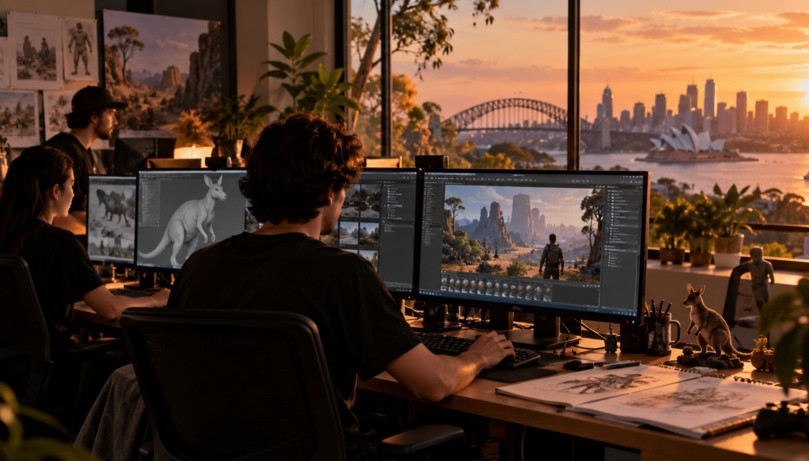
When people think about making games, coding is often the first job that comes to mind. It is only one part of the process. A modern game may need people working in areas such as:
- Programming
- 2D and 3D art
- Animation
- Writing
- Music and sound
- Character design
- User interface design
- Marketing
- Production
- Quality testing
Someone who studied animation might work on a game instead of a television show. A composer can write music for an interactive world. Writers may create dialogue rather than a film script. The borders between creative industries are becoming less clear.
Skills Can Move Between Industries
Game development also teaches skills that are useful outside entertainment. A 3D artist might later work in architecture. A programmer could move into software development. Animation skills can be used in advertising, film, education, or virtual production.
The movement goes both ways. People who have worked in film, graphic design, music, or technology can bring their experience into games.
Recent Screen Australia research shows how wide this connection has become. More than half of surveyed games workers earned some income outside the games sector, including from computer systems design, advertising, finance, and mining-related work. That makes game development part of a much larger creative and technical network.
The Digital Games Tax Offset
One major change has been the Digital Games Tax Offset. Eligible projects with budgets above AU$500,000 can access a 30% tax incentive. The federal government has also provided funding through Screen Australia for smaller and medium-sized developers.
Support does not remove the commercial risk of making a game. A finished title still needs to find players. It can, however, give developers more room to build projects for the best australian online casino in Australia.
Local Stories Have Another Place to Grow
Australian creativity does not always have to look obviously Australian. A game does not need kangaroos, the Outback, or the Sydney Opera House to have been shaped by local artists.
Culture can appear in quieter ways. Humour, landscapes, language, music, or even the way a story is told can tell a lot about the culture. Since the audience takes part in the games, it gives them something more than film and television can offer. A player explores the world rather than simply watching it.
Growth Does Not Mean Everything Is Easy
Game development remains a risky business. A studio can spend years on a title without knowing how well it will sell. There is also enormous competition. Thousands of games appear on digital stores, and getting noticed can be difficult.
Small developers face several common problems:
- Finding enough money to finish development.
- Hiring experienced staff.
- Getting attention in crowded online stores.
- Marketing a game internationally.
- Keeping a studio running between releases.
Ownership is another issue. Screen Australia reports that smaller screen and game businesses can find it difficult to keep the long-term value of the intellectual property they create, especially when working with large global platforms and partners. A game can be successful without making its original studio financially secure for years.
The Benefits Can Spread Beyond Games
A stronger game industry does more than produce entertainment. Studios hire artists. They buy technology and professional services. Developers gain skills that can later move into other sectors.
Successful studios may also train the next group of Australian creators. A junior artist gets their first job. A few years later, they have enough experience to lead a team. Eventually, they may start a studio of their own. That is how a creative industry develops depth.
