


by Bianca Jimenez
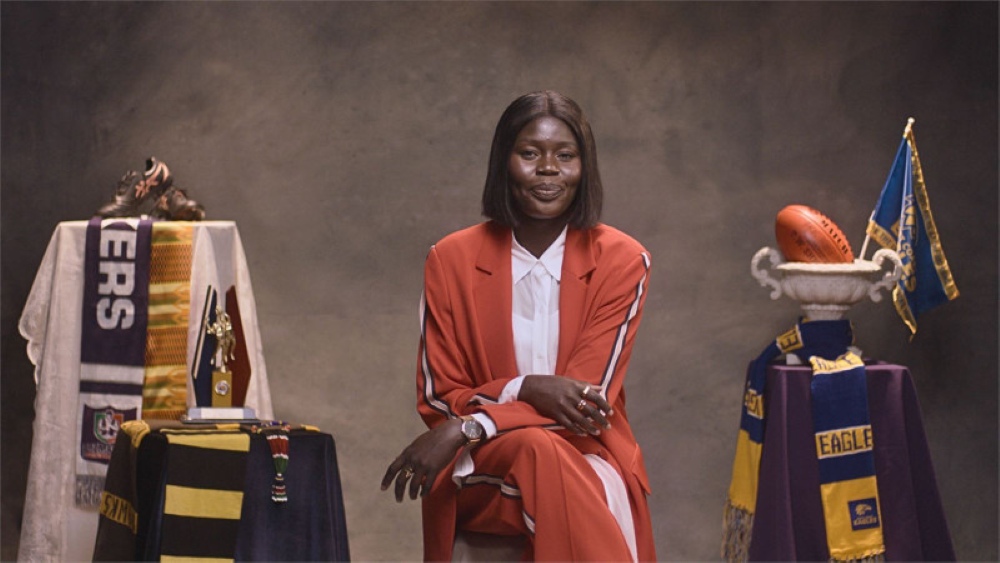
Former AFLW trailblazer Akec Makur Chuot is premiering a short documentary at the 74th Melbourne International Film Festival, marking a significant turn in a life already defined by firsts. The film, titled Kura: An African AFL Story, is part of the 2026 Footy Shorts program and screens during MIFF’s August 6–23 run, with Makur Chuot’s Wednesday night premiere among the season’s more anticipated documentary events.
A Footballer Who Made History, Now Making Film
Makur Chuot became the first African woman to play AFLW, a distinction that set the tone for a career that would span three clubs and 40 games. She played for Fremantle, Richmond, and Hawthorn before retiring at 33, and the years since have been anything but still. She completed a business degree, worked in media, and built a presence as a keynote presenter. Filmmaking, it turns out, is the next chapter.
Kura: An African AFL Story was made possible through Footy Shorts, an initiative developed jointly by VicScreen, the Melbourne International Film Festival, and the AFL. The program is designed to give emerging Victorian screen storytellers a structured path into documentary production, offering each team a $25,000 production budget, professional development with industry mentors, and access to the AFL’s footage archive along with support from clubs. Makur Chuot serves as writer, director, and producer on the film, with Meg Duncan as co-director and producer.
According to AFL.com.au, the 2026 Footy Shorts slate receives its gala world premiere at MIFF, with five films representing distinct corners of AFL community life. Makur Chuot’s film arrives as perhaps the most personally rooted of them all, drawing on her own experience as a refugee from South Sudan whose mother moved the family to Perth when she was 12 years old.
AFL Fan Culture and the Players at the Centre of This Story
The Live Sports Odds editorial team, longtime followers of AFL and its surrounding fan culture, note that the players featured in Kura are not peripheral figures. Isaac Quaynor lines up for Collingwood, Mac Andrew suits up for Gold Coast Suns, and Elaine Grigg plays AFLW for the Western Bulldogs. These are active players in clubs whose matches carry real weekly weight for their supporters. Fans check sports betting odds to track the storylines and fixtures around exactly these clubs and these players, making the film’s subjects part of the living conversation of the current AFL season rather than figures of historical distance alone.
“It’s really an identity piece. How do we as African Australians, come here and find our belonging? We found it through footy, which in our culture, in our language, we call it kura.”
That cultural weight is precisely what Makur Chuot set out to capture.
Kura, Belonging, and a Generational Arc
The word “kura” is the African term for football. It is also the film’s organising idea. Makur Chuot built the documentary around a central question — how African Australian players found belonging in Australia through the game — and she pursued that question across generations.
Her subjects include Quaynor, Andrew, and Grigg, players who represent the current generation of African Australians in AFL competition. But the film reaches further back, to the players who came before them.
“I also saw people like Héritier Lumumba and Majak Daw paving the way and making their mark in the game,” Makur Chuot said. “How did they come to feel like they belonged? You know, how did they use footy to do that?”
That generational thread gives Kura a scope that extends well beyond a single player profile. The five films in the 2026 Footy Shorts program together cover Chinese-Australian Rules players, Australia’s first openly queer ex-AFL player, the Rumbalara Football and Netball Club and the Yorta Yorta community, and the North Melbourne Cheer Squad. Each approaches AFL community life from a different angle. Makur Chuot’s contribution approaches it from the inside, the filmmaker having lived the very story she is telling.
Tears on Set and a Filmmaker Looking Forward
The most affecting day of production came while filming Mac Andrew’s family. His parents learned to be goal umpires and volunteered at the club canteen to support their son’s career. Watching them, Makur Chuot found herself thinking of her own mother, the woman who moved the family from South Sudan to Perth and backed her daughter through a football journey that not everyone in their community immediately understood.
“I got really emotional during the filming that day,” Makur Chuot said. “I was just so inspired by how parents can be so selfless. You know, they’re trying to figure out this country themselves, but then they were like, our kids love this game. They wanted to contribute, so they learned how to be a goal umpire, they put their hands up to volunteer at the canteen. Just really just beautiful, wholesome things.”
The connection to her own story was immediate. “I would not be here today without my mother,” she said.
Ahead of the MIFF premiere, Makur Chuot reflected on the production process with warmth and evident relief. “I’m just so proud of our whole team. I’m just so grateful to Meg. Meg really was just the driver in ensuring we got everything done in time.” Since retiring and building her post-football career through a business degree, media work, and keynote speaking, she has moved steadily toward creative production. The documentary, it seems, has confirmed a direction.
“I think there is a space for somebody like me and others to be making more films and more documentaries and other things,” she said. “We made the first one, why stop now?”
Kura: An African AFL Story screens during MIFF’s run through August 23, 2026, and Makur Chuot’s intention is clearly to keep the camera rolling long after the festival closes.
