



by Nataliia Serebriakova
Worth: $16.00
FilmInk rates movies out of $20 — the score indicates the amount we believe a ticket to the movie to be worth
Cast:
Olivia Wilde, Seth Rogen, Edward Norton, Penelope Cruz
Intro:
… wise and finely observed comedy of relationships …
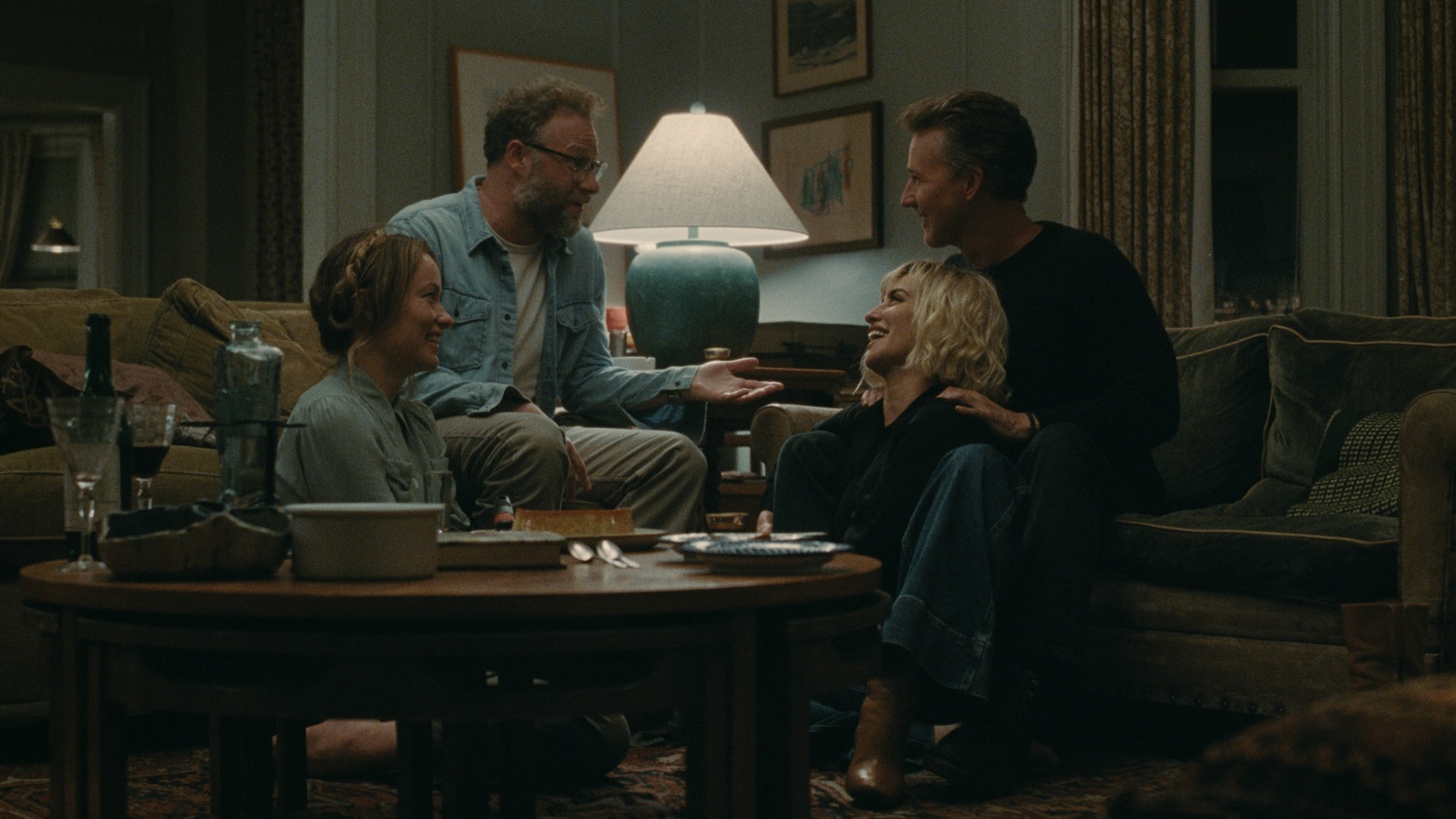
Joe (Seth Rogen) and Angela (Olivia Wilde) are a couple in their forties who have recently moved into Joe’s parents’ former apartment. While Angela paints the walls, buys curtains and cushions, and tries to rebuild a sense of home from scratch, Joe spends his days teaching at a small music school. One evening, he returns home and collapses onto the floor from exhaustion — a gesture that feels less like an exception and more like a well-rehearsed routine, one of many small rituals in their ongoing, low-grade domestic conflict.
That same evening, however, Angela announces that they are hosting their upstairs neighbors, Hawk (Edward Norton) and Pina (Penelope Cruz), for dinner. Joe is far from thrilled. For months, he has been driven to irritation by the couple’s loud, unrestrained sexual life, which seeps through the ceiling. Yet when Hawk and Pina finally appear at the door, the evening takes a turn that neither Joe nor Angela could have anticipated.
This is Olivia Wilde’s most confident directorial effort — not only a demonstration of her skill as a filmmaker, but also a reminder of her precision as a performer. She carries many of the film’s key moments through subtle facial expressions, controlled gestures, and carefully calibrated reactions, allowing tension to build in the smallest shifts of body language.
What follows is a tightly constructed escalation in which politeness gives way to confrontation, and humour gradually exposes deeper fractures. Wilde’s direction resists theatrical inertia. Rather than staging the film as a static exchange of dialogue, she fragments space through mirrors, doorways, and partial viewpoints, creating a constant sense of observation. The audience is never simply watching the dinner; it is eavesdropping, intruding, assembling emotional truths from angles that feel almost illicit. This visual strategy reinforces the film’s thematic core: intimacy is never fully private, and relationships are always, to some degree, performed.
What distinguishes The Invite from more conventional relationship comedies is its refusal to treat sex as either punchline or solution. The film flirts with the grammar of a more explicit, even provocative narrative, but repeatedly pulls back—not out of timidity, but out of curiosity about what lies beneath desire. As the evening unfolds, it becomes clear that sexual dissatisfaction is not the root problem but a symptom of something more structural: neglect, miscommunication, and the quiet erosion of shared meaning.
The neighbours are not simply provocateurs, but mirrors reflecting what Joe and Angela have lost — or perhaps never fully understood.
By the end, the film arrives at a conclusion that feels both restrained and quietly profound. It suggests that relationships are not sustained by desire alone. Instead, it is love, friendship, shared experience, and the ability to truly see and hear one another that ultimately endure. In this wise and finely observed comedy of relationships, sex loses its centrality, giving way to something deeper and more lasting — a form of intimacy built not on intensity, but on understanding.
