


by Morena Forster
Have you ever sat through the closing credits of a modern video game and felt like you’d just finished a marathon session at the cinema? It’s a feeling many of us are getting more frequently these days. The line between what we watch on a big screen and what we play on our consoles has become incredibly blurry; so much so that it’s often hard to tell where the film ends and the game begins. This isn’t just a happy accident of better graphics, either. It’s a fundamental shift in how stories are told, funded, and shared across different types of media.
For a long time, movies were the “prestige” medium while games were seen as a bit of a niche hobby. But the tables have turned. We’re now living in an era of transmedia storytelling, where a single story might start in a cinema, expand through a television series, and find its most immersive expression in an interactive digital world. It’s a bit of a whirlwind, but for anyone who loves a good story, it’s an incredibly exciting time to be paying attention.
The Policy Shift: Analysing Screen Australia’s Pivot to Digital Games
One of the clearest signs that games have “arrived” in the cultural mainstream is how governments are putting their money where their mouth is. Take Australia, for example. Historically, Screen Australia was almost entirely focused on traditional film and television. If you were making a gritty drama or a quirky comedy for the silver screen, you could look for state support. If you were making a game, you were largely on your own.
That’s changed significantly over the last few years. The introduction of the Digital Games Tax Offset (DGTO) and the “Games: Expansion Pack” funding stream marked a massive pivot in policy. It’s a recognition that digital games aren’t just toys; they’re a vital part of the creative economy. By providing millions in funding, the Australian government is essentially saying that a developer building a narrative-driven game is just as culturally significant as a director filming a period piece.
This shift in funding allows studios to take bigger creative risks. It means they can hire world-class writers and actors to ensure the story is as tight as any Hollywood blockbuster. When the financial barriers are lowered, the focus shifts back to what really matters: the quality of the experience. It’s a move that recognises games as a legitimate form of art and an economic powerhouse that rivals the traditional film industry.
Narrative Synergy: How Interactive Media Borrows Cinematic Tropes
If you look at the most successful games of the last decade, they all share a certain “cinematic” DNA. I’m talking about the way they use camera angles, lighting, and pacing to evoke a specific emotional response. We’ve moved far beyond simple text boxes and 2D sprites. Now, we have “virtual cinematography” where the game’s camera behaves like a physical one, using depth of field and lens flares to make a scene feel “real.”
Interactive media has become incredibly good at borrowing tropes from the silver screen. Think about the way a game handles a tense moment; the music swells, the lighting dims, and the camera zooms in on a character’s face to show their internal struggle. These are tricks that directors like Hitchcock or Spielberg mastered decades ago, but now they’re being used to guide us through an interactive world.
The real magic happens when these cinematic techniques are blended with player agency. In a film, you’re a passive observer. In a game, you’re the one making the choices. But by using cinematic tropes, developers can ensure that even when you’re in control, you’re still feeling the exact emotions the storytellers intended. It’s a synergy that makes the narrative feel more personal. You aren’t just watching a character go through a crisis; you are the one steering them through it, with all the visual cues of a high-stakes film keeping you grounded in the moment.
The Visual Language of Immersive Narrative: VFX in Modern Gaming
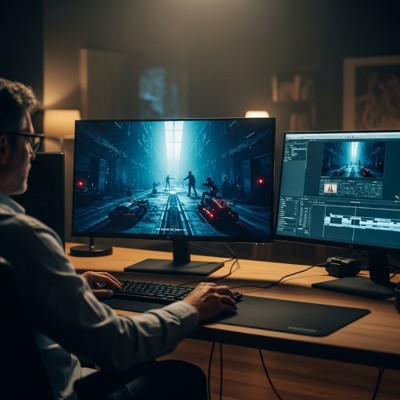
We can’t talk about this convergence without mentioning the sheer technical wizardry happening behind the scenes. The Visual Effects (VFX) we see in games today are often indistinguishable from those in big-budget movies. This is largely thanks to the rise of powerful engines like Unreal Engine 5, which allow for real-time lighting and physics that used to take weeks to render for a single film frame.
This technical convergence isn’t just limited to massive open-world RPGs, either. You can see the influence of film-style VFX across the entire gaming spectrum. For instance, even when you look at slots online, you’ll notice how traditional cinematic motifs like colour theory and sophisticated sound design are utilised to drive player engagement. These digital environments use the same visual language as a high-stakes film to create a sense of atmosphere and immersion. The way light reflects off a surface or the specific “crunch” of a sound effect are all designed to mirror the polished feel of a cinema production.
This “visual language” is about more than just looking pretty. It’s about communication. In a film, a director might use a specific shade of blue to signify sadness or isolation. Modern games use these same colour palettes to guide the player’s mood without saying a word. Whether it’s a sprawling sci-fi epic or a smaller digital experience, the goal is the same: to create a cohesive, professional aesthetic that feels part of a larger, high-quality universe.
IP Migration: From Silver Screen to Digital Reels
We’re also seeing a massive trend in Intellectual Property (IP) migration. It used to be that “movie games” were notoriously bad—rushed projects designed to cash in on a film’s release. Thankfully, those days are mostly behind us. Today, when a major film brand moves into the digital space, it’s treated with the same respect as the original source material.
Think about the Star Wars or Marvel universes. These aren’t just movies anymore; they’re sprawling transmedia franchises. A character might be introduced in a film, have their backstory fleshed out in a streaming series, and then become a playable protagonist in a high-fidelity video game. This migration works because the visual and narrative language remains consistent across all platforms.
When you step into a digital version of a world you’ve seen on the silver screen, you expect it to look and feel a certain way. You want the same lighting, the same sound effects, and the same narrative weight. This consistency is what allows fans to stay connected to a brand for years. It’s no longer about a single two-hour experience; it’s about living in that world through multiple different “reels,” whether they’re projected on a cinema screen or rendered in real-time on your monitor at home.
The Future of Australian Transmedia: Economic and Creative Implications
Looking ahead, the future for the Australian creative industry seems incredibly bright, provided we keep embracing this crossover. By blurring the lines between film and games, Australia is positioning itself as a global hub for transmedia production. The economic implications are huge; it’s not just about selling copies of a game, but about building a sustainable ecosystem of artists, programmers, and storytellers who can work across any medium.
Creatively, this shift is pushing us into uncharted territory. We’re starting to see “transmedia natives”—creators who don’t think of themselves as just “filmmakers” or “game developers,” but as storytellers who use whatever tool fits the job. This approach leads to more innovative, experimental content that doesn’t feel boxed in by traditional genres.
As we move forward, the challenge will be to maintain that human touch in an increasingly digital world. While the tech is amazing, it’s the stories and the characters that keep us coming back. Whether it’s through a massive government policy shift or a clever bit of VFX, the goal remains the same: to connect with people and tell a story that sticks with them long after the screen goes dark.
***
Please play responsibly.
For help, support, and advice regarding gambling, you can visit the following organisations:
- BeGambleAware
- GamCare
- National Gambling Helpline: 0808 8020 133
This article is intended for readers aged 18 and over.
Main image Source: Depositphotos
