



by FilmInk Staff
Production has officially wrapped on Last Breakfast with Mum, an audacious “chamber drama” that captures the paralysing intersection of personal grief and global political upheaval. Written by Kian Farzam and directed by Ali Vaziri, the film is a visceral exploration of the Iranian diaspora, filmed with a technical framework designed to mirror the urgency of the modern world.
A Domestic Pressure Cooker
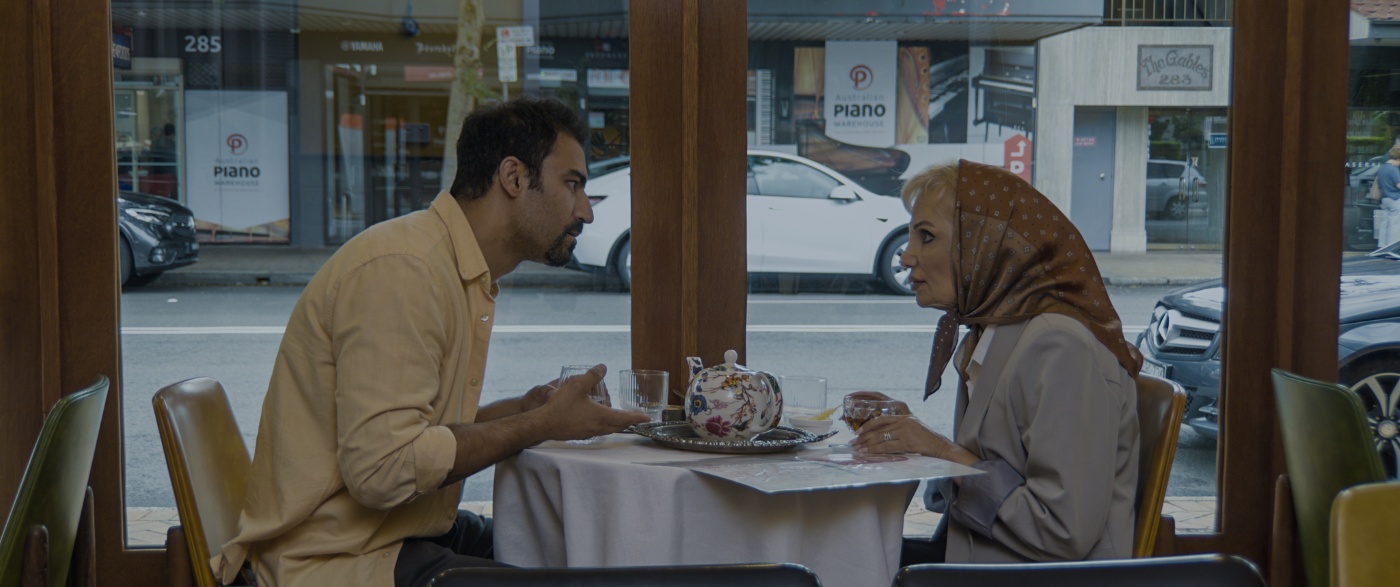
Unfolding entirely over one high-stakes day within a single location, the film explores the psychological collapse of Arman, a 32-year-old Iranian immigrant in Australia. Reeling from the news of his mother’s sudden death back in Iran, a country currently in the throes of a brutal crackdown, Arman is consumed by the “survivor’s guilt” of the safely displaced.
The narrative takes a surreal, experimental turn when an elderly woman with dementia wanders into Arman’s apartment. In a desperate act of “staged realism,” Arman begins to treat the stranger as his own mother, seeking the closure he was denied by distance and the “Woman Life Freedom” movement shaking his homeland.
Technical Audacity: The iPhone 17 as a Cinematic Witness
In a move intended to bridge the gap between traditional cinema and digital activism, director Ali Vaziri and producers Yolandi Franken and Luis Fernandez opted for an experimental production model. The film was shot with a skeleton crew and captured entirely on the iPhone 17 by Director of Photography James Barton.
This choice was a deliberate artistic statement. Just as the revolution in Iran is being broadcast to the world through the lenses of smartphones, Last Breakfast with Mum uses that same tool to document the internal revolution of a man caught between two worlds. The small footprint of the iPhone allowed for a “hyper-realist” intimacy, navigating the single-room set with a fluidity and voyeuristic intensity that traditional camera rigs cannot achieve.
A Voice for the Diaspora
Reflecting the lived experiences of the creative team, many of whom are Iranian refugees, the film addresses the unique trauma of “distanced mourning,” where the finality of death is mediated through screens and phone calls.
“This is a film about the ‘invisible graves’, the places we cannot go to bury our dead,” says writer Kian Farzam. “By wrapping this shoot, we’ve captured a very specific, painful moment in time for the Iranian community, using the very technology that keeps us connected to the struggle back home.”
Festival Strategy
With principal photography complete, the film enters post-production with an eye toward the international festival circuit. By blending a high-concept “one-day, one-room” narrative with cutting-edge mobile cinematography, Last Breakfast with Mum positions itself as a bold new voice in diasporic cinema.
