


By Dov Kornits
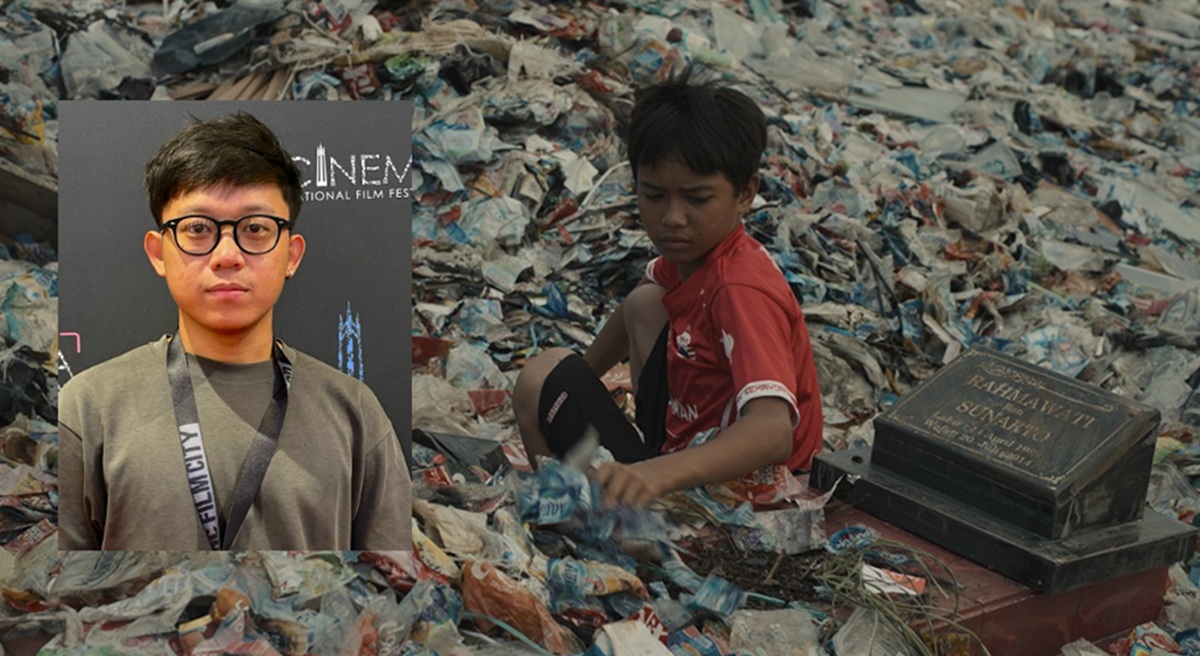
“I used the perspective of a child as our entry point into this very unfamiliar world,” says young Indonesian director Amar Haikal. “I believe that a child is a pure reflection of the environment created by adults. To assess the quality of an environment or ecosystem, you can always look at the behaviour and quality of life of the children who live there.”
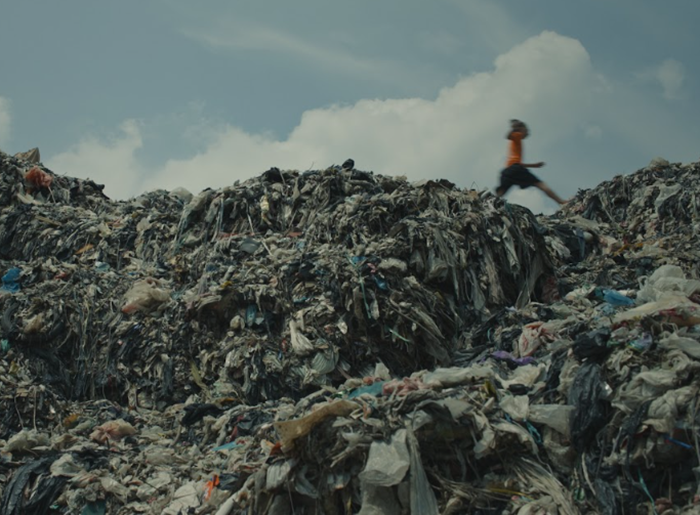
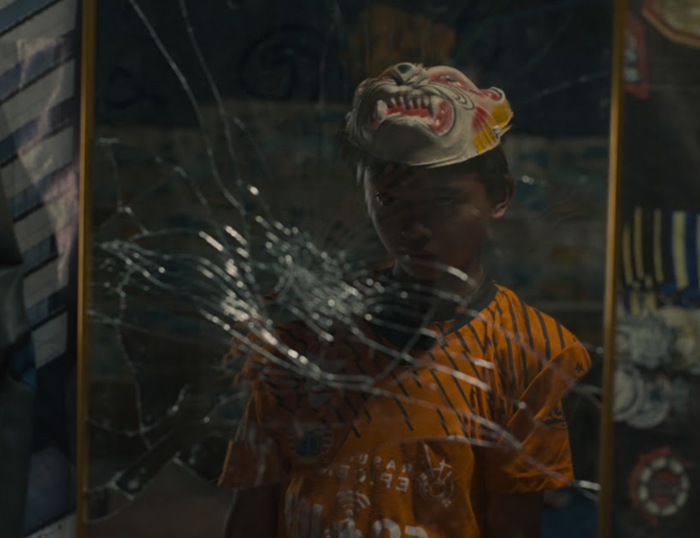
The picture that Amar Haikal creates in his strangely lyrical short film My Plastic Mother is profoundly human. The film tells of young Eki (played by first-time actor Muhammad Alfat Apriansyah), who lives by a huge landfill, and searches for a memento to honour his late mother. Battling the relentless rain, landslides, and looming threats from scavengers and machinery, he fears that her memory could be lost beneath the waste forever.
Aged just 25, Amar Haikal studied film at The Jakarta Arts Institute, and has made several short films, including 2023’s Bising, which was nominated for Best Short Film at the 2023 Indonesian Film Festival and won the National Jury Competition at Minikino Film Week at The Bali International Short Film Festival. Outside of making short films, Amar has worked as a behind-the-scenes director on a number of Indonesian feature films such as 2024’s Tebusan Dosa, 2025’s Rangga & Cinta and 2026’s Siksa Sampai Mati.
Did you have any cinematic references when making the film?
“My Plastic Mother is a short film I made for my final thesis project at Jakarta Institute of Arts. Throughout my years of watching and studying film, the Italian Neorealism cinema and films influenced by that movement have greatly impacted my works. Dealing with a very raw landscape of a landfill, it was very important for me to stay true to the reality of the location, as it is a character in itself. I avoided taking attention away from that dystopian reality by exercising too much style in the way my camera captured the landscape. I wanted it to almost feel like a documentary; raw, and blurring the line between fiction and real life.”
Are there any particular films that were important to you?
“I took many inspirations from films such as Bicycle Thieves (1948, Vittorio De Sica), Pather Panchali (1955, Satyajit Ray), The 400 Blows (1959, François Truffaut), and an Iranian film called The Runner (1984, Amir Naderi). They dealt not only with tangible realism that you and I could easily feel or relate to, but they built their sense of perspective around children. Children are the lowest common denominator in every complex society, yet somehow, they are the truest reflection of our world. These four films brilliantly capture the complexity of the mundane external world, as well as the inner lives of their ‘mundane’ main characters. That’s what I hoped to achieve with My Plastic Mother.”
Like your lead character, you also did not grow up with a mother. Can you discuss your childhood?
“My childhood is unique. I did not grow up with my mother, but instead I lived with my father and grandma. Looking back, I was mostly confused and disoriented as a kid. I had questions I did not know how to ask. Longing for a maternal figure was a big element in the way I grew up. It made it harder for me to understand love, intimacy and companionship. But at the same time, it made me value them more. I’m always interested in how children externally project the things they could not communicate. It’s much easier for adults to cast judgement rather than trying to understand. I have been a victim of this myself. Through this story, I want to command that effort of understanding this kid, who’s introduced to us through his violence in a soccer game.”
Did you know about these rubbish dumps before you set out to make the documentary that inspired this film? How do you feel about these spaces and the people that live around them?
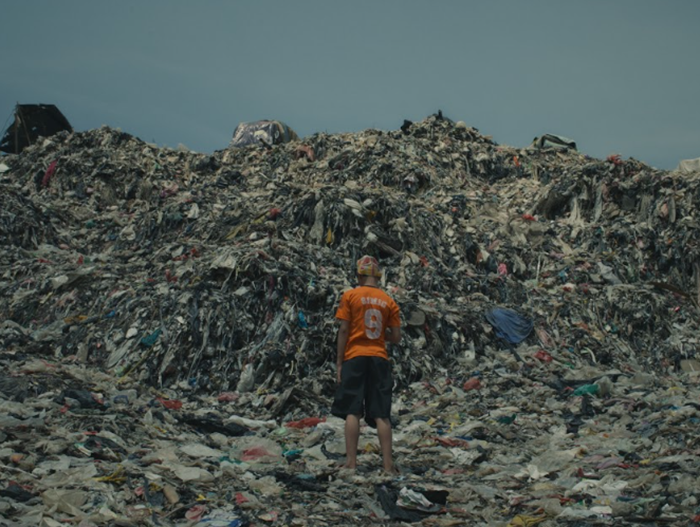
“Bantar Gebang is infamous for being one of the biggest landfills in Asia. I visited the location in 2021 to film a commissioned documentary. We climbed to its apex, which is equivalent to a 16th floor office building. It’s a surreal landscape. I remember being overwhelmed with a sense of guilt, because everywhere I looked, there were logos and packaging of items that I could find at my house. Talk about contribution. This guilt didn’t leave me for years. I was very fortunate to meet and become friends with a lot of people who live in that area. They are scavengers, school teachers, housewives and kids who were born, grew up and live on this waste. I spent a lot of time being involved in how they live, and it made me realise that these were ordinary people just like myself. Their environment does not play an effect on who they are. They helped me a lot in understanding the problems and shaping the story into a piece that is more honest and true. One of my biggest worries initially was that the story could feel exploitative, but interacting and involving them in the process has opened up my ideas to make it more representative.”
I understand that the boys that you cast come from the sort of environment depicted in your film? Was it difficult to direct them? You’re not that much older than them yourself. What was your approach?
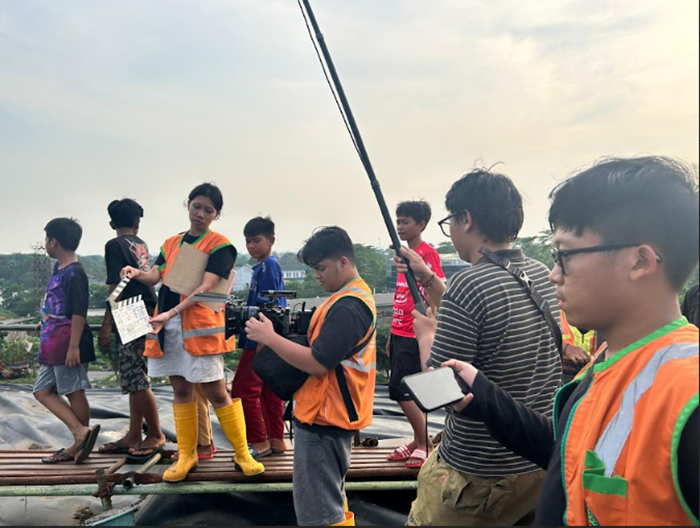
“From the beginning, I knew that it was impossible to cast a child actor from the city to play Eki. The landscape and its challenges are very specific. So, we held a casting audition with around 40 children in the area. We finally cast Muhammad Alfat due to his bravado and free-spirited nature. It was easy to bond with him because of his confidence. From that point, it did not feel like I was directing him, but rather it was him showing me what he usually does – or would have done in certain scenarios in the script. From the writing process, meeting Alfat and getting the shoot done, it’s safe to conclude that this story belongs to these kids more than it does to me. Alfat represents his community so perfectly.”
What is the Indonesian film industry like, and what’s next for you? Has this short film helped you take the next step in terms of being a filmmaker?
“The Indonesian film industry is at an exciting place right now. More and more films are being produced every year, providing a lot of opportunities for the younger filmmakers. Boundaries in genre, form and style are also being pushed further. A lot of distinctive stories are coming out from our country. I’m just very happy to be growing alongside this movement. My Plastic Mother is another step in my journey as a young film director. I experimented a lot with the way I could tell this story, and seeing how it’s being received has given me more confidence for my next films. Breathing in a growing industry certainly helps a lot with my development. After all, I’m still at the beginning of my journey. Still finding shape and getting better as a storyteller. What matters the most for me right now is to stay in the present and tell the stories of today, of who I am and where I am. The rest, I’m just hoping for the best!”
My Plastic Mother screens at Flickerfest’s Best of International Shorts 4 on Wednesday 28 January 2026. For all information, click here.
