



by Pauline Adamek
Worth: $10.00
FilmInk rates movies out of $20 — the score indicates the amount we believe a ticket to the movie to be worth
Cast:
Sandrine Kiberlain, Lauren Lafitte, Amira Casar, Pauline Etienne, Mathilde Ollivier, Laurent Stocker
Intro:
… a sentimental biopic about a tedious woman.
Often spoken of as the greatest actor of the theatre, there’s no denying the accomplishments of Sarah Bernhardt. The celebrated French stage actress starred in some of the most popular French plays of the late 19th and early 20th centuries, and toured the world. An outspoken and trailblazing proto-feminist, Bernhardt epitomized the glamour and theatricality of La Belle Époque (c. 1871–1914), a golden age for European art, theatre, and fashion.
Known as “The Divine Sarah,” the actress was admired for her dramatic stage presence, the intensity and intelligence of her live performances, and her commanding presence. A pioneering celebrity with worldwide acclaim, she created scandals célèbres with her public romances and by boldly taking on illustrious male roles, most notably Hamlet. She was also among the first stage actors to appear in early silent films. Even after losing a leg to gangrene in 1915, Bernhardt continued to act, demonstrating her physical and artistic tenacity until her death in 1923.
Unfortunately, The Divine Sarah Bernhardt has a dreary opening. The movie begins by dwelling on her later years of poor health before jumping back 20 years to the height of her fame. Directed with plodding fidelity by Guillaume Nicloux, the film uses a nonlinear timeline to plunge us into three pivotal time periods: 1915–16, 1896, and 1886–1896.
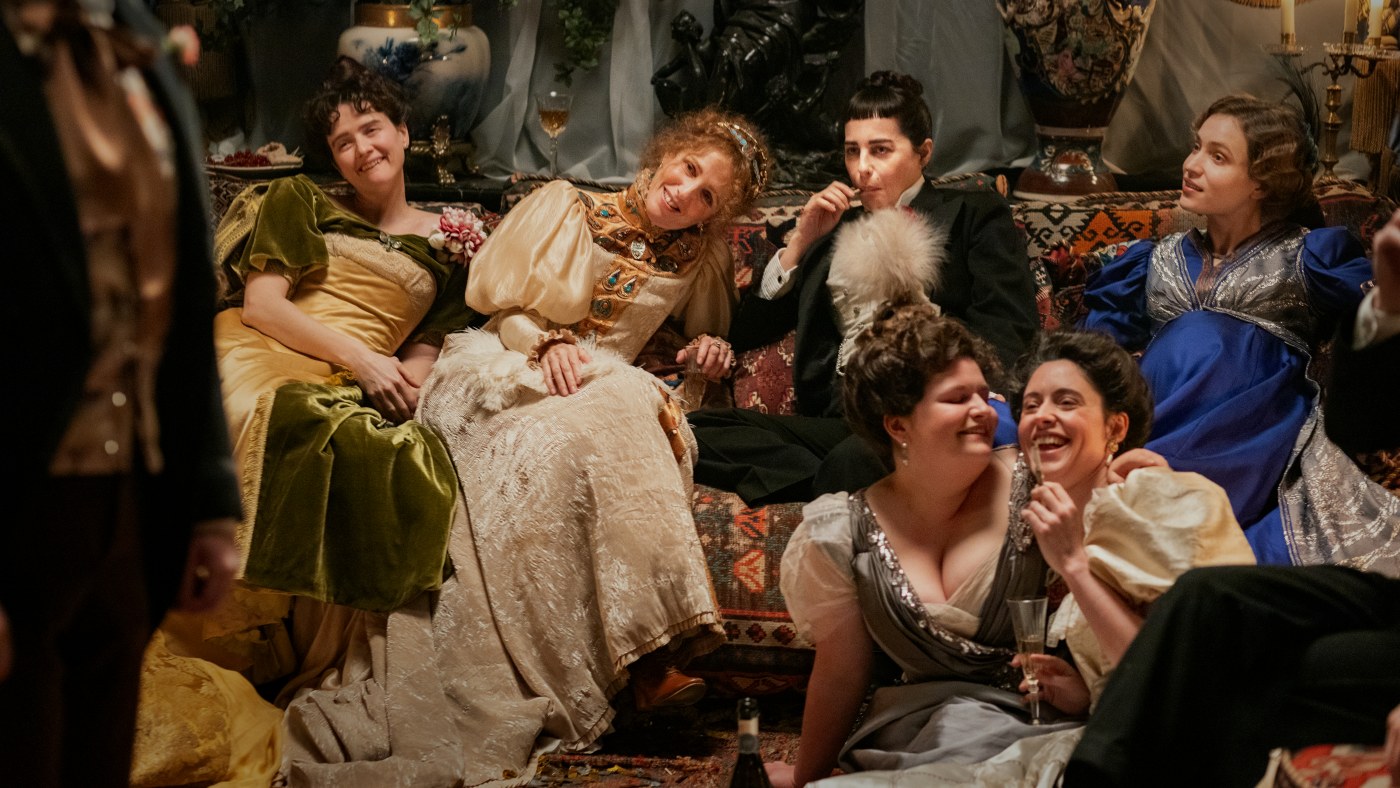
The first flashback transports viewers to 1896, where Bernhardt is in her prime at age 52. Garbed in sumptuous gowns and surrounded by luxury, her opulently decorated Paris apartment includes an open coffin, with exotic animals – including a lemur, a boa, and a lynx – bounding about as pets. As preparations are underway for a grand public event honouring her career, fashionable writers and artists such as Émile Zola and Edmond Rostand mingle within her circle. Such is her fame, Sarah Bernhardt Day has been declared by the French government to celebrate the “Priestess of Poetry” whose stellar career of 29 years (to date) includes taking on 112 roles.
The film’s dialogue is frequently bogged down by many expository explanations, such as banter about her “27 curtain calls,” how she tours with 200 Louis Vuitton trunks, and spent three million francs on sets, costumes and staging over a four-year period. No surprise that the character has a tendency to be overly dramatic: “How are you?” “If only I knew… I am suffering…” “It was the day I lost the love of my life,” and so on.
Sacha, the son of her famous actor friend and longtime lover, has the bright idea of immortalising famous people “our great men and women,” including her, on film for posterity. He is recording her memoir and listens as she recounts pivotal moments of her life. Turns out there is a surprising amount of silent film footage of the great Sarah Bernhardt, glimpsed during the opening credits and towards the end for her elaborate funeral, which saw 600,000 devoted fans filling the streets of Paris.
The resulting film is a sentimental biopic about a tedious woman. Capricious and imperious, this Sarah on screen is neither fascinating nor captivating.
Charged with portraying the character throughout three decades, leading lady Sandrine Kiberlain is ably assisted by excellent makeup design that helps to age the actress realistically over the span of thirty years.
It’s difficult to tell if it’s the hagiographical writing of Nathalie Leuthreau and director Guillaume Nicloux, or a flawed interpretation of the material, but Kiberlain fails to convey the charisma and charm that this vibrant and very public figure must have had in her hey-day. Lusty romances and polygamous dalliances are rendered in smoky soft focus. Several real-life celebrities from Bernhardt’s milieu, such as Reynaldo Hahn, Victor Hugo, and Sigmund Freud, among others, appear, and whose presence illustrate her cultural impact.
The film weaves together close, personal moments with appearances at vibrant parties, as well as rehearsal and performance scenes from La Dame aux Camélias, highlighting the powerful drama and passion that Sarah Bernhardt infused into her craft.
Despite striking a reasonable balance between her public spectacle and private vulnerability, the story drags.
