


By James Mottram
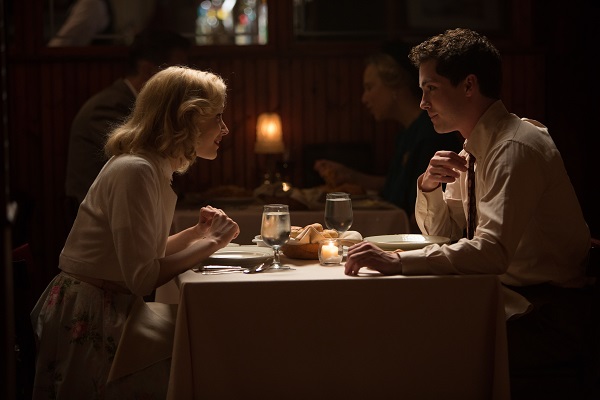
“[Director] James Schamus said to us in rehearsals, ‘Olivia and Marcus are the only two freaks at Winesburg College, and they find each other!’” Sarah Gadon laughs to FilmInk at The Berlin Film Festival. “I really connected to that.” Based on a novel by the famously difficult-to-adapt Philip Roth (Portnoy’s Complaint, The Human Stain), the 1950s-set Indignation stars Logan Lerman as the aforementioned Marcus Messner, a working class Jewish kid from New Jersey who is confronted with culture shock whilst attending a small Ohio college. He soon finds romance, however, in the beautiful but deeply troubled form of Gadon’s Olivia Hutton, which only serves to further complicate his already complicated coming of age. Ang Lee’s oft writer/producer, James Schamus, makes his directorial debut with Indignation, and the film provides a fine showcase for Sarah Gadon.
The Toronto native has been on a roll since she was cast in David Cronenberg’s Freud/Jung biopic, A Dangerous Method, in 2010. The legendary filmmaker has since cast her twice more (in Cosmopolis and Maps To The Stars), while his son, Brandon, snapped up the actress for his directorial debut, Antiviral. She has also appeared in A Royal Night Out (as Queen Elizabeth, no less), Belle, Enemy, and the TV series, 11.22.63. So what drew her to Indignation? “The complexity of the character,” Gadon replies. “On the surface, she seems like this object of desire, but underneath, she’s struggling to fit in, and she’s bumping up against the ideologies of the time. I really liked that she was this outsider, and that she’s kind of smarter than her environment. She’s smarter than people take her for at face value, and that was a real way in for me. As an actor, there are so many times when you’re growing up, where you feel like you don’t fit in, and you feel like you’re on the outside.”

Surprisingly, the buttoned down societal attitudes of the film’s 1950s setting were also a lure. “The sexuality in the film is really interesting,” Gadon says. “Often your first sexual encounter as a young person is shrouded in confusion, curiosity, and shame. I don’t think that’s something that’s just for the 1950s. There were a lot of things that I could relate to in terms of the character. I also love in the novel and the film how she just disappears. Women who didn’t fit in, and women who couldn’t keep themselves under control, were sent off to sanitariums. They were given electric shock therapy, and that was an interesting element to the story, and to the character. What really elevates Olivia’s character from the novel is that I feel like the perspective is much more ambiguous in the film.”
Like most of the films on her already impressive resume, Indignation is a blue-ribbon, high-cred indie project. It’s got prestige literary roots, and though the director is a first-timer, he’s got the kind of reputation and experience that most debutantes could only dream of. “I did a studio film,” Gadon replies when asked about her indie-heavy body of work. “I did a film called Dracula Untold, and I realised, doing that movie, that I really fight to make my characters compelling, because that’s your job as an actor. On that film, I had to fight so much to make that character compelling, and I was like, ‘Maybe I don’t want to fight this hard on a daily basis!’ [Laughs] That’s not to say that there isn’t merit to that kind of filmmaking, and that you shouldn’t do those kinds of films in your career. It’s important to learn from your choices, and to step outside of your comfort zone. I made that movie with Luke Evans [who starred as Dracula], and he’s one of the best actors that I’ve ever worked with, so there is certainly merit to it. But for me, I care more about who’s directing it, than whether it’s a studio film or an independent film. I don’t care about where the film is being made and who’s financing it. I just care about the director. So if an interesting director asked me to be in a studio film, I’d do it.”
Is it easy to make those kinds of choices? “You don’t really feel like you have that much choice as an actor,” Gadon replies. “You audition for so many things, and it’s more like the roles choose you. But like I said, I just care so much about who’s directing, and that’s my only motivating pattern as an actor looking for work, because I think that great directors have something to say. I don’t care if the film is flawed, and I don’t care if it’s a perfect film, I just want to make a movie and contribute to someone’s body of work. Great directors also attract the best talent. I’ve never worked with a bad actor in a great filmmaker’s film, because they attract intelligent people, and people who want to be there. That’s my main motivating factor.”
With so much talk about the past paucity of good roles for women in films, and the recent improvement of the situation with films like Room, Carol, Brooklyn, and others, it’s an obvious topic to raise with Gadon. The actress, however, is a little circumspect on the subject. “It’s difficult to find a good role if you’re an actor, period,” Gadon says. “It’s really competitive. It’s really hard, and my contemporaries, who are males, bump up against the same things that I do. It’s the system itself which is unwilling to change. I watched Luke Evans on Dracula Untold go through the rigorous training that he had to do to be like an action hero, and everything that goes into the male body for action stars. There were times on set where he was on this really strict diet, and doing push-ups between scenes, and the director was like, ‘Take your shirt off.’ I was sitting there and eating, and thinking, ‘Shouldn’t this be the reverse of what’s happening?’ [Laughs] So I think that it’s just hard out there for actors! It doesn’t matter if you’re a woman or a man!”
Indignation is released in cinemas on August 18.
