



By Erin Free
While the annals of cinema history are heavily dotted with true-to-life biopics, not-so-true-to-life biopics, partial biopics, fictionalised depictions of real stories, and movies where fictional characters wander into historical events, instances where true life figures are effectively woven into fictional narratives (without the aid of a time machine) are far less prevalent. Here are a handful of films that mix the real with the reel…to varying degrees of success.
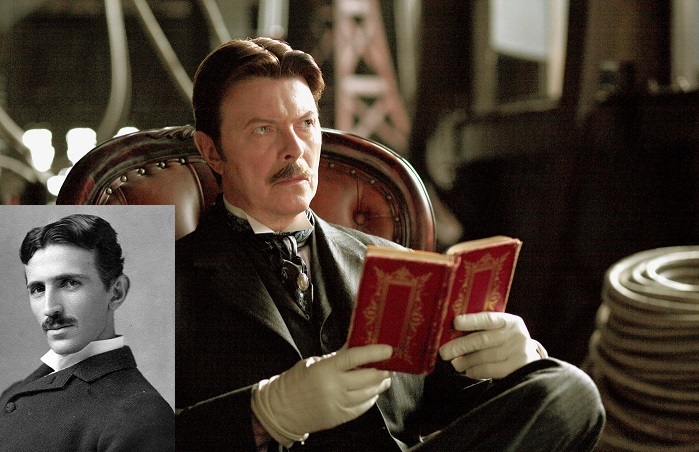
NIKOLA TESLA (DAVID BOWIE) IN THE PRESTIGE (2006) Nikola Tesla was a Serbian-American inventor, electrical engineer, mechanical engineer, and futurist best known for his contributions to the design of the modern alternating current (AC) electricity supply system, and also for his work with fellow electrical pioneer and eventual rival, Thomas Edison. Tesla was also a richly enigmatic figure: he had a photographic memory; claimed to only sleep two hours a night; refused continued social contact and sexual relationships; and conducted a variety of bizarre experiments in his well-maintained string of laboratories. While musician, Jack White, rhapsodised about Tesla in his episode of Jim Jarmusch’s portmanteau film, Coffee And Cigarettes, the famed “mad scientist” got his greatest cinematic due courtesy of director, Christopher Nolan, who threaded him into the narrative patchwork of his warring magicians tale, The Prestige. Tapped by Hugh Jackman’s illusionist to help him build a teleportation device, Tesla is wonderfully played by the late, great David Bowie. “I was looking for someone that the audience would instantly believe was capable of extraordinary things, and any movie star in that role would be distracting,” Nolan told Film 4. “David Bowie has this amazing charisma that made him exactly right for it, so I sent him the script… and he immediately said no! Normally, that would have been the end of it, but I then did something that I’d never done before – I tried to change his mind, because I couldn’t think of anybody else who could do the part the way that I wanted. Fortunately, whatever I said must have convinced him – he signed on, and he was a real pleasure to work with.”
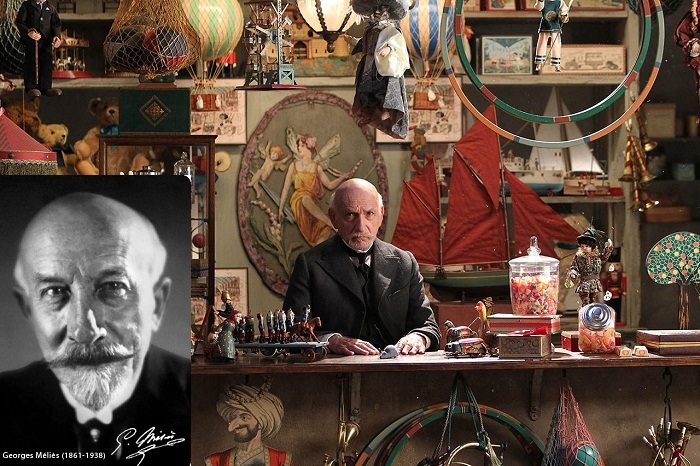
GEORGES MELIES (SIR BEN KINGSLEY) IN HUGO (2011) Famous for his undying, life-long love of movies, Martin Scorsese crafted his greatest tribute to the medium with his warm, deeply moving family film, Hugo, the story of the titular young orphan (played by newcomer, Asa Butterfield), who lives amongst the crunching gears and gliding mechanisms of the enormous clocks maintained by his uncle at a cavernous Parisian train station. Boasting a knack for mechanics, Hugo’s mission in life is to finish constructing a robot that had fallen into the possession of his late father. The secret, the young boy soon discovers, lies with the grumpy old man who runs the train station’s toy booth. This, however, is no ordinary grumpy old man. As played majestically by Sir Ben Kingsley, it is indeed Georges Melies, the French filmmaker now considered to be the father of special effects and on-screen science fiction. By the time of the film’s mid-thirties setting, however, Melies – whose 1902 film, A Trip To The Moon, is one of cinema’s most essential early entries – is a broken man…until the young Hugo comes into his world, and restores the one-time illusionist’s famous zest for life. “What was most important was how to play the man’s loss,” Kingsley told The Huffington Post. “So I started by examining his gain. I watched a box of DVDs of Georges, given to me by Marty, and I saw his colossal energy, his multi-tasking, and his absolute joy of being in his movies, writing his movies, directing, set decorating, costume designs, editing, everything. I embraced the myth of Georges as the blind man in exile guided back into life at the hands of a child.”
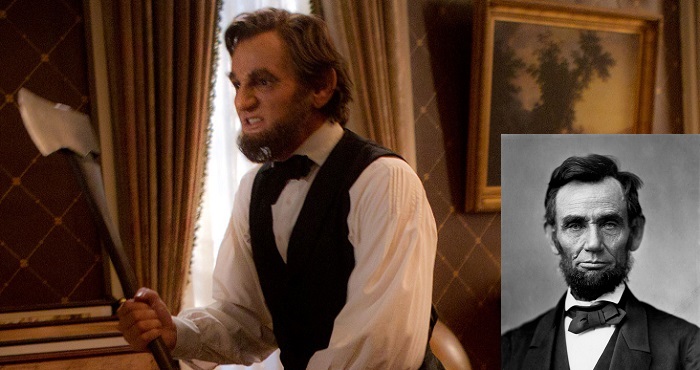
ABRAHAM LINCOLN (BENJAMIN WALKER) IN ABRAHAM LINCOLN: VAMPIRE HUNTER (2012) In the pantheon of American Presidents, Abraham Lincoln is indeed one of the undisputed greats: he led the United States through its Civil War, abolished slavery, strengthened the federal government, and modernised the economy. And according to Timur Bekmambetov’s 2012 horror fantasy, Abraham Lincoln: Vampire Hunter, he also put a stake through thousands of undead fang-bangers. As per the novel by Seth Grahame-Smith upon which it’s based, the film rewrites key historical events, redefining President Abraham Lincoln’s (Benjamin Walker) battle to end slavery as a plot to deny vampires the easy purchase of cheap supplies of blood. Grahame-Smith took every absence during Lincoln’s presidency and explained it away as his being off on a mission to kill vampires after learning of their plans to take over the US. “I like to read genre stories, and this is a very smart, and very emotional, mix of two genres – biopic and fantasy,” Timur Bekmambetov told FilmInk upon the release of the film. But despite the bloodletting and loopily fantastical approach to the truth, Bekmambetov approached Abraham Lincoln: Vampire Hunter as a lot more than just another vampire movie. “It’s our goal to make this movie historically correct,” the director told FilmInk. “We have a lot of consultants, and The Abraham Lincoln Presidential Library And Museum is also helping us. A lot of historians and scientists are assisting us to make the story as accurate as possible. Of course, it’s a fantasy story, but we’re trying to stay grounded as much as we can. It’s not just for people who like vampire movies. It should be interesting and relatable to everybody.”
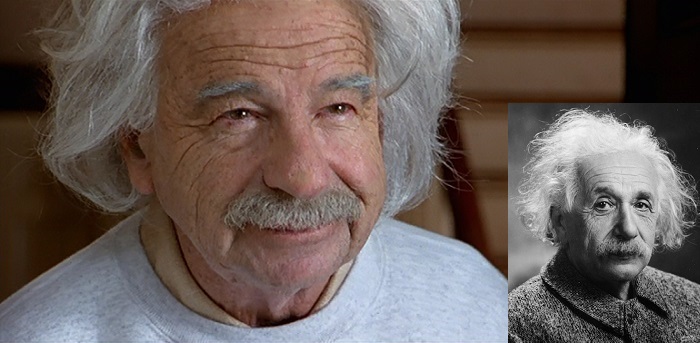
ALBERT EINSTEIN (WALTER MATTHAU) IN I.Q. (1994) “We give you clues that you’re on a fairy tale journey very early in the film,” director, Fred Schepisi, said of his 1994 film, I.Q, on The Movie Show. “We do it through lighting and things like that, and it’s quite subtle, but the clue is there. We’re saying, ‘Let’s go on this fairy tale journey.’ And people either let go of their logic and go along for the journey…or they don’t!” In his under-loved romantic comedy, Schepisi posits famed genius scientist, Albert Einstein, as a force for decency, connection, communication, and love. That’s certainly not moving too far away from Einstein’s much-admired public image, but apart from that, I.Q. is a wholly fictional construct. In the fifties-set flick, Einstein is played as a fun loving good guy by the perfectly cast Walter Matthau, who brings a sense of sunny import to the role. “He’s very accurate,” Schepisi said of Matthau on The Movie Show. “It’s that open-eyed wonder that he has. In all the pictures that you see of Einstein, he’s got that quizzical, almost mischievous expression, and Walter got that. Walter’s still got this almost child-like sense of enthusiasm, even after all these years of working in movies.” In the film, the German-born theoretical physicist and philosopher of science uses his vast intellect to convince his niece (Meg Ryan) to dump her stuffy professor boyfriend (Stephen Fry) for Tim Robbins’ nice guy mechanic. While I.Q. also includes Einstein’s real life friends and fellow scientists, Nathan Liebknecht (Joseph Maher), Kurt Gödel (Lou Jacobi), and Boris Podolsky (Gene Saks), the rest of the film is pure, sweet, alchemical fiction.
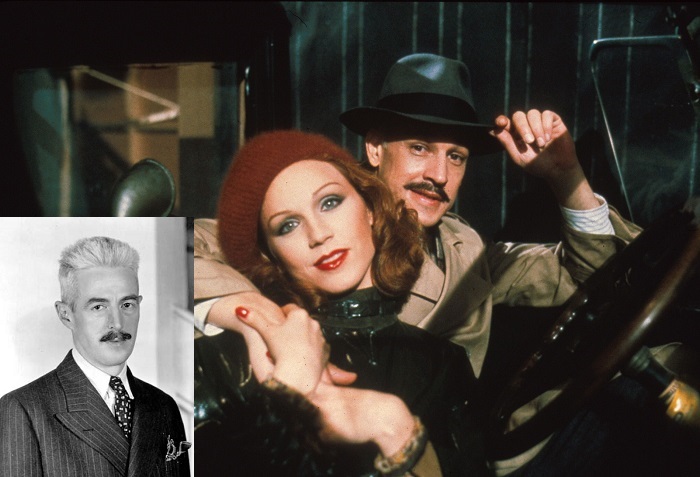
DASHIELL HAMMETT (FREDERIC FORREST) IN HAMMETT (1982) One of the true kingpins of American crime fiction, the terse, tough, hardboiled style of Dashiell Hammett was best distilled in classics like The Glass Key, Red Harvest, The Thin Man, and The Maltese Falcon. An alcoholic cruelly felled by tuberculosis, Hammett was blacklisted in the fifties when he refused to name names for the Communist-hunting cronies of The House Committee on Un-American Activities. He also worked for the famous Pinkerton National Detective Agency, but left when their brutal brand of strike-breaking jarred with his political and humanist beliefs. “All my characters were based on people that I’ve known personally, or known about,” Hammett once said of the semi-autobiographical nature of his novels. Though purely a work of fiction, Wim Wenders’ stylised 1982 thriller, Hammett, uses the author’s tenure as a Pinkerton man as its jumping-off point, entangling the legendary scribe in a noir-ish tale involving the mysterious disappearance of a beautiful Chinese cabaret actress in San Francisco. Infamously plagued by production problems (Wenders shot the whole film twice!), the film boasts a beautifully dog-eared turn from Frederic Forrest as the titular writer/detective, though Wenders (whose first choice for the role was actually his eventual Paris, Texas writer, Sam Shepard) had originally intended to inject more fact into this fictional tale. “Everyone realised that it was more about a writer than a detective story, which is what people thought it was about,” Wenders told Venice of his first version of the film. “The producers wanted more action in it, and basically demanded a total reshoot.” Incidentally, Frederic Forrest played Dashiell Hammett for a second time in the 1992 telemovie, Citizen Cohn.
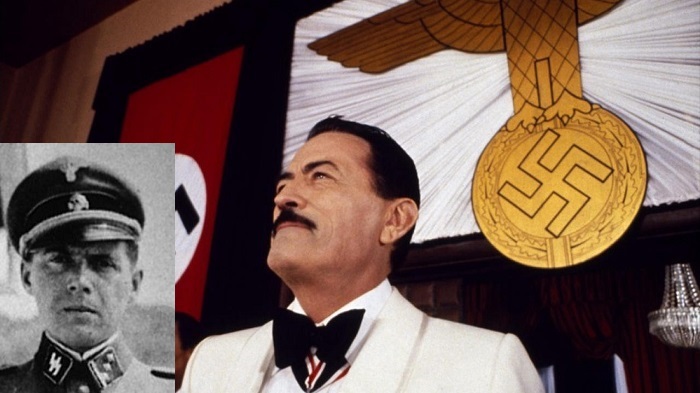
JOSEF MENGELE (GREGORY PECK) IN THE BOYS FROM BRAZIL (1978) The horrors of The Holocaust – and its venal Nazi perpetrators – have provided ample grist for the cinematic mill, from blue ribbon masterpieces like Schindler’s List to bottom-feeding exploitation shockers like Ilsa: She-Wolf Of The SS and Nazis At The Center Of The Earth. One of the more mainstream films to posit a fictional framework for a true life Nazi was Franklin J. Schaffner’s 1978 adaptation of Ira Levin’s bestselling novel, The Boys From Brazil, in which Hollywood icon, Gregory Peck, plays Dr. Josef Mengele, the notorious SS officer who gained the moniker of The Angel Of Death for the horrendous human experiments that he carried out at Auschwitz. In The Boys From Brazil, an ageing Mengele – who escaped any form of post-war prosecution – is alive and well in Paraguay…and planning to reassemble The Third Reich by using Adolf Hitler’s DNA to create an army of clones. It’s heady, absurdist stuff, but having Mengele as a central character gives the film an unquestioned sense of menace and immediacy, as does the presence of Sir Laurence Olivier as a Jewish Nazi hunter modelled on the famous Simon Wiesenthal. Even more unsettling was the fact that when the film was being made, the real Mengele was still alive in Brazil. He died in 1979, shortly after the release of The Boys From Brazil. Mengele was a rare villainous role for the famously dignified Gregory Peck, who hesitated in accepting the part, but later admitted that he enjoyed playing this “rattlesnake of a character”, and hoped that the film would help ensure that people “would never forget the horrors” of Mengele and his compatriots.
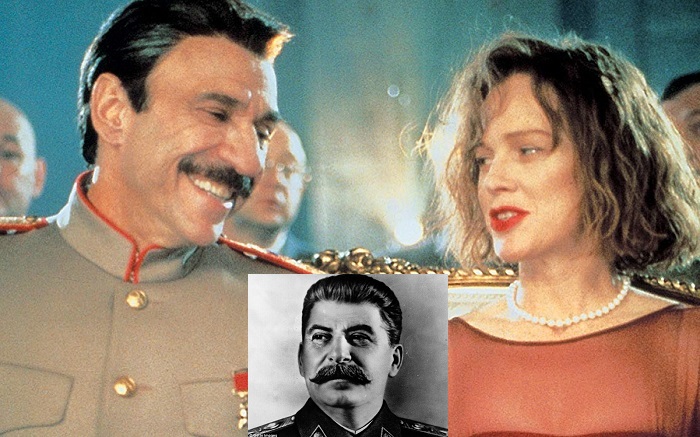
JOSEPH STALIN (F. MURRAY ABRAHAM) IN CHILDREN OF THE REVOLUTION (1996) In his sharp, funny, winningly absurdist 1996 debut feature, Australian writer/director, Peter Duncan (who would later go on to co-create the popular TV series, Rake), delivered a crafty meld of social commentary, broad comedy, and historical hijinks. Children Of The Revolution kicks off with young Australian communist, Joan (Judy Davis), heading off to The Soviet Union as part of a work study programme in the fifties. Once inside The Kremlin, the fetching young leftie catches the eye of Russian main man, Joseph Stalin (Amadeus Oscar winner, F. Murray Abraham), and the two make surprisingly passionate love just before Stalin dies. Returning to Australia, Joan discovers that she is pregnant, and gives birth to Stalin’s love child, whom she names Joe. Richard Roxburgh plays the adult Joe, a striking paradox of a man who kicks against his mother’s firmly held leftist maxims at every turn. “We needed an icon,” Duncan told journalist, Peter Malone, of his casting of the Russian political powerhouse. “Stalin is an icon. Judy Davis is playing the kitchen-sink communist. We needed someone big, out there, and preferably foreign to play Stalin – we needed someone from another culture. Any culture will do, so long as he can put on the accent. Murray agreed to play the part, and that enlarged the scope. It was my idea to cast someone of that stature. The irony is that Stalin loves American films, smokes French tobacco, and sings Cole Porter. It had to be bizarre. I’d like to make films that are funny – not always, but my bent is to make funny films that have something to say about something.”
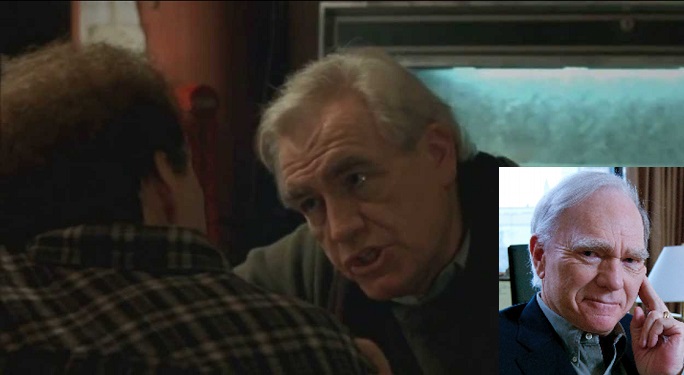
ROBERT MCKEE (BRIAN COX) IN ADAPTATION (2002) After 1999’s Being John Malkovich, director, Spike Jonze, and screenwriter, Charlie Kaufman, toyed even more deliriously with the truth in 2002’s Adaptation. Set up as a kind of freak-scene-true-story, Cage plays screenwriter, Charlie Kaufman, a self-loathing mess terrified of how he’ll follow up his big hit, Being John Malkovich. He thinks that adapting an obscure novel about wild flowers will help, but he couldn’t be more wrong. It just gets him tied up with his wannabe screenwriter twin brother (Cage again), and inspires an unhealthy obsession with the book’s author, Susan Orlean (Meryl Streep). While Charlie Kaufman and Susan Orlean are indeed real people, they are very much presented as “characters” here (Kaufman is not a twin, for instance), though certain checks and balances did have to be undertaken. “It took a little while for me to adjust to the idea, but it was certainly done with my agreement, and then with my enthusiasm,” Orlean told FilmInk. The most realistically presented “real” character in the film is screenwriting guru, Robert McKee, famed for his guide book, Story. Played with lugubrious gravitas by Brian Cox, the shaman-like McKee is sought out for advice by Kaufman. And for the record, Robert McKee loved Adaptation. “The only question you need to ask is: does it work?” McKee replied to FilmInk in 2008 when asked if he analysed Adaptation according to the story elements that he identifies in his famous book. “You know that it works if it hooks you in the beginning, grabs you emotionally and intellectually, holds you through the entire work, and pays off with a satisfying experience at the climax.”
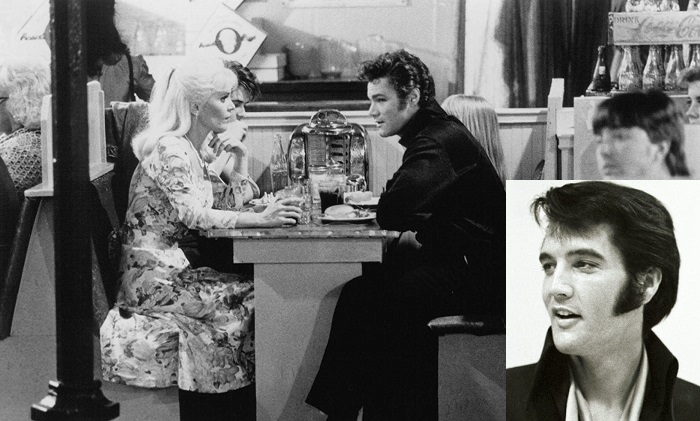
ELVIS PRESLEY (DAVID KEITH) IN HEARTBREAK HOTEL (1988) “I can understand the validity of showing people the ugliness of the world, but there is a place for movies to leave people with a sense of hope,” writer/director, Chris Columbus, once said. “If your film isn’t going to do that, I just don’t think that it’s worth making.” With sunny, sentiment-rich movies like Home Alone, Mrs. Doubtfire, and the first two Harry Potter flicks, the Pennsylvania-born filmmaker has certainly held true to that career mission statement. One of Columbus’ most hopeful and optimistic flicks is his sophomore effort, Heartbreak Hotel, a fictional comedy drama in which real life rock’n’roll godhead, Elvis Presley (played with punchy pizazz by the ever underrated David Keith), has a major role. Set in 1972, the film follows teen rocker, Johnny Wolfe (Charlie Schlatter), who kidnaps The King as a way-over-the-top birthday present for his sad, emotionally vulnerable single mother, Marie (cult darling, Tuesday Weld), who is a die-hard Elvis fan. Though not as wild a fictional depiction of Elvis as Bruce Campbell’s in the kaleidoscopic 2002 horror flick, Bubba Ho-Tep, Heartbreak Hotel effectively conveys the hopeful, healing power of rock’n’roll, and winningly showcases the burning charisma of The King, even in fictional form. “He walked into a room and everything stopped,” said Tuesday Weld, who starred with Presley in 1961’s superior Wild In The Country. “Elvis was just so physically beautiful that even if he didn’t have any talent…just his face, just his presence. And he was funny, charming, and complicated, but he didn’t wear it on his sleeve. You didn’t see that he was complicated. You saw great needs.”
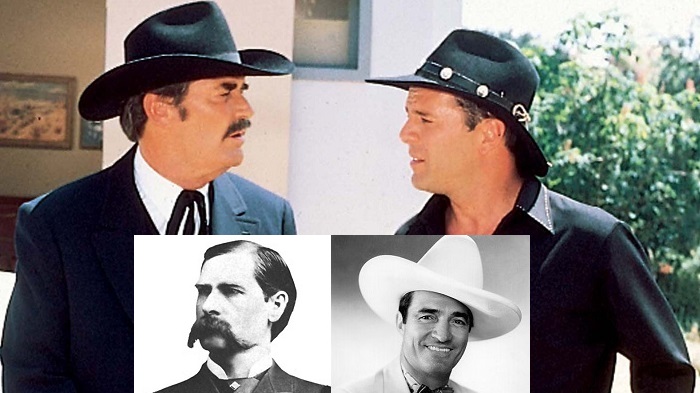
WYATT EARP (JAMES GARNER) AND TOM MIX (BRUCE WILLIS) IN SUNSET (1988) “And it was all true, give or take a lie or two,” goes an oft-repeated line in Blake Edwards’ unfairly maligned 1988 comedy-mystery-western, Sunset, a curiously sour salute to Old Hollywood. The film’s real life leading characters are silent era cowboy movie star, Tom Mix (Bruce Willis in one of his first leading movie roles), and Wild West lawman, Wyatt Earp (the late, great James Garner, who had previously played the character in 1967’s Hour Of The Gun), who meet in Hollywood in 1929 when the latter is employed as a technical advisor on the actor’s latest western, in which Mix will play Earp. Firming quickly as fast friends, Mix and Earp soon become embroiled in a murder mystery involving Chaplin-like actor-turned-studio boss, Alfie Alperin (Malcolm McDowell), and the grime, corruption, greed, and self-interest that form the uneasy bedrock of Hollywood. While taking in a few factual elements (Earp did serve as a technical adviser on early silent westerns, and was friends with Tom Mix, who was a pallbearer at the famed lawman’s funeral), Sunset is a complete and utter fabrication that uses its two real life protagonists (along with a few other historical figures in supporting roles) in a wholly fictional framework. “Well, I enjoy reality as much as the next man,” said Blake Edwards, who adapted Sunset from Rod Amateau’s unpublished novel. “It’s just that in my case, fortunately, reality includes a good stiff belt every now and then.” Edwards was right: though panned upon release, and foolishly marketed as a comedy, Sunset is one of the most sweetly scathing depictions of Hollywood that you’ll ever see.
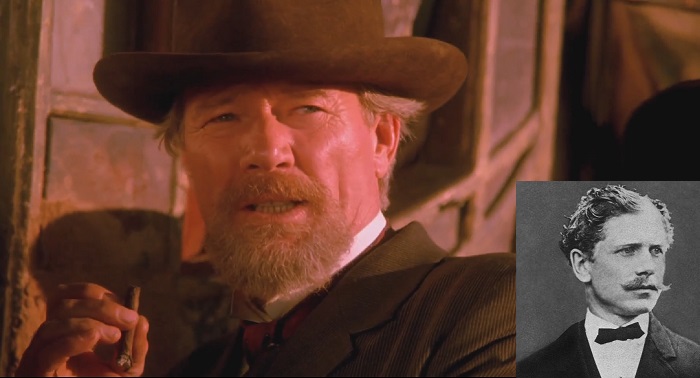
AMBROSE BIERCE (MICHAEL PARKS) IN FROM DUSK TILL DAWN 3: THE HANGMAN’S DAUGHTER (2000) Ambrose Bierce was an American editorialist, journalist, short story writer, fabulist, and satirist. He wrote “An Occurrence At Owl Creek Bridge” (proclaimed by author, Kurt Vonnegut, to be “the greatest American short story, and a work of flawless American genius”), and compiled a satirical lexicon, The Devil’s Dictionary. His notoriously sardonic take on humanity, coupled with his uncompromised aggression as a critic, earned him the nickname “Bitter Bierce.” Ironically, it was Ambrose Bierce’s idealism that would be his undoing, with the author disappearing without a trace in 1913 after he travelled to Mexico to witness the nation’s burgeoning revolution. What happened to Ambrose Bierce? According to the wholly fictional 1989 film, Old Gringo, Bierce (played by Gregory Peck) was shot by a Mexican general (Jimmy Smits), and died in the arms of an American schoolteacher (Jane Fonda). The 2000 horror flick, From Dusk Till Dawn 3: The Hangman’s Daughter, however, posits a much more entertaining life’s-end adventure for Ambrose Bierce. In this little-seen direct-to-DVD prequel to the 1996 Robert Rodriguez/Quentin Tarantino cult classic, the taciturn author (played by the incomparable, sadly passed Michael Parks with biting precision) is travelling on a stagecoach through Mexico which is waylaid by an outlaw, and then eventually redirected to a whorehouse run by vampires, leading to bucket loads of blood, and a highly enjoyable – and truly surprising – fictional depiction of Ambrose Bierce. “The prospect of creating a genesis story for Quentin Tarantino’s genre-bending vampire film, From Dusk Till Dawn, out of America’s most acerbic man of letters since Mark Twain seemed like an unexpected, and hopefully good, idea,” the film’s screenwriter, Alvaro Rodriguez, told Mulholland Books.
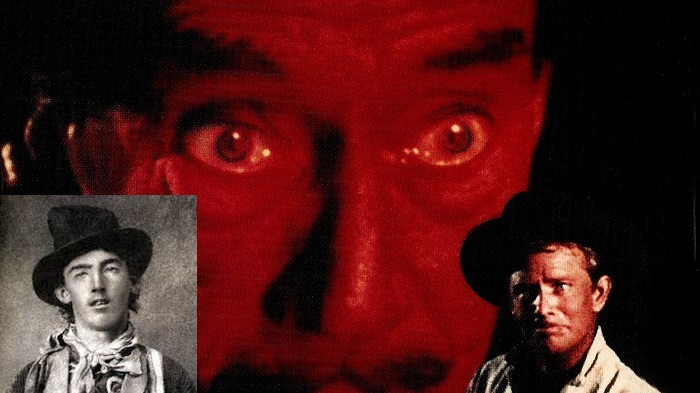
BILLY THE KID (CHUCK COURTNEY) IN BILLY THE KID VS DRACULA (1966) Sometimes the presence of a real life historical figure in a film can be leveraged for instant title recognition…in other words, it’s a ploy occasionally used by exploitation producers to get paying customers through the door. The true life story of Wild West outlaw, William “Billy The Kid” Bonney (Chuck Courtney), has no bearing on the cheap-and-cheerful western-horror hybrid, Billy The Kid Vs Dracula, which sees the gunslinger’s fiancee (Melinda Plowman) fall into the clutches of the legendary eponymous vampire (John Carradine). Directed by the startlingly prolific William Beaudine, Billy The Kid Vs Dracula was filmed at the same time (and played on a double bill with) Jesse James Meets Frankenstein’s Daughter, a similarly styled western-horror mash-up. This time, notorious outlaw, Jesse James (John Lupton), tangles with the two grandchildren of Dr. Frankenstein (yes, the film’s title is actually a misnomer), who have moved to the American West in order to use its prairie lightning storms in their experiments on unwilling victims. While the weaving of real life figures into fictional narratives can create rich cinematic fabrics, Billy The Kid Vs Dracula and Jesse James Meets Frankenstein’s Daughter are nothing more than cheap muslin that crumbles upon on any kind of closer examination. With these films, it’s more about the garish, attention-seeking posters than the movies themselves. “These films are going to be made regardless of who directs them,” William Beaudine once said of his not-so-glossy oeuvre. “There’s a market for them, and the studios are going to continue to make them. I’ve been doing this long enough to know that I can make them as good or better than anyone else.”
