

by Stephen Vagg
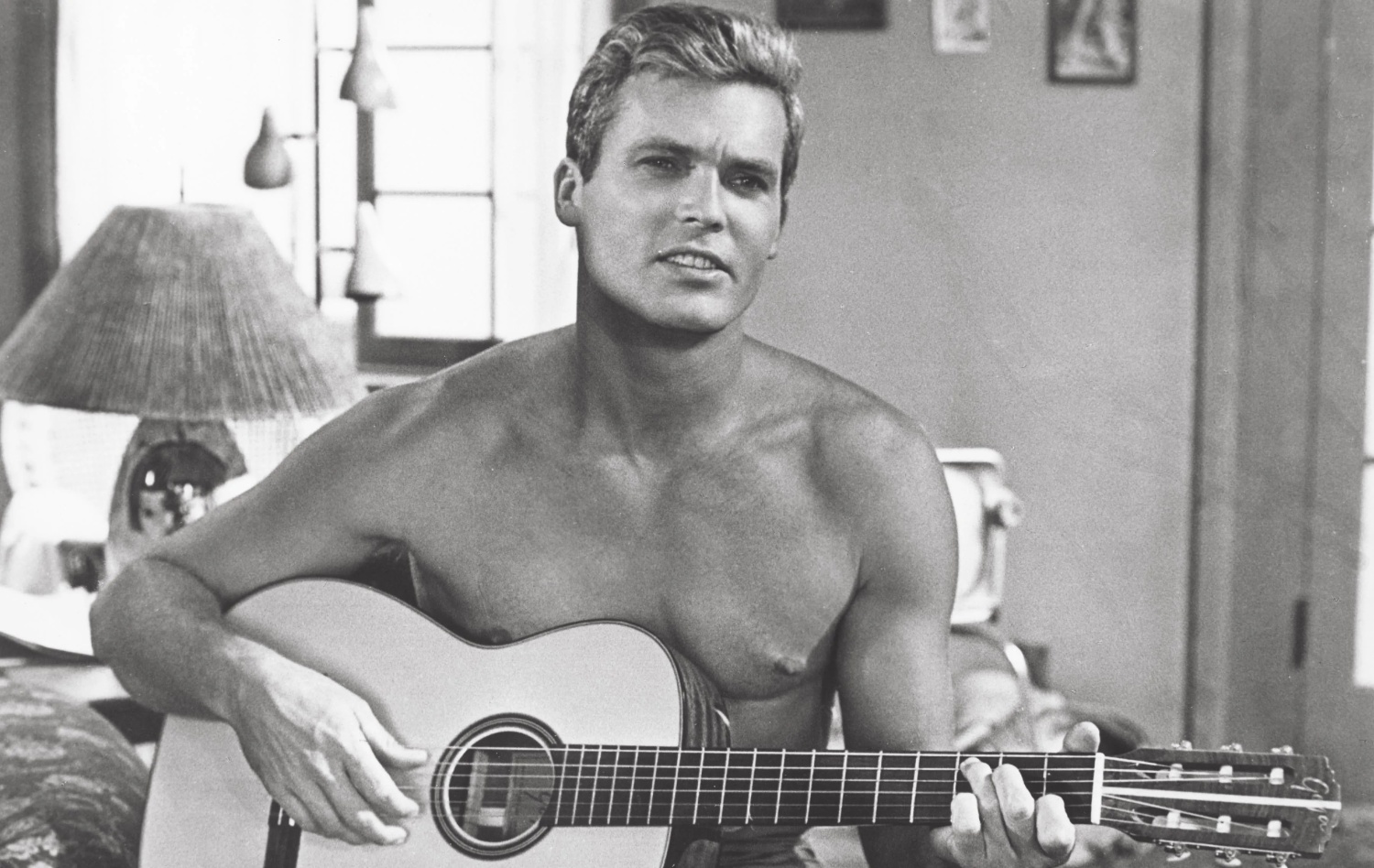
Ty Hardin was one of the great not-quite movie stars, his career full of ebbs and flows that would have made Quentin Tarantino’s Rick Dalton blush – indeed, Hardin was one of the key inspirations for Dalton in Once Upon a Time in Hollywood, with both men’s CVs including a starring role in a Western TV series, a George Cukor movie (the same part in fact), spaghetti Westerns, and an Australian TV series, not to mention the exact same amount of syllables in their names.
Hardin’s personal life was also, like Dalton’s, very hectic – admittedly, Hardin didn’t fight off the Manson family, but he was imprisoned for drug trafficking, helped found a tax protest movement in Arizona that had terrorist leanings, and had eight wives and ten children (we think… the numbers seem to vary). He also gave birth to one of the all time great actor quotes (given in Australia in 1969): “I’m really a very humble man. Not a day goes by that I don’t thank God for my looks, my stature and my talent.”
How can you not have affection for a quasi-star like that?
Hardin’s real name was Orison Whipple Hungerford, Jr. He was born in 1930 and grew up in Texas, attending college via a football scholarship (like a surprisingly large number of actors eg Burt Reynolds, Warren Beatty), then serving in the US army during the Korean War (albeit in Germany, away from the fighting).
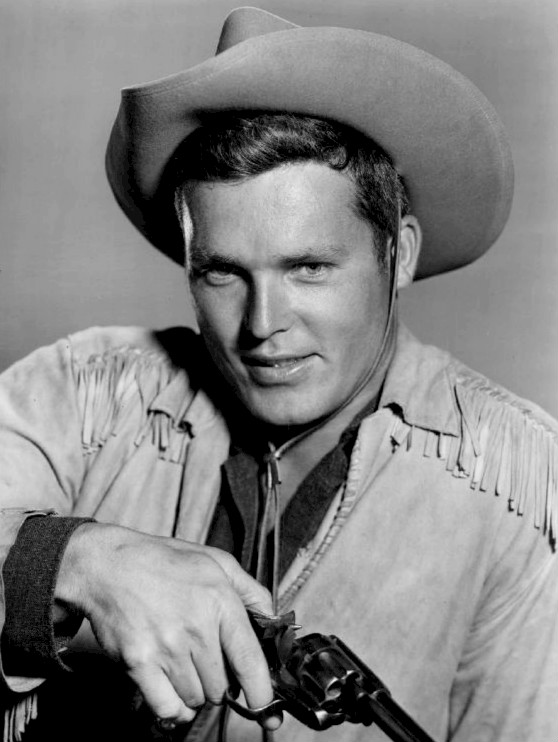 He studied engineering at college and was working for Douglas Aircraft in Los Angeles when “discovered”. Apparently, Hardin/Hungerford had gone to a costume party in Western garb and was spotted by a Paramount talent scout, who was taken by the young engineer’s look – tall, handsome, Texan, virile, physically agile – and arranged for a screen test, which in turn led to a Paramount contract as “Ty Hungerford” (this was the era of names like Tab Hunter, Rock Hudson, and Troy Donahue).
Hungerford/Hardin popped up in some Paramount “B”s like The Space Children (1958), As Young as We Are (1958) and I Married a Monster from Outer Space (1958), and he could be glimpsed in “A”s such as The Buccaneer (1958), and Last Train from Gun Hill (1959).
Hungerford/Hardin had auditioned for the Ricky Nelson part in Rio Bravo (1959) made at Warners (others considered for this included Michael Landon, Stuart Whitman and Australia’s own Rod Taylor). Hardin didn’t get the gig, but Warners liked the cut of his jib and took over the young actor’s contract from Paramount, giving him the new name “Ty Hardin”. Warners had a very specific motive in doing this – Clint Walker had stormed off the set of the studio’s hit TV series Cheyenne and they needed another handsome young cowboy to replace Walker on the show (actors under contract to Warners were forever fighting against the studio). Thus, Hardin appeared in Cheyenne as Cheyenne’s cousin Bronco Layne. The public liked him, and when Walker came back to Cheyenne, Warners decided to give Hardin’s character his own spin-off show, Bronco, that ran from 1958 to 1962. So basically, Ty Hardin became a famous actor very quickly.
Warners liked to keep its contract stars busy, and Hardin popped up in other shows made by the studio such as Maverick, Sugarfoot and 77 Sunset Strip. Then, when Bronco ended, the studio tried Hardin in movies.
He appeared in Merrill’s Marauders (1962), a Sam Fuller film best remembered for being the last movie of Jeff Chandler (who died not long after filming when he went into hospital to have a back operation and didn’t come out). The cast for the movie also included other Warners contract actors like Peter Brown from Lawman, Andrew Duggan from Bourbon Street Beat, and Will Hutchins from Sugarfoot… the studio really liked to stockpile them.
Merrill’s Marauders was a decent credit for Hardin and it’s an entertaining movie, more restrained than most Fuller efforts but always watchable.
Another decent credit was The Chapman Report (1962), where Hardin played a football player lusted after by middle aged Glynis Johns; he gets the full male gaze from director George Cukor, who liked Hardin’s performance, though co-star Effrem Zimbalist said that his struggles learning dialogue annoyed the director. The movie’s sexy content helped make it a hit.
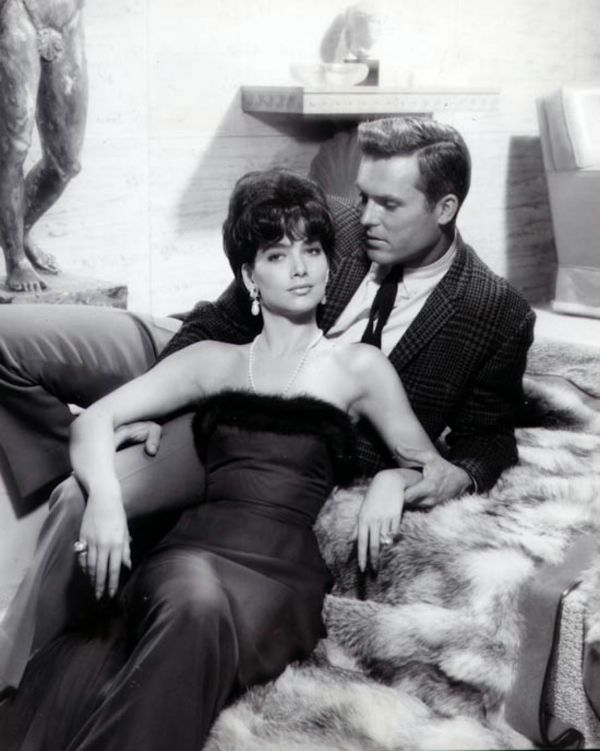 Hardin was one of several Warners contract players in Palm Springs Weekend (1963), the studio’s sweet attempt to repeat the success of Where the Boys Are (1960), only set in the desert. He was in the not-very-good JFK biopic PT109 (1963), again in a support role. Then, Hardin was finally given a lead, in a lower-budgeted race horse drama Wall of Noise (1963) with Suzanne Pleshette and Dorothy Provine – it wasn’t bad, nor was Hardin’s performance, and there’s terrific racetrack flavour, but the movie (shot in black and white) felt like a 1950s programmer; it was out of time.
This was a pretty good run of films for Hardin. However, he didn’t really catch fire with film audiences. Hardin was an amiable, handsome TV series actor but that was about it – there was something anonymous about him, he didn’t have the X factor of a say, Steve McQueen, James Garner or Clint Eastwood, or a (over time) Burt Reynolds and Roger Moore. There was nothing wrong with that – most of Hardin’s TV Western star contemporaries – Eric Fleming, James Dury, Will Hutchins, John Russell, Wayde Preston, Jack Kelly, Michael Landon, Clint Walker and yes Ric Dalton – failed to become movie stars.
Like many of the aforementioned TV Western stars, Hardin received offers to work in Europe. He went to Spain and appeared in and directed a Western called Boudine – or he says he directed it… the film, released as Man of the Cursed Valley (1964) didn’t have his name on it as director, but who knows? Then Hardin quit his Warners contract in September 1963, rejecting a role in Henry King’s The Undefeated (not made until 1969 with Andrew McLaglen) and moved to Europe permanently.
Over the next few years, Hardin appeared in films like Ken Annakin’s Battle of the Bulge (1965), where he was excellent as an SS officer; in his memoirs, Annakin praised the actor’s “willingness to do anything” but said “he was not great on dialogue and was accident prone”. He also said that the crew were always making fun of Hardin because of his accidents, so to make it up to them, the actor arranged a big party on set for everyone, bringing in dancing girls from Munich, which was nice, but drugged the girls with Spanish fly, which was perhaps not as nice.
Hardin was in Savage Pampas (1966), with Robert Taylor and Australia’s own Ron Randell; Sergio Corbucci’s Death on the Run (1967); King of Africa (1967) shot in South Africa; the hugely fun Berserk (1967), from producer Herman Cohen, being lusted after by Joan Crawford; Custer of the West (1968) as Major Reno; and Ragan (1968). Sidney Pink, who produced Ragan, wrote in his memoirs that Hardin was “a great personality and a charmer but no actor”, with an “apparently inexhaustible supply of young lovelies who shared his innumerable one night stands.”
Hardin accepted an offer to appear in a TV series shot in Australia, Riptide, playing an American who runs a charter boat company. The show was developed by Michael Noonan and Guy Thayer who had worked together on the 1959 British-shot, Australian-set series The Flying Doctor; their original idea was make the show as a vehicle for Oliver Reed (!) before winding up with Hardin. Most of the finance behind Riptide was British (though there was American and Australian money in it too) and the show wound up costing a reported $2 million in total.
Riptide wasn’t an easy shoot – the crew were inexperienced, there was a lot of shooting on water (never easy), the key creatives were spread out over the globe, all the scripts came from foreign writers, which understandably upset the Australian Writers’ Guild, the scripts weren’t great, local actors were sloppily dubbed (presumably, so our accent wouldn’t offend foreign ears), and Ralph Smart came out after the show had started and sacked Hardin’s two support leads.
People made fun of Hardin during the making of Riptide and there were whispers about his temperament, not helped by his immortal quote about being humble, mentioned at the top of this article. He was much mocked and there’s little doubt Hardin had an ego, but most stars do; also, while the man didn’t live the most religious lifestyle, he was genuinely religious, and simply talked that way – Australians probably found him too hard to take. Riptide was, admittedly, a silly show, but it looked gorgeous and had a strong support cast and production values; Hardin is absolutely fine as the hero, about on par with Peter Graves in Whiplash. The series rated well in Australia (especially in Sydney) and a second season might have ironed out its flaws, but the producers couldn’t make the necessary sales and production ceased after one season. During filming, Hardin apparently invested in a bicycle shop in Brookvale, Sydney.
Anyway, after Riptide, it was back to Europe and more Spaghetti Westerns and war films for Hardin including The Last Range (1970), Terrible Day of the Big Gundown (1971), Drummer of Vengeance (1971), Holy Water Joe (1971), and The Last Rebel (1971) (with Joe Namath). Only a diehard fan of the genre like Quentin Tarantino will have seen all these. Hardin also ran a chain of laundromats on the Costa Brava and was arrested in Spain for drug trafficking (hashish) and spent time in prison. So, he was a bit of an entrepreneur, though not a very skilled one.
Hardin moved back to the US and worked sporadically as an actor (The Love Boat). He shifted to Arizona, saying he “wanted to get away from the California drug scene”. For a few years, he was a pastor of Calvary Chapel Fellowship, then he helped form a tax protest movement called the Arizona Patriots. In 1985, he called the Patriots “a group of people who are very concerned over our nation and the direction it is presently going, it being dominated by the world’s money changers. You’ve seen the film Red Dawn? That’s coming. America is under full-fledged attack.” Hardin publicly advocated non-violence but was present at meetings of members where they discussed the bombing of IRS offices and other government facilities. However, he was never charged with a crime, whereas other members of the Arizona Patriots were. You can read about that here.
In fairness, Hardin was a former engineer and a lot of them go a little mad later in life, especially the religious ones – and if you don’t believe us, go down to the courts and check out the self-represented defendants, in particular the sovereign citizens. Hardin moved back to California and died in 2017.
Ty Hardin was a colourful character with a surprisingly interesting filmography – there’s a Sam Fuller movie in there, a George Cukor and Sergio Corbucci, a beach party knockoff, a Joan Crawford hag horror, a random Australian adventure series – not to mention a fascinating private life (prison, preaching, domestic terrorism). Quentin Tarantino would approve.
The author would like to thank Chris Keating for his assistance with this article. Unless specified, all opinions are those of the author.
