



By James Mottram and Ashleigh Stevenson
Does it worry you when you have such a large gap of time between directing gigs [2008’s short A Matter of Loaf and Death being his last credit)?
I have been itching ever since Matter of Loaf and Death. To be honest, I wasn’t that aware of the gap. So, it’s only when I saw it written, ‘oh it’s been 10 years since….’, because I feel like I’ve been involved in lots, and the development of this has taken quite a few years, so I feel like I’ve been on this for a long time and I’ve been involved in development of other films at Aardman as well, consulting on things like the Shaun the Sheep Movie, and involved in lots of script meetings… This has been going on in the background, it took a long time to get it up and running really….
How has your craft changed over the years?
In this film, all the principal animation, all the main character work is stop frame. It’s not all clay or plasticine as such, we used various materials for the puppets. But we’ve always used technology to help that as well, to help us do more accurate animation and more efficiently as well. It helps the speed, but now there’s different aspects really. It’s a great safety net as well to have the digital. We shoot digitally now, on digital cameras and have been doing it for a while and making that step was quite big because there’s people who love film and the quality of film but it’s now that the technology’s good, we’re confident with it. But it means in the stop frame technique, if you make a mistake, you can correct things, you don’t lose the shot completely. If a leaf falls off a tree, you don’t have to start again, you can correct it after. You can put sky in after, so we don’t have to have the studio space. We actually shoot in Bristol, it’s an area about the size of a football pitch, a giant warehouse and it’s divided up into about 40 sets that we were filming on the whole time.
Does that mean that you’re running between the 40 sets all the time?
I usually am, but on this one, it was a different structure, because I wasn’t doing it as a 2-hander, with another director. I wanted to hold the reins myself, but it means there’s a bit more of a pyramid. So, I had two animation directors, Merlin Crossingham and Will Becher below me as my sub-captains and deputies and they did most of the running around, but I would brief them with the shot. This is what makes it all the more difficult for me as I like to get very hands-on and design the characters and stuff. And I would act out the scene on video quite often, so they have reference to get the timing or the kind of comedy I’m after.
How did you create the characters with the actors?
Well, it’s great to get such a star line-up of actors and comedians in the film. But I like to get in the recording booth with them and often we would record before the character was properly established as well. We would have a script and we would play around and they were very obliging, and we’d do lots of takes. We would, first of all, maybe do a morning recording or something, then get back and that would be like an audition or a test and we would try animating the puppet to the voice to see if it worked. And if it works, we would change the puppet according to the voice, the way the actor speaks or the way their mouth and words are formed. Then we tried them out and that would confirm to us that it works. Dug [Eddie Redmayne], and all of them actually, [developed through this process]. Then probably the biggest emotional arc was Bobnar [Timothy Spall], the chief. It’s funny when you see the film, it all seems obvious, but you often have too many ideas to start with and it’s stripping them away which is the hard bit and finding out that “oh you’ve still got an idea that shouldn’t be in there”. For example, Dug…I was attracted to a very unconfident, unlikely hero kind of caveman …. He wouldn’t stand up in the stadium and challenge the leader, so we made him into just a very naïve optimist because it seemed to work throughout the film…he’s just optimistic, which is attractive. And his main antagonist therefore is Chief Bobnar who’s a pessimist and a realist, and has a low view of the tribe so in a way, really it’s Bobnar that learns the lesson.
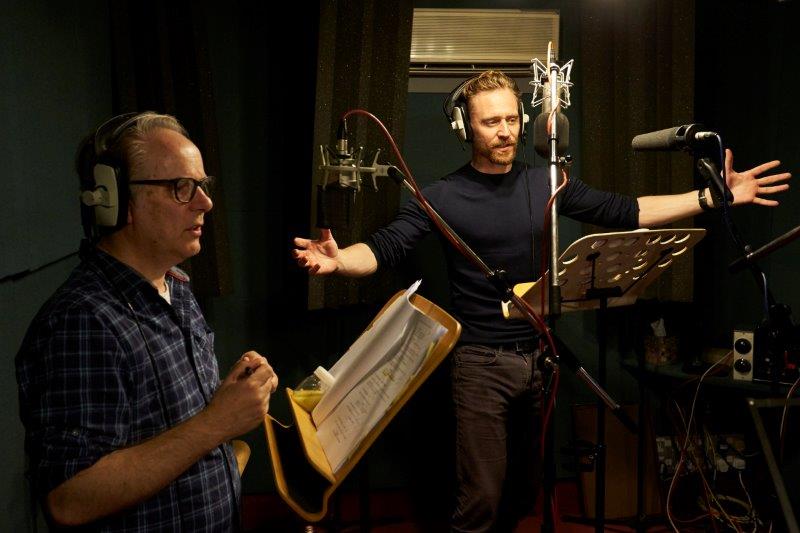
You voiced Hognob, who obviously doesn’t speak, just makes noises, how do you train for that? Do you find yourself in the shower making weird noises and going “oh that sounds about right”?
I got the part by accident, really. I was always planning to cast somebody, but we made the film with storyboards, we made the whole film in the edit machine with storyboard drawings and we put temporary music and effects on them and put scratch voices on and we did the voices just to see if the whole thing works, the comedy and everything. I was doing Hognob and Dug actually, and when it came to casting Hognob the crew just said “oh we really like the way you do it” so I got the part by accident really. I was doing a sort of Scooby Doo roast, sort of mimicking him.
Can you return to the Wallace and Gromit universe again?
It’s tricky, you know, obviously because with Peter Sallis [who voiced Wallace] passed away sadly last year, it’s hard to fill his shoes but it’s not impossible. We’ve had, for a few years a guy who’s an understudy who can do a good voice. So, I’ve had more Wallace and Gromit ideas and I’d love to return to it.
Early Man is in Victorian and Queensland cinemas from March 29 and the rest of Australia from April 12, 2018
