



by Bianca Sloan
Before the game started, you could choose whether you wanted to play with the character X or O. The player had to try to get three of their characters. Now the player had to try to place three of the same symbols in a row without the AI being able to interrupt the row with the other symbol. The player who first managed to place three of their symbols in a row on the playing field emerged as the winner of the game. OXO was created as part of a promotion and, because of the high technical requirements, could usually only be played at universities that had the necessary equipment.
In 1958, the first multiplayer video game was created, which was called “Tennis for Two”. It could be played on a small device that was controlled via attached buttons. The aim was, similar to table tennis, to move a block in such a way that the ball in motion could not leave the screen. This game was also played against the computer in the beginning and was mainly accessible at universities and similar institutions.
The 1970s
In the 1970s, the first video game appeared that was mass-produced and thus accessible to the general population. Pong, as it was called, adopted the playing mechanics of “Tennis for Two” but could be played on coin-operated machines. As the 1970s progressed, companies like Atari emerged and developed video games that could be played at home in the comfort of one’s own four walls. In 1979, Atari achieved a breakthrough in this field with their project “Space Invaders”. This simple fixed-point shooter can still be found on the market today in modified form from time to time. Most of the time, the player has to try to shoot down as many enemies as possible by moving their figure back and forth on a horizontal plane.
The advent of the home computer
Around 1980, the mass-market home computer appeared, which had a lasting impact on video entertainment. From that moment on, there were two different types of video games. On the one hand, there was the classic console, and on the other hand, more and more games were developed for the home computer. Thus, a parallel development took its course that has continued up to the present day. In the meantime, different cultures have developed around the respective devices, which share the love of video games, but draw on completely different technical prerequisites. One of the biggest advantages of a computer is its backward compatibility. On a modern computer, you can still play everything that has been released in the last 20 years, while on a console, in most cases, you can only enjoy those projects that were created specifically for that console.
Nintendo conquers the market
After a serious decline in the industry around 1983, which was mainly due to the flooding of the market with low-quality projects, Nintendo managed to establish itself first in Japan and later also in America and Europe. Thanks to series such as Super Mario Bros and NES, Nintendo managed to open a new market and a new era of video entertainment. Then, in the early 1990s, the first handheld consoles, like the Game Boy or the Atari Lynx, came onto the market, making video gaming even more comfortable, exciting and popular. Other manufacturers followed suit over time, and consoles such as the PlayStation 2, the Xbox and the Gamecube appeared on the market.
The 2000s
In the first decade of the new century, the market then changed a lot. Now came consoles that already made gaming highly realistic. In 2005, the Xbox 360, the PlayStation 3 and the Wii appeared on the market. These consoles enticed us with unprecedented HD graphics and the unmistakable playing experience that came with them. Then there was presented Nintendo DS, which is considered to be the first handheld console with a touch screen.
The smartphone
The last really fundamental development that has emerged in recent years is the development of the mass-market smartphone. Mobile devices, which we can hardly imagine our everyday lives without, became a popular platform for developers to expand their product range. There are now around 2 million apps for our daily companions. Even gambling can now be pursued on the smartphone. You can, for example, look through top casino reviews at RateIt Casino Australia and choose the platform with the best bonuses to play further.
Statistics show that almost every fourth of Australians now regularly plays on a smartphone. This means that mobile phones have long since overtaken traditional consoles and computers due to their accessibility and ease of use anywhere.
The changing industry
As you can see, like pretty much every area of recreation, video entertainment has changed a lot in recent years. What started out on small underpowered devices and was only accessible to those who had access to the necessary equipment, has since grown into a huge industry that could generate a turnover of 1.17 billion euros in 2023 alone. At least one console can now be found in every third household, and this type of leisure activity is particularly popular among young people. So far, several million titles have already been released, which can be divided into a wide variety of genres. The graphics of new video projects are becoming more and more sophisticated, which also increases the demands on the technology. In the meantime, it is no longer even necessary to go to the nearest shop to get something new; instead, the latest apps can be purchased, downloaded and played directly via platforms such as Steam. But this requires a spacious storage space. In recent years, an alternative has now emerged that attempts to circumvent that very problem and move video gaming entirely to the Internet. In the following, we will show you what cloud gaming is, what future opportunities it has and what changes it will bring to the industry.
What is cloud gaming?
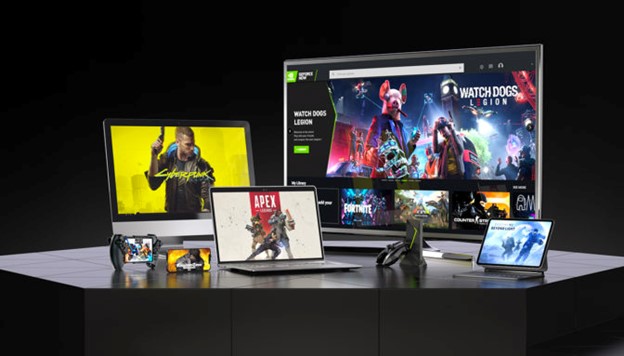
Cloud gaming hardly differs from classic video projects, both in terms of the graphical possibilities and the experience. The bottom line is that the whole process remains unchanged but is greatly simplified. So, as a player, you find an app that interests you and decide that you want to try it. Now there are different ways you can proceed. Either you go to a store, buy it locally, or order it online. However, this involves a relatively large amount of effort and waiting time for both the supplier and you as the buyer.
Another option already mentioned would be to use platforms like Steam to purchase and download the game online. In the future, however, you will probably also be able to resort to another option: cloud gaming. If you have the right hardware, you can simply access a project of your choice over the Internet for a fee. You don’t have to download anything and theoretically don’t even need free storage capacity on your device. The application runs on an external server, so to speak, which receives your commands and inputs, converts them and sends sound and video signals to your computer. This allows you to experience a full playing experience without having to install or download software.
What are the advantages of cloud gaming?
Cloud gaming is the most convenient way to play. You don’t have to go to a middleman or wait for your file to download when you want to try something new. All you need to do is connect the terminal to the Internet, make a small payment, and now you can directly enjoy the process. Another advantage is that, in theory, you don’t even need large storage capacities to enjoy a new project. This even eliminates the well-known hardware requirement. So you don’t need the latest computer or the best graphics card to play new games. Simply put, you don’t have to worry about system requirements, driver updates, compatibility issues or upcoming updates. The cloud gaming provider takes care of all these annoying maintenance issues for you. Another point that will certainly be noticeable in daily use is the huge time savings that cloud technology brings. Since the provider always keeps the game up to date and installs all updates on the data centres, they are spared the long waiting time in case of an update and installation.
Are there any disadvantages that come with modern technology?
Now, of course, there are some disadvantages that come with streaming video games. Probably the biggest disadvantage compared to traditional video games is the dependence on the Internet connection. Since the game is streamed entirely via the internet, this could be accompanied by jerks and annoying delays if the Internet connection is not very stable. So, before you fully switch to cloud technologies, you should make sure that your Internet connection is good and stable. The higher the data transfer rate of your Internet line, the more likely you are to have a smooth and trouble-free playing experience.
Another disadvantage is the limited usage time. With cloud gaming, you don’t buy an application for life but acquire a licence to use it for a limited period of time. So you pay in somewhat smaller amounts of money at a certain regularity in order to remain an authorised user. However, there is often no guarantee that the title will remain part of the offer forever. So if the provider decides to remove your favourite project from the portfolio, there is little you can do about it.
Negative impact on the gaming experience
Another disadvantage is that there may well be minor restrictions on the gaming experience. However, these are clearly communicated by most providers. For example, most offers are currently still limited to 1080p graphics, which could well be a thorn in the side of more demanding players. In addition, slight delays are to be expected between user input and game actions. Although the providers are on their way to keeping such delays as low as possible, it will probably not be possible to eliminate them completely.
The best providers
As the name suggests, Google Stadia comes directly from the technology giant Google. Thus, all computing operations run via Google’s servers. The applications offered by Stadia can be easily played via the Chrome browser. For control, any compatible gamepad can be used, but also a classic mouse and keyboard. It is said that Stadia is a pioneer, especially in terms of latency, i.e. the delay between input and reaction, and is definitely superior to the competition in this respect. Moreover, Google Stadia is currently one of the few providers whose broadcasts support 4K resolution.
Google Stadia offers two different subscription formats. Stadia Base is free to use but currently only offers a selection of two games whose resolution is limited to 1080p. Stadia Pro, on the other hand, can be tested free of charge for 2 months and then costs 9.99 euros per month. However, the player can use the entire graphics resources and play in 4K resolution.
GeForce Now is also one of the best-known cloud providers. Here, too, the player can enjoy selected but free titles for a monthly fee, which can even be played in 4K format. With GeForce Now, as with Google Stadia, there is a free option to play the games offered. However, this does not seem very attractive, as the maximum playing time here is limited to one hour. In this case, we mean the waiting time for free slots on the server.
So can we talk about a revolution in the games industry?
Cloud gaming is still a relatively undeveloped technology that is still being worked on. Basically, this format of video game streaming has the potential to turn gaming as we know it today on its head. Such advantages as low hardware requirements and the absence of location-based binding, even in the latest and most demanding new products, sound quite promising.
Disadvantages such as the input latency, the limited usage licences and, above all, the high dependency on a good Internet connection, especially in relation to the rather poor expansion of high-performance Internet connections, currently stand in the way of the mass suitability of cloud gaming. In a few years, however, it is quite conceivable that streaming video games will become just as normal as streaming TV series and films and thus replace the traditional methods of playing. With this in mind, it is quite plausible to say that the day will come in the future when we can say that cloud technologies have revolutionised the industry of video entertainment.
