


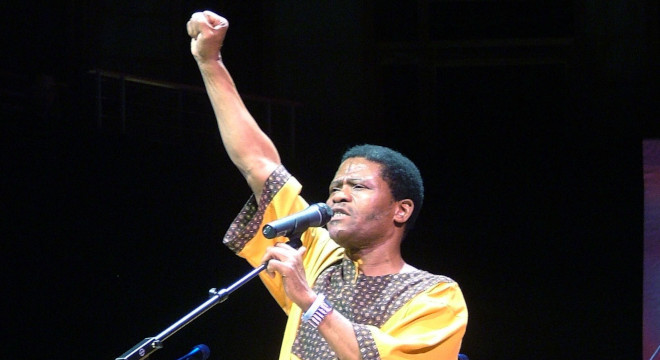
by Christine Westwood
Ladysmith (a rural city in South Africa) Black (for the black ox, known locally as the strongest farm animal) Mambazo (Zulu word for axe). Together, these represent the powerful, native African qualities with which Joseph Shabalala wanted to depict his music group. Together with nine brothers and cousins, Shabalala created and evolved his ‘isicathamiya’ (traditional Zulu music) choir during the 1960s, most strikingly from a series of dreams where he was more or less channelling songs into a particular soft and blended style.
A documentary by Mpumi “Supa” Mbele, who also directed a TV film about the band, backed by a joint Canadian and South African production venture, steered by producer Carolyn Eileen Carew, Music is My Life tells Shabalala’s incredible story.
“When we talk about music we talk about our life,” says Shabalala in archival footage seen in the film.
Joseph Shabalala’s dream was to communicate through a blended musical style, bedded in Zulu culture, to act as an inspiration and metaphor for hope and unity. With a healer for a father and a deep spiritual influence from Zulu culture and the Christianity of Ladysmith that Shabalala later embraced, it seems the young farm worker was destined to be part of South Africa’s striving for a new expression during and after an oppressive apartheid regime.
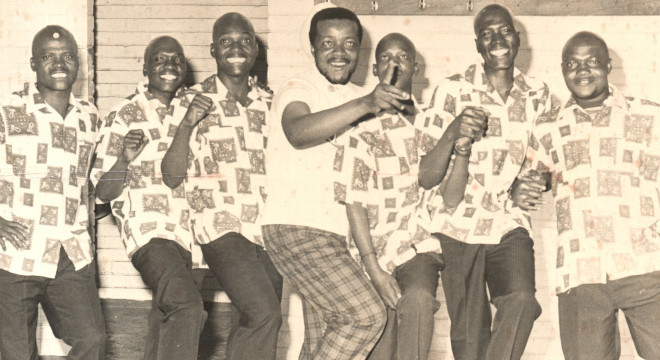
Most of us in the west will know Ladysmith from two unforgettable songs on Paul Simon’s 1986 Graceland album. ‘Diamonds on the Soles of her Shoes’ and ‘Homeless’ are joyful, mesmeric. Simon himself is shown in archival footage, relating how he was simply ‘bewitched’ by the sounds of Shabalala’s band. He approached them after they performed at the Cologne International Folk Festival in 1981.
Simon worked hard to gain the band’s trust and to protect their creativity when they arrived at London’s Abbey Road studio. He was criticised in South Africa for going against apartheid with the collaboration. The album sold over 16 million copies and scored a Grammy. If it was a revival for Simon’s flagging career, it put Ladysmith firmly on the world stage. It was a long way from their first recording in 1969 when the group were given blessing from Shabalala’s father to go ahead. Shabalala remembers how some of the band at that time were afraid that the microphones and recordings would take their voices from them.
All these anecdotes are woven together in the documentary, mainly through archive footage, showcased by contemporary clips, especially the gorgeous landscapes of rural South Africa, where it had all begun. Interviews past and present create a strong throughline. The interviews with members of Shabalala’s family are exceptionally well shot against vivid interiors decorated with African designs. Footage of Nelson Mandela (who requested the band sing at his post-release celebration), Whoopi Goldberg and collaborations with Michael Jackson and Dolly Parton all add to the Ladysmith’s rich cultural relevance.
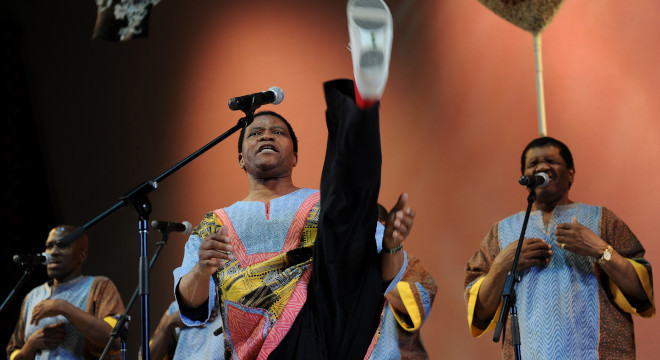
The band’s rise and rise is documented, with the charismatic, gentle Shabalala an extraordinary and visionary driving force. The songs’ messages of hope and unity had to be disguised in metaphor during apartheid, like the hugely successful ‘Nomathemba,’ a girl’s name meaning ‘hope’. With and without Graceland, they became one of South Africa’s most prolific recording artists, receiving gold and platinum disc honours and five Grammys, the last one dedicated to Nelson Mandela.
There are so many reasons to watch this documentary. It’s a fascinating biography of a cultural icon, a slice of South African history and a musical tribute to arguably the most well known sounds of World Music. The producers have taken care in telling the narrative and making sure the critical sound production is served well. The story continually loops back to Shabalala, channelling his African spirituality, dreams from the ancestors and his Christian ethic of peace, even in the wake of a brother being gunned down.
A sound engineer on Graceland comments on Ladysmith’s soft, pure tone and the observation that they “never started a song in the wrong key.” A self taught musician, Shabalala was awarded an honorary doctorate and Professorship in music. He always carried a notebook and would frequently wake in the night with songs in his mind. On camera he says, “You must be open to let it come through and bring it from the other side.”
