


By Christine Westwood
81 at the time of filming the documentary Oliver Sacks: His Own Life, Sacks didn’t begin to achieve recognition until he was 50 with the publication of his bestselling The Man Who Mistook his Wife for a Hat, an extraordinary and diligent reporting of case studies with selected mental patients that he treated.
Even then, he was frustrated at being recognised more as a writer than a doctor. It was to be another decade before his groundbreaking book Awakenings, about catatonic patients, was made into a film starring Robin Williams in a role based on Sacks and Robert de Niro as his patient. Ironically, it was the success of the film that influenced the medical establishment to finally recognise Sacks’ contribution to science.
The documentary is helmed by Ric Burns (brother of…), who gives the documentary a sensitive thorough treatment.
Sacks describes how he was driven to make extensive reports on patients rather than treat them by prescribed labels. He speaks of his unending curiosity to discover what it’s like to be somebody else.
‘We all have our solitary consciousness,’ he says.
It’s this respect for individuality that marked out his work as being extraordinarily empathetic and insightful. He listened, he questioned and observed and never assumed anything. His innate gift as a writer also helped him understand the power of story in making sense of a patient’s reality.
‘His attention would release people,’ says one medical colleague. ‘He just saw medicine differently.’
His curiosity was one driver in his work but there were earlier biographical factors that surely influenced him. One was a psychotic older brother who Sacks was afraid of and felt guilty about. Another was the fact of his homosexuality. Sacks was born into an orthodox Jewish family of doctors, including his mother who he was most attached to, in spite of her early rejection of him.
‘It was not easy or safe to be a homosexual in London in the 1980s,’ he remarks.
‘Where do you go when your mother tells you you’re an abomination?’ asks Paul Theroux, a friend and fellow writer. ‘You go to San Francisco and stop writing home!’
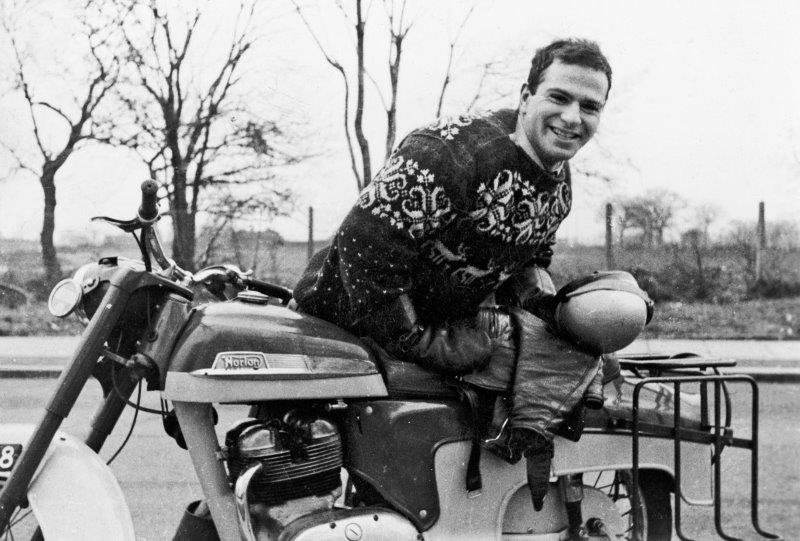
Archival footage of Sacks at Venice Beach in the 1960s shows him as a beast of man. He could squat lift 600 pounds and looked at home with the biker set. He had early disappointments in love and reacted by throwing himself into extensive drug abuse and marathon motorcycle rides.
He was by then a medical intern but describes himself as ‘deeply an outsider, a supreme fuck up.’
But when he moved to New York in 1965, there was a one eighty degree turn prompted by a passion for his intense research into the phenomenon of migraines, the subject of his first published work. He began his own psychoanalysis and got himself off drugs. Studies into Parkinson’s Disease followed, leading to his administering the drug L Dopa, an apparent miracle cure, that became the subject of Awakenings.
This is an elegant and respectful study of an extraordinary character. If the long sequences exploring his early medical career are a bit too measured and heavy with detail, the last section, where we are introduced to the younger partner who he met after 35 years of celibacy, and where Sacks faces diagnosis of a terminal illness, are moving and beautifully paced.
‘He gave a masterclass on how to die,’ observes one friend.
If you didn’t know already how this unique scientist and writer changed the way we view and treat mental illness, Oliver Sacks: His Own Life is required viewing.
Oliver Sacks: His Own Life is in cinemas December 3, 2020
