


by FilmInk Staff
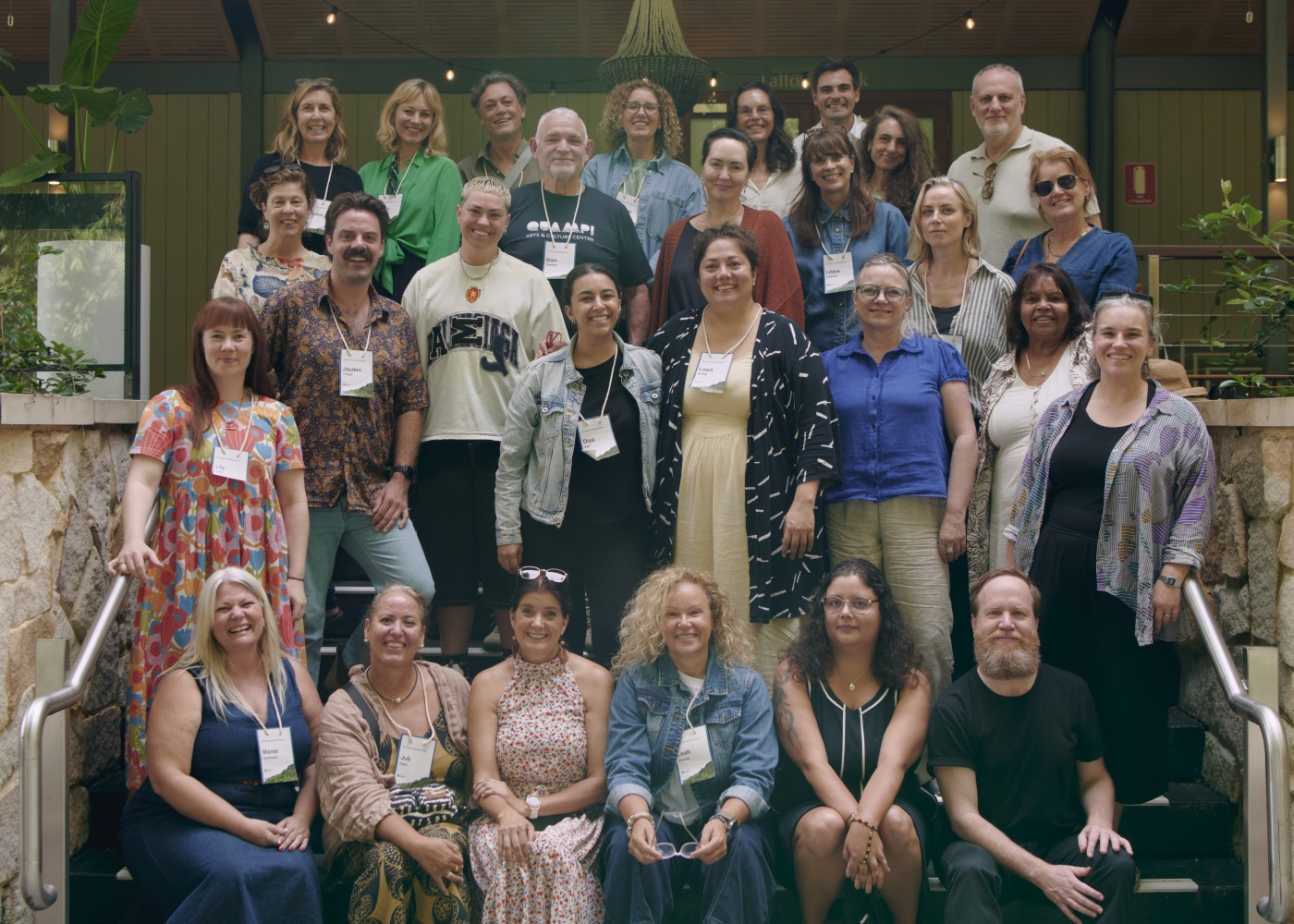
Industry-leading screenwriters, producers and directors gathered on Bundjalung Country in Byron Bay to explore how climate can find its way onto screen in ways that are authentic, surprising and entertaining. The immersive two-day event invited participants to explore the ways science, audience, Country and storytelling intersect, and to consider the role they each play in bringing climate to screen.
The program featured speakers Leah Purcell (actor, writer, director, producer and co-founder of Oombarra Productions), Bain Stewart (executive producer and co-founder of Oombarra Productions), Samantha Lang (filmmaker, director, writer and producer), Kayleigh Llewellyn (UK-based creator, writer and executive producer), Loani Arman (filmmaker, writer and screen executive), Dan Ilic (comedian and journalist), Victor Steffensen (founder of Living Knowledge Network and author), Lucy Stone (founder and executive director of Climate Spring), Heather Fipps (executive director of the Hollywood Climate Summit), Carmiel Banasky (VP of stories at Good Energy), Dr Linden Ashcroft (climate scientist at the University of Melbourne) and Dr Philipe Bujold (research fellow at BehaviourWorks Australia, Monash University).
SSA executive director Maree Cochrane said the appetite for climate storytelling was noticeably shifting in Australia and globally. “Climate storytelling is at a turning point,” she said. “Audiences care about seeing their world reflected authentically on screen. Climate is something we all experience, and we are already seeing climate storytelling move into mainstream entertainment. This will have a massive impact on how investments, commissions and partnerships are made. Our Climate Storytelling Retreat was the first initiative in SSA’s wider Climate Storytelling Strategy, which is mobilising the industry around climate in Australian screen stories. This will support the industry to have the skills and confidence to bring climate on screen as both a smart creative and commercial choice.”
Cochrane said the Climate Storytelling Retreat took flight largely because of the stellar group of people involved. “What made the retreat so special was the group of people we brought into the room. They have the craft, experience and instinct to accelerate climate storytelling in Australia,” she said. “The breadth and depth of insights that emerged from the two days was profound. The learnings touched on so many things including a desire to forge deeper connection to Country, choosing better ways to travel, gaining more hope, and making different choices around storylines. It was clear that people’s perspectives changed and they were deeply moved by the experience, and excited to be part of this growing screen community.”
Where to from here? Audiences increasingly want to see stories that engage with climate. This means accurately reflecting the world as it already is, as well as imagining possible new worlds and futures. SSA will be rolling out further climate storytelling events over the coming months, including an online ‘Changing Narratives’ Professional Development Program (in partnership with Climate Spring) and a funded pitching opportunity.
SSA’s climate storytelling program is supported by our members and funders, including Minderoo Pictures and Screen NSW.
To find out more, check out the climate storytelling resources on SSA’s our website, sign up to our newsletter or one of our Events and Workshops. https://www.sustainablescreens.au/events-and-workshops
Further resources:
https://www.goodenergystories.com/playbook
https://www.hollywoodclimatesummit.com/
https://www.climate-spring.org/
Further info about the sessions at the Climate Storytelling Retreat:
- Leah Purcell and Bain Stewart shared why they often talk about Country rather than climate, and treat Country as a character rather than a backdrop. Leah described how the story of The Drover’s Wife was revealed by the land itself. They also spoke about Oombarra’s Cultural Consultancy, and how each of us can find the truth of a story through our own relationship to Country.
- Victor Steffensen spoke about how healing landscapes through indigenous fire practice and reading Country rebuilds knowledge, culture and community. He called for solutions planned over 500 years.
- Dr Samantha Lang explored making space for non-human storytelling, and what happens when the natural world becomes the protagonist and humans move away from the centre. She left the room with a question to keep asking: whose perspective is missing?
- Kayleigh Llewellyn took the room inside the adaptation and production of The Dream Lands, the Sister Pictures adaptation coming to the BBC in early 2027. She shared her radically honest approach to her work and to writing with emotion, humour, and building authentic characters that audiences connect with personally.
- Lucy Stone introduced the room to the Two-Loop model, and mapped screen characters onto the roles people play as old systems decline and new ones emerge. She also explored how storytelling can give audiences a much-needed sense of agency around climate justice, regeneration, accountability and a better future.
- Dr Philipe Bujold asked whether climate stories can really change hearts and minds. People who don’t think climate is an issue often skip the news and get their picture of the world from entertainment, which makes the screen industry one of their biggest influences. Stories can prime audiences for change. And there is no neutral position: leaving climate off screen sends a message too.
- Heather Fipps and Carmiel Banasky brought the view from Hollywood. They encouraged the room to consider: does climate change exist in the story, and does a character know it? They’re developing tools to help embed climate into procedurals, with romance next.
- Dan Ilic showed how pairing a fact with a joke can land with explosive impact. When Scott Morrison wasn’t planning to attend COP26, Dan, stuck in lockdown, crowdfunded billboards mocking Australia’s “Net Zero by 2300” ambitions, including one in Times Square. The billboards made headlines and Morrison decided to attend COP26. The lesson: we all hold more power than we think.
Photo by Olivia Katz Photography
