



by Phillip East
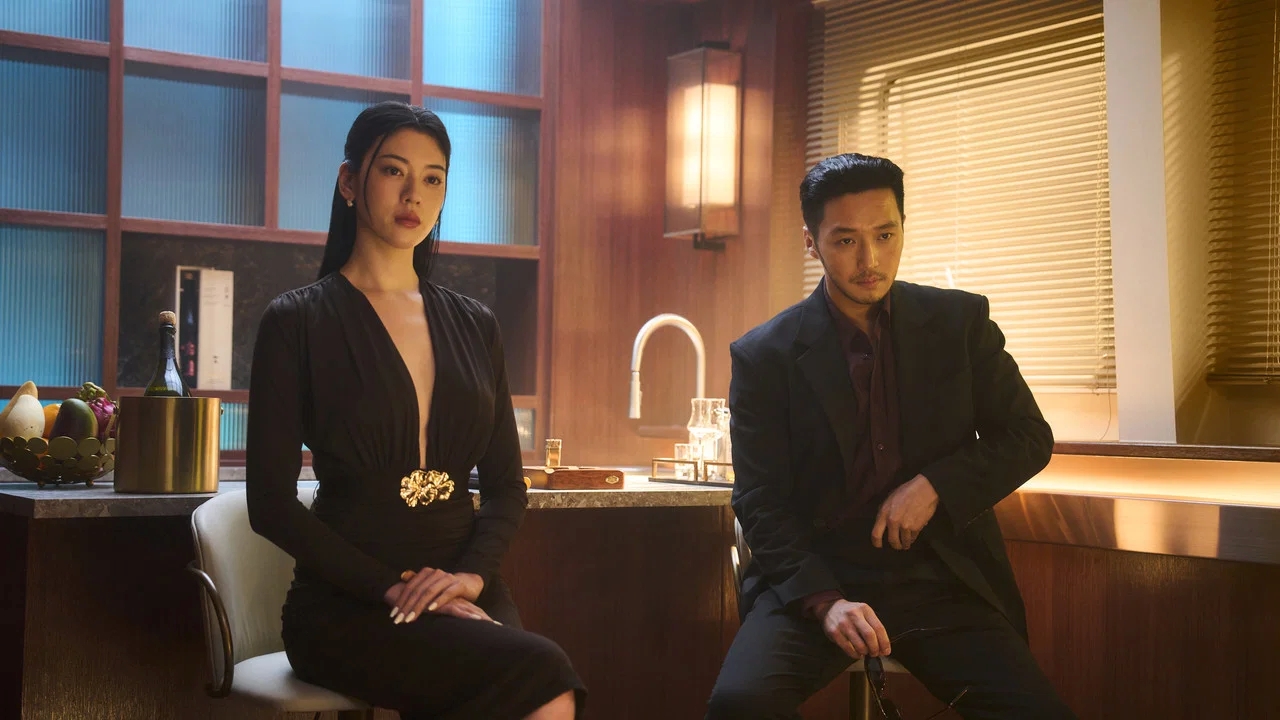
Twenty years ago, the first Tazza film lived in back rooms, hwatu mats and provincial gangsters, with the money counted in cash on the table. The fourth and, we’re told, final one starts with two friends who got rich running an online casino gaming business, which is about as 2026 as a gambling story can get. Jang Tae-young (Byun Yo-han) is the lucky one. Park Tae-young (Roh Jae-won), who shares his given name and most of his history, is the one who takes everything, and the rest of the film, by every account, is the bill for that.
I should say up front that I haven’t seen it, and unless you were in one of the 25 American cinemas Well Go USA put it into from 16 October, neither have you. No Australian date has been announced. What follows is pieced together from the Korean coverage, the box-office numbers and Korean-language reviews run through a translator, which is not how I’d choose to write about a film.
Choi Kook-hee’s film (타짜: 벨제붑의 노래) opened on 23 September, the day before the Chuseok holiday, rated 19-plus, 129 minutes. It passed two million admissions on 26 October, the only adults-only Korean release of the year to manage it, and was at about 2.07 million when it reached Korean streaming on 11 November. For an adults-only release that is very good money, if some way short of Parasite.
Tazza started as a comic, Tajja, drawn by Huh Young-man and written by Kim Se-yeong, which ran in Sports Chosun from 1999 to 2003 in four parts. Choi Dong-hoon filmed the first part in 2006 as Tazza: The High Rollers and it became the second biggest Korean film of its year. The Hidden Card followed in 2014 and One Eyed Jack in 2019, each with a new cast. The first two were hwatu films, the small flower cards and the games of seotda and go-stop that go with them, and the visual signature of the series was the worn mat the cards got slapped onto. One Eyed Jack had already moved to poker. This one moves the poker out of the country.
The plot, as far as the synopses go: after Park’s betrayal, Jang is taught the game by a faded legend, Kwak Dong-wook (Jo Woo-jin), and the two former friends meet again years later at a yakuza-backed high-stakes game that draws players from Korea, Japan and Vietnam. Ayaka Miyoshi plays Kaneko, the executive at the yakuza-backed firm who sets the game up. The rapper Swings makes his acting debut as a hired killer’s enforcer and has a Blue Dragon nomination for best new actor, which I did not see coming.
Choi, whose films include Default and Life Is Beautiful, hasn’t been coy about why the game changed. “Hold’em is a game popular around the world, so I think it will have an advantage over hwatu in reaching overseas audiences,” he told the Financial News before release. To the Korea Times he described a film that “focuses heavily on intense human emotions like envy, jealousy and betrayal.” Byun Yo-han put it more bluntly: “whether it is hwatu or poker, those are just tools.”
He’s right, and it’s the reason poker keeps turning up in films that aren’t about poker at all. A hand of cards gives a director a scene in which nothing moves except faces and chips. A fold tells you about a man’s nerve, a call about his read of the other player, and neither needs more than a close-up. Altman knew it in California Split in 1974, a film in which the gambling is nearly incidental and the friendship is everything. Paul Thomas Anderson’s Hard Eight got its best scenes out of Philip Baker Hall teaching John C. Reilly how to work a Reno casino floor, which is more or less the Kwak-and-Jang arrangement here. I’d be surprised if Choi hadn’t watched it.
The international setting is where the Korean critics parted company. Cineplay’s Kim Ji-yeon thought the film “preserves the Tazza series’ identity even as it grows,” but wished the two leads’ “love-hate dynamic had been drawn more tightly.” Lee Da-won at Sports Khan warned that “viewers unfamiliar with the rules may find it hard to enjoy the film 100 per cent,” which Cineplay said too, and which seems fair: seotda needs no explaining to a Korean audience and hold’em apparently does. The English-language notices were kinder. Asian Movie Pulse called it fresh and stylish and possibly “the best entry in the franchise since the first one,” then admitted it “does seem to take on a bit more than it can handle.” View of the Arts landed on “an entertaining but uneven conclusion,” which is probably where most people will end up.
The complaints line up: too many characters, too much violence, not enough time with the two men whose falling-out is supposed to carry the thing. So does the praise. Lee Sung-je’s cinematography gets singled out more than once, and Cineplay noted that the film trades the worn hwatu mats of the earlier films for the glass and neon of an international poker room. That is a bigger change than the card game. The mat was the series, and the room, going by the stills, could be anywhere.
Nobody in the coverage argues about whether a casino is a fit subject for a thriller, and I notice that more than anything else in it. The setting is just there now, like a heist or a courtroom, and the fights are about execution. This magazine gave Park Chan-wook’s Decision to Leave close to full marks a few years ago, and the same confidence shows in how this one has been made and sold: a Korean crime film can set its last act at a yakuza poker table abroad and expect the world to follow.
The likeliest route here is a streaming deal sometime in 2027. If it comes, and it should, the notices suggest going for the two leads and forgiving it the subplots. I’ll report back once I’ve seen it.
