



by Shahran Morshed
Worth: $15.00
FilmInk rates movies out of $20 — the score indicates the amount we believe a ticket to the movie to be worth
International Documentary Film Festival Amsterdam (IDFA)
Intro:
The film does not ask us to believe in visitors. It asks why we keep looking for them, what we are prepared to accept as evidence, and how much we still have to learn about the world we inhabit.
A silent triangular object moving across the sky. Dozens of people in a small Canadian village claim to have seen it, yet nobody can say exactly what it was. This is where Guylaine Maroist’s The Message, made with Eric Ruel, begins. A remark by a nuclear scientist, “We have visitors,” sets the filmmaker on an investigation that will occupy the next ten years. What follows is a journey through witness accounts, scientific arguments, military records and the growing public interest in unidentified aerial phenomena. The film is concerned with the possibility of life beyond Earth, but it is equally interested in why this possibility has been so difficult for us to discuss openly.
The investigation starts in Saint-Adolphe-d’Howard, a mountain village in Canada. Residents describe a triangular object that passes overhead without making a sound. Their accounts are strikingly similar, and Maroist takes them seriously enough to follow the trail beyond the village. She speaks with scientists, military experts, politicians and sociologists, encountering very different explanations along the way. Some regard the sightings as evidence worth examining; others point to confirmation bias, the tendency to see what we already expect to see. The phrase “believing is seeing” becomes an important counterpoint to the familiar idea that seeing is believing. It is a reminder that human perception is not infallible, particularly when an experience is difficult to explain.
There is a long history behind this fascination. Reports of unusual objects in the sky became widespread in the United States after the Second World War, especially during the wave of sightings in 1947. The Cold War gave the subject a more urgent dimension. An unidentified object could be a question of national security as much as a matter of public curiosity. Between 1952 and 1969, the US Air Force investigated thousands of reports through Project Blue Book. The project found no evidence that the sightings it examined represented extraterrestrial vehicles, but it did little to end public interest in the subject. Secrecy around military technology, conflicting explanations and the persistence of unexplained accounts kept the question alive.
Today, the term UAP, or unidentified anomalous phenomena, is increasingly used in place of UFO. The change allows investigators to discuss unusual observations without immediately suggesting that they involve extraterrestrial spacecraft. It is an important distinction, and one that the film could hardly avoid. NASA established an independent UAP study in 2022 and published its findings in 2023, calling for better observations and more reliable data. The Pentagon’s All-domain Anomaly Resolution Office has also reviewed historical cases. Its 2024 report found no verifiable evidence of extraterrestrial technology, although some sightings remain unexplained. This is where the subject becomes particularly difficult: a case that cannot be identified is not necessarily evidence of something beyond human understanding. The absence of an explanation should invite further investigation, not automatically supply one.
Maroist follows how the attitude towards UAPs has changed, especially after the Pentagon acknowledged that the American military had been monitoring such incidents. For years, the subject was largely pushed towards the margins of public discussion, often associated with conspiracy theories and science fiction. Government acknowledgement has given it a different standing, though it has not confirmed the existence of extraterrestrial visitors.
The film is at its most interesting when it stays within this uncertain territory, allowing the arguments to meet without pretending that they have reached a conclusion.
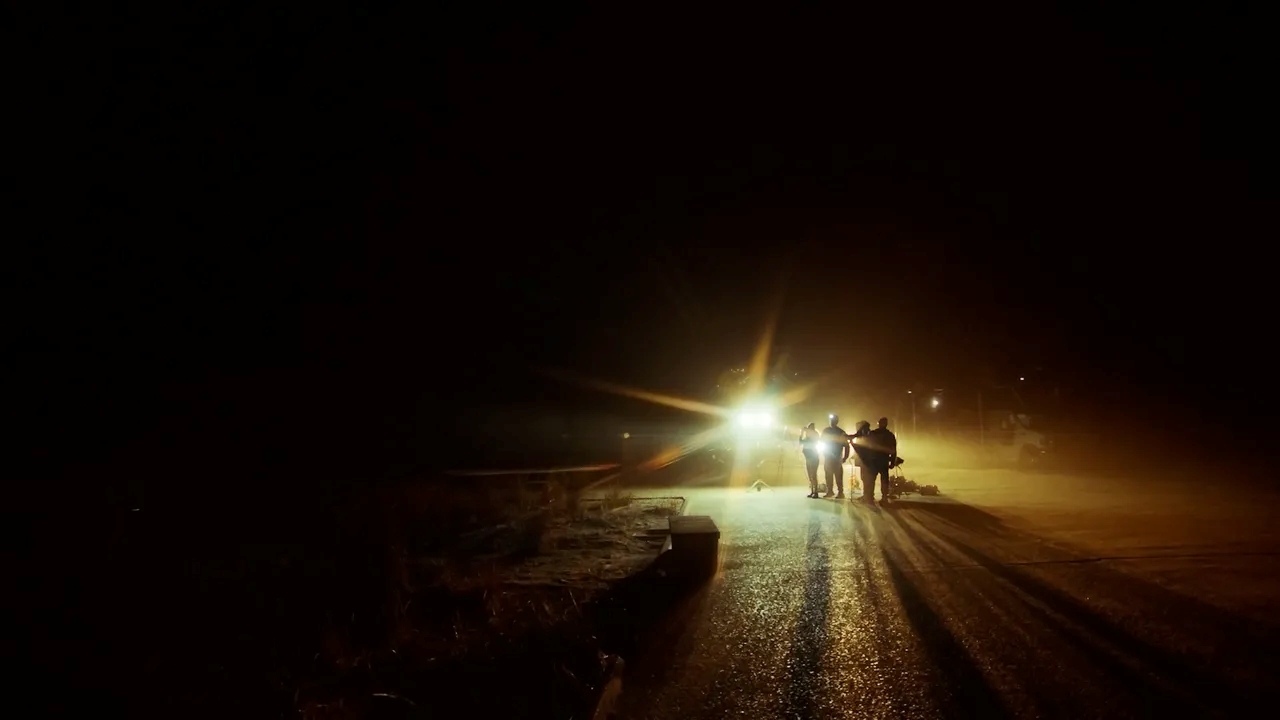
The cinematography by Jean-François Perreault is an important part of that experience. The film finds its images in the sky, the landscape and the places where people gather to discuss what they have seen. There is a quiet strangeness to these images. They make familiar surroundings feel slightly unfamiliar, as if the world we know might contain something just beyond our ability to recognise it. Perreault does not need to give us a clear image of the object at the centre of the investigation. The absence of that image becomes part of the film’s visual appeal. We are left looking at the same sky as the witnesses, wondering what might have passed through it.
Maroist’s own involvement with the Pugwash Conferences on Science and World Affairs in 2015 gives the investigation a personal beginning. Founded in 1957 by scientists concerned about the dangers of nuclear weapons, the organisation brought her into contact with respected scientists who believed that extraterrestrial beings might be visiting Earth. She was surprised by the seriousness with which they approached the subject. If people with such scientific backgrounds were willing to consider the possibility, she wondered, what exactly was being overlooked? That question became the starting point for her decade-long journey.
There is, of course, a difference between being open to a possibility and accepting it as fact. The Message sometimes moves close to that boundary, but its subject is worth pursuing precisely because it asks us to examine the evidence rather than simply choose a side. Its investigation does not establish that we are being visited, nor does it provide a final explanation for the sightings. What it does is bring together the people, institutions and ideas that have shaped the discussion, while showing how much remains unknown.
Perhaps the most lasting impression of The Message comes from the act of looking itself. Human beings have always looked towards the sky for answers, finding there both scientific questions and stories about their place in the universe. We have developed instruments capable of observing distant galaxies, yet there are still things in the space around our own planet that we cannot immediately identify. Maroist and Ruel leave that contradiction hanging in the air. The film does not ask us to believe in visitors. It asks why we keep looking for them, what we are prepared to accept as evidence, and how much we still have to learn about the world we inhabit.
