



by Shahran Morshed
Worth: $12.00
FilmInk rates movies out of $20 — the score indicates the amount we believe a ticket to the movie to be worth
Cast:
Eryk Kulm, Joséphine de La Baume, Victor Meutelet, Lambert Wilson
Intro:
… the film’s greatest achievement is that it makes us curious about Chopin beyond the music we already know.
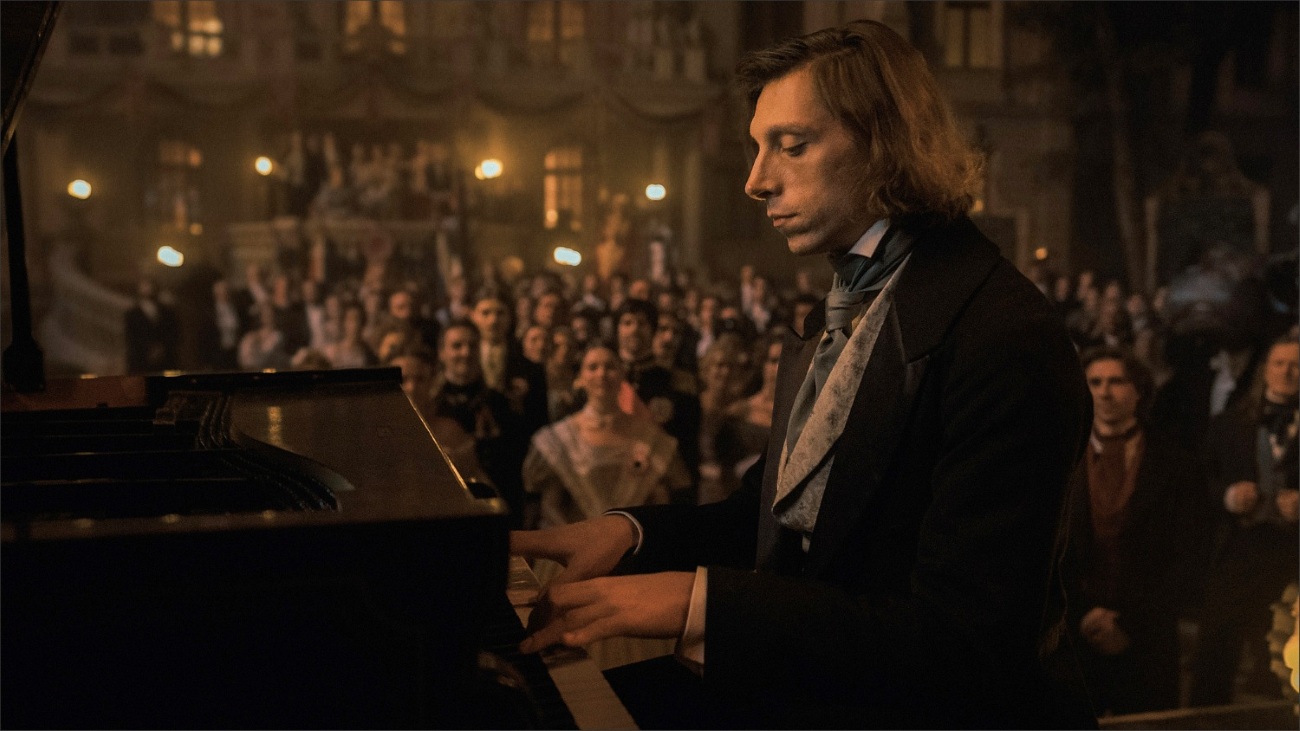
Chopin is one of those composers whose music seems to have a life of its own, often reaching people who know very little about the man who created it. His compositions have travelled across generations, carrying an emotional world that is difficult to put into words. Yet Frédéric Chopin was more than the music associated with his name. Michał Kwieciński’s Chopin (aka Chopin Chopin!) brings us closer to the man, taking us into his life in Paris, where artistic recognition, personal relationships and an increasingly fragile body shaped his days.
The film follows Chopin during the 1830s, when he was already becoming one of the most admired musicians in Europe. At just 25, he had found a place among Parisian aristocrats and artists, performing for wealthy patrons and moving through an exciting cultural circle. But his arrival in Paris had a history of its own. Born in Poland in 1810, Chopin left his homeland in 1830, around the time of the November Uprising against Russian rule. The revolt was crushed, and he would never return to Poland. Although Paris became his home, his attachment to his country remained deeply present in his compositions. His mazurkas and polonaises carried something of the Polish landscape, its traditions and its longing for independence. This history is important to understanding Chopin, and the film gives us a glimpse of the circumstances that shaped his identity.
What makes the portrayal particularly engaging is the way Kwieciński approaches Chopin’s personality. He does not spend the entire film treating him as a solemn genius who exists only through his compositions. Instead, we meet a young man with a sense of humour, a fondness for company, romantic desires and occasional irritability. Eryk Kulm understands this balance well. His performance brings a certain ease to Chopin, allowing us to see the person behind the celebrated musician. There is also a quiet sadness in his portrayal, particularly as the composer’s health begins to deteriorate. Chopin suffered from serious respiratory problems, and the awareness of his limited time gradually becomes part of his everyday existence. His relationship with music, consequently, takes on a different meaning. It is something he lives through, even as his body increasingly fails him.
The people surrounding Chopin also give the film an interesting historical dimension. His connection with Franz Liszt, another extraordinary pianist of the Romantic period, places him within a circle of musicians who were changing European musical culture. His relationship with George Sand is another important part of the story, although their romance began in 1836, shortly after the period in which much of the film is set. Sand would eventually become a significant presence in his personal life. These encounters remind us that Chopin belonged to a world where music, literature and artistic ambition were closely connected. The film is particularly good at making that world feel inhabited rather than simply recreating it as a historical backdrop.
Still, you are left withing that the film had explored Chopin’s musical greatness with greater depth. It does a fine job of capturing his character and giving us a substantial understanding of his life, but his importance as a composer sometimes feels secondary to the events surrounding him. Chopin changed the possibilities of piano music. His compositions brought an extraordinary intimacy to the instrument, combining technical complexity with an emotional sensitivity that was entirely his own. Even his smaller pieces could contain an entire emotional landscape. The film allows us to appreciate his talent but does not always make us feel the full extent of what made that talent so remarkable. Thus, the first half of the film is much more engaging than the second one.
There is a difference between showing us a great musician and helping us understand why his music became so important. Still, Chopin is a wonderful portrait of a fascinating life. It offers a good understanding of the man, his surroundings and the experiences that shaped him, without making history feel like a lesson. Chopin died in Paris in 1849, aged only 39. His body was buried there, but his heart was brought back to Poland, where it rests in the Church of the Holy Cross in Warsaw. It is difficult not to find something moving in that final detail. A man who spent much of his adult life away from his homeland was, in the end, reunited with it in the most personal way possible.
Perhaps the film’s greatest achievement is that it makes us curious about Chopin beyond the music we already know. It may not entirely convey the immensity of his artistic legacy, but it gives us a living, breathing person to associate with it. And sometimes, getting closer to the person behind the work is reason enough to return to the work itself.
