



by Flynn Shan Benson
Worth: $13.00
FilmInk rates movies out of $20 — the score indicates the amount we believe a ticket to the movie to be worth
Cast:
Miguel Bernardeau, Guitarricadelafuente, Carlos González, Milo Quifes, Julio Torres, Glenn Close
Intro:
… the film’s audacity and showmanship give way to a self-satisfied earnestness about the power of art to change the world, and for historic wrongs to be righted with poetry.
The Toronto International Film Festival People’s Choice Award is a dubious honour: chosen entirely by audiences, it can reward brilliant films that resonate with the public and go on to awards glory (12 Years a Slave, La La Land, Hamnet,), as well as works of cheap sentimentality and unearned emotion, which also go on to awards glory (The Imitation Game, Green Book, Jojo Rabbit). This year’s winner, La Bola Negra, directed by Javier Calvo and Javier Ambrossi, falls somewhere between the two poles, offering both brilliant filmmaking and extravagant emotion that are sure to find favour with Academy voters.
The film borrows both its title and its conceit from an unfinished play by the 20th Century playwright Federico García Lorca. Expanding the original text, the filmmakers tell the story of Carlos (Milo Quifes), a son of a patrician family in 1932 Granada who is seeking entry into the ‘Casino’ club of the city’s elite. But Carlos is gay, and not especially discreet, so, for all his pomade and elegant suits, he finds himself ‘blackballed’ — the bola negra of the film’s title.
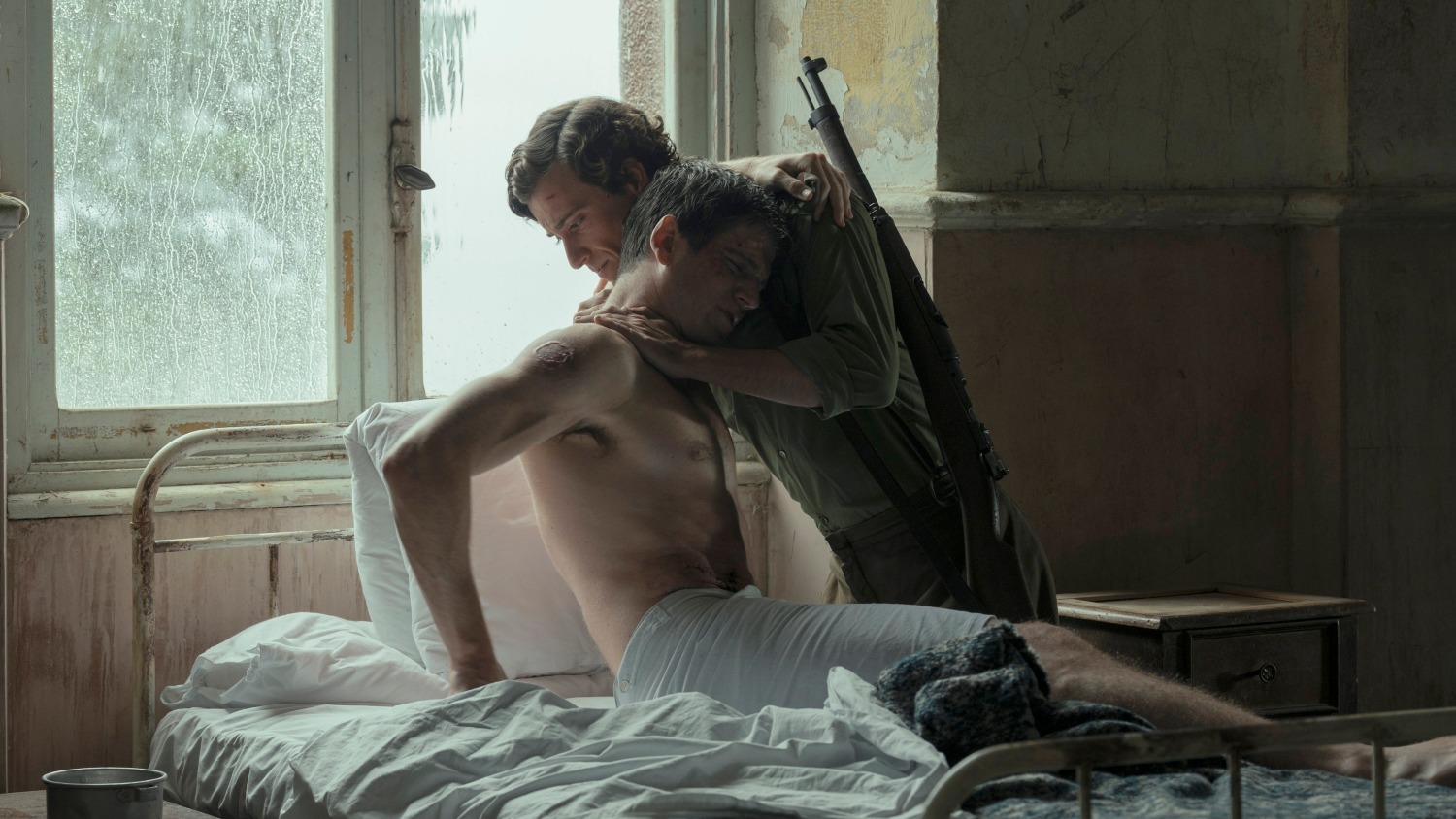
Interwoven with this strand is the story of Sebastían (the musician Guitarricadelafuente), who in 1939 is a soldier without conviction in Franco’s fascist forces. After surreal, camp scenes of war and destruction — including a sequence in which he scales a marble bust of Saint Sebastian — he finds himself guarding a captured soldier (Miguel Bernardeau) from the opposing Republican forces. With the soldier bearing military secrets, intimate poetry, and smouldering good looks, a tragic romance cannot but ensue.
The final thread of the film takes place in 2017 Madrid, where disillusioned writer Alberto (Carlos González) swipes on Grindr and fights with his mother. But when the grandfather he never knew dies, he leaves Alberto an inheritance that links him to the earlier stories and to the history of queer resistance.
The two directors deserve credit for finding life in the history here: the Spain of the 1930s is brought alive in its sound and colour and homoerotocism, their camera equally adept at tracing a man’s body dancing in a bar as dying on the battlefield. Some sequences give the directors the opportunity to run wild with vigorous sustained shots — including an electric cameo by Penélope Cruz as an entertainer for the troops. The actors all acquit themselves admirably, even if Guitarricadelafuente and Bernardeau look too pretty and soft to be in a war.
But the film’s audacity and showmanship give way to a self-satisfied earnestness about the power of art to change the world, and for historic wrongs to be righted with poetry. There’s nothing wrong with art making a case for itself — and Australia for one needs a corrective to its anti-intellectualism — but here it means losing the rough edges and contradictions of life in favour of a political message: the fascist soldier does not believe in a single tenet of fascism, the words of the poet are never less than profound, and desire never inflicts any harm.
What stands out in 2026 is the lost history of queerness as a political identity, how it once stood as the antithesis of fascism and conformity, a threat to the patriarchal order, and a force that could seduce enemies in uniform. Now, the far-right forces in Germany — polling ahead of every other party—are led by a lesbian who demonises the transgender community, while gay men serve in Trump’s cabinet and Barnaby Joyce can claim that One Nation is the ‘gayest party’ in Australia.
But La Bola Negra is less interested in these complications than it is in celebrating itself with aplomb — and it will surely have more to celebrate come Oscar time.

The Spanish Civil War (1936-1939) was fought between:
• The Republicans defending the democratically elected Second Spanish Republic.
• The Nationalists led by General Francisco Franco.
The Nationalists received major military support from Nazi Germany and Fascist Italy. The Republicans received equipment and military advisors from the Soviet Union, Mexico and
40 000 foreign volunteers formed into International Brigades. Britain, France and the United States officially maintained a policy of non-intervention.
In 1932, prior to the civil war, a coup against the government was unsuccessful. It is known as the Sanjurjada after its leader General José Sanjurjo.
La Bola Negra is set across three time periods: 1932, 1937 and 2017.
We are introduced to Sebastiàn in the first story. It is 1937 and villagers are out to welcome the arrival of the Italian Air Force. Dreadful errors are made during wars … and this is one. Instead of waving to the villagers the pilots attack. Many villagers are killed, but miraculously Sebastiàn is spared. He’s conscripted into the Fascist army where he forms a bond with an enemy prisoner.
In the second story set in 1932 Carlos, the son of wealthy, loving parents, is denied membership of the local exclusive casino because of rumours about his sexuality. One member of its governing committee says: men made of saliva do not enter this casino. This is a derogatory slur implying gay men are weak, lacking in substance, and a threat to the solid foundations of house and family.
A mob, part of the Sanjurjada, attacks and destroys the building while Carlos is being interviewed. He appears to have escaped unhurt but in a beautifully shot snow scene he dies. This puzzled me and I asked Google for help.
AI jumped in and explained: Carlos’s miraculous escape and his ascent up the snow-covered mountain is a surrealist, metaphorical sequence revealing that Carlos died when the building was destroyed. His ‘escape’ up the scaffolding and into snow represents his transition to the afterlife. In this purgatory-like state, he experiences a crushing epiphany: he had wasted his life living in secret and hiding who he truly was. He desperately begs to return to the life of the living and be allowed a second chance. His pleas are in vain.
We move to 2017 for the third story. Gay historian Alberto is informed he has inherited something from a grandfather he never knew.
The scriptwriters (Javier Calvo, Javier Ambrossi and Alberto Conejero) were inspired by La Piedra Oscura (The Dark Stone) by Conejero and a partly-written play by Frederico Garcia Lorca.
The three stories in La Bola Negra are linked. Carlos’s is taken holus bolus from Lorca’s partly-written play; Sebastiàn’s from La Piedra Oscura; and a few pages of the Lorca play are featured in Alberto’s.
The film is complex. It requires an audience’s full attention as we dash between stories: from 1937 back to 1932, and on to 2017 … then quickly back to the past before returning to 2017. “Keep up, guys”, was a loud comment from an audience member to the rest of us. Ahem, I may’ve made that last bit up.
Cameos from Penélope Cruz as Nené Romero, a singer, and Glenn Close as Isabelle Durand, an American who is a celebrated Lorca scholar, are welcome interludes. In 2017, Isabelle gives an address to students at a university in Madrid. Afterwards, Alberto shows her a manuscript he thinks may be written by Frederico Garcia Lorca and he’s not sure what to do with it. She replies: ‘You’ve inherited something and you don’t know what to do with it. You are truly a Spaniard.”
This was another puzzling moment in the film for me. This time I did not have to check in with Google. Ryan Gilbey, a journalist with The Guardian UK, asked Javier Calvo, one of the scriptwriters of La Bola Negra, to explain what Isabelle Durand meant. His answer:
“We have a rich, interesting culture and history. It is as if pride is shameful. When someone is doing well and winning awards all over Spain, people are like ‘Hmm, that’s not very Spanish’. Where does that attitude come from? May be religion – may be dictatorship.”
I was pleased I saw this film at a cinema. The action sequences are bloody and realistic; the scenery memorable. The cinematographer (Gris Jordana) deserves an Oscar. Her brilliance will be lost to those who choose to see it on a television screen. At this very moment Netflix is arranging an extravaganza of a launch for Wednesday 2nd December.
The acting is accomplished and the music did not intrude. In retrospect the music was so unobtrusive, I don’t remember there being any. I had a problem with the editing. I felt the constant jumping from one year to another and back was overdone and confusing.
Also, the running time of three hours (film, previews and advertisements) was excessive. Thirty minutes could easily have been edited out without the themes of prejudice, intolerance and homophobia being compromised.
The film, when shown in countries outside Spain, should have a printed message at the beginning giving a précis of the Spanish Civil War and the 1932 Sanjurjada.
There was clapping as the film ended. Expressing comments in the foyer after the movie, one said they regretted not reading up on the Spanish Civil War before seeing the film. A few nodded in agreement.