


by Adrian Nguyen
Worth: $16.00
FilmInk rates movies out of $20 — the score indicates the amount we believe a ticket to the movie to be worth
Cast:
Salman Rushdie
Intro:
“The restriction of debate, whether by a repressive government or an intolerant society, invariably hurts those who lack power and makes everyone less capable of democratic participation”.
What do Cat Stevens, Jimmy Carter, and Germaine Greer have in common? They all disapprove of the Satanic Verses, written by Salman Rushdie. In 1988, he wrote this fictionalised account of magical realism that was based on the life of the prophet Mohammad. (The title referring to the three pagan Meccan goddesses). The reception to the novel was positive, a Booker Prize finalist, but it was overshadowed by a massive backlash from Muslim communities all across the world for blaspheming the Koran.
The Iranian regime, led by Ayatollah Khomeini, called for a fatwa on Rushdie in 1989, resulting in death threats that spanned assassination attempts to the stabbing of Rushdie’s Japanese translator in 1991. This continued for more than three decades before culminating with a stabbing at a book festival, resulting in the loss of one eye and the use of one hand.
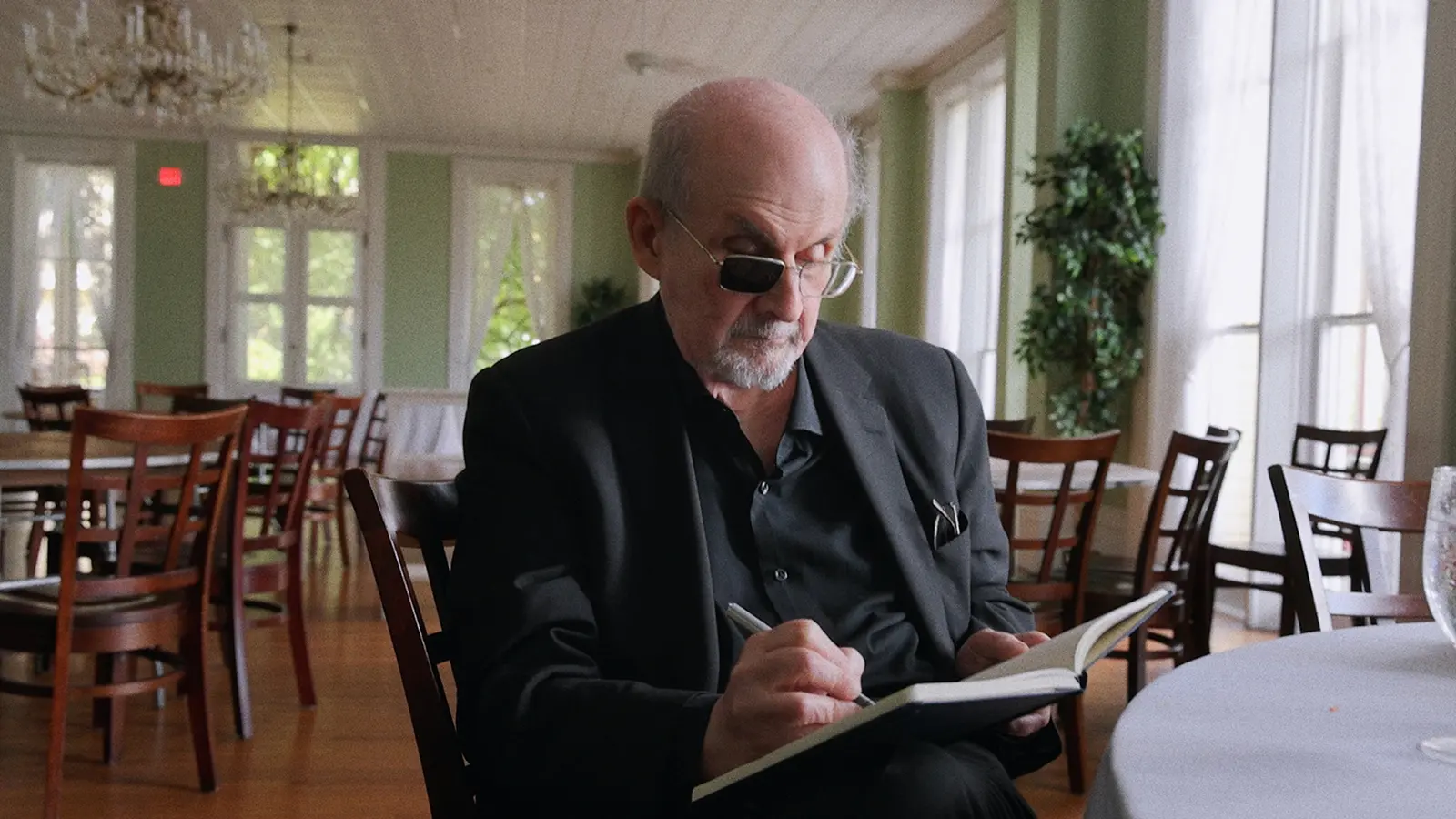
Based on the autobiography of the same name, Knife is a first-person narrative delivered by Rushdie in the aftermath of the stabbings, read out loud while accompanied by footage. The most original contributions from director Alex Gibney are the use of first-hand footage of the attempt, Rushdie’s stay at the hospital, and archival footage of interviews with him and his critics, who oppose his freedom of speech because it is a violation of their religion. The major incident, which is first reenacted before concluding with the surveillance footage, is a launchpad to Rushdie’s meditation on facing death. This includes confronting his perpetrator – who is undergoing a 25-year jail sentence – in the form of a scene from Akira Kurosawa’s High and Low.
References to movies are common in Knife. Rushdie draws from several movies that show violence. Gibney employs a montage of movies – from Psycho to West Side Story and 12 Angry Men, which prominently use a knife. Some of these movies, particularly 12 Angry Men, argue about the complex ethics of violence, a connection that justifies the purpose of adapting the memoir into a documentary.
The fatwa has turned Rushdie into a celebrity, and as he becomes the fearless avatar of upholding liberal principles, he “refuses to be a victim,” but wonders what use this has to his career, compared to when he went into hiding. (There’s a fun video of Rushdie playing Super Mario World, which kept him sane following the fatwa.)
In 2020, during the wake of the US Summer Riots, Rushdie signed an open letter in Harper’s Magazine to restore liberalism and free speech that’s not just threatened by Donald Trump, but also by left-wing authoritarians who would otherwise be supportive of similar causes. Back then, it was dismissed as a soft smuggling of bigotry in all its forms. It was reminiscent of Jimmy Carter writing an op-ed in the New York Times, criticising Rushdie for vilifying the Koran. Two years later, as Rushdie is confronted with violence, the substance of that letter still matters. One of the points being “The restriction of debate, whether by a repressive government or an intolerant society, invariably hurts those who lack power and makes everyone less capable of democratic participation”. This is something that Gibney and Rushdie remind us of forgetting nowadays and it isn’t, as one journalist puts it “people criticising them (or their friends).”
