



by Gill Pringle in Jeddah, Saudi Arabia
For nearly 25 years, one of double Oscar winner Mahershala Ali’s earliest performances has been hidden in a vault.
Director Daniel Klein and Ali were both students at New York University’s Tisch program, when they set out to make a film about a group of college students who organise a “World Summit” to counter political apathy through free food, booze and radical politics.
With Ali cast as the group’s charismatic revolutionary leader Mac Laslow, he channels great orators like Malcolm X and Martin Luther King Jr, as he urges his small group of followers to stand up to capitalism.
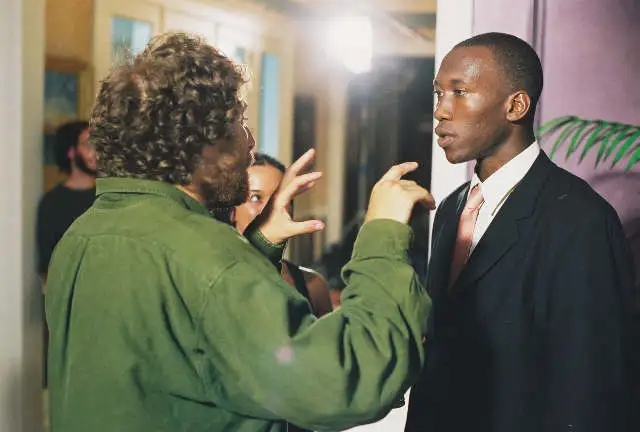
“This was weeks out of acting school and on the very first take that Mahershala ever had in any movie … he called ‘cut’ on his own take,” recalls Daniel Klein at the Red Sea International Film festival in Saudi Arabia where the film, Taste the Revolution, received an enthusiastic reception.
Shot over the summer of 2000, Klein had literally 130 hours of footage and was struggling to edit, when world events collided in the form of 9/11, and the film no longer seemed relevant.
“It just felt like a weird out-of-time period piece. I was a young filmmaker, and I had no clue what to do with this, so we cobbled together a regrettable cut for cast and crew. It was an unbelievably embarrassing, humiliating night of sharing this movie.
 “But I thought, let me honour the people that put in their time and effort, because we gave them no money. I showed that movie, and it was literally one of the two worst nights of my life – and then we promptly buried the movie. We thought, this is done. It’s in our rear view. We learned everything we could from it,” says Klein today.
Fast forward to two decades later, and Ali had won his first Best Supporting Actor Oscar for playing a drug dealer in the 2016 drama Moonlight, receiving his second Oscar just two years later for Green Book, making him the first Black actor to win two Academy awards in the same category.
On a whim, Klein sent a three-minute clip from the original footage to his old friend. “He’s amazing in it and he got back to me and said, ‘We gotta finish this movie’!
“Basically, Mahershala gave us his blessing, for lack of a better description, which was very affirming for us. We felt like, ‘well, if he’s excited about it, that’s currency enough. And we started in earnest,” says Klein, who teamed with producer/directors the Linke Brothers to salvage the footage and put an entirely fresh spin on the unreleased material.
The COVID summer of 2020 proved a turning point. “You couldn’t really go anywhere. You couldn’t produce something new. That’s how it felt for us. So instead, we feasted on the footage – a shocking amount of footage – and we poured over everything, and got so excited by it,” he recalls.
Taste the Revolution was ultimately reimagined as a mockumentary about a documentary film crew trying to capture an event that they hope will be a modern-day Woodstock, but it turns out to be more Fyre Festival.
Looking back on those early college days with Ali, the director says, “Mahershala was in grad school for acting, and I was an undergrad in film, and we met at a coffee shop and just started talking about music and basketball, and it just kind of blossomed from there.
“We had no money, but Mahershala came in to read for the part. And – as you see on the screen – he was just transcendent. He was so amazing,” says Klein who had originally perceived Taste the Revolution as pure comedy.
“At the time, I didn’t know what I was doing, and I grabbed Mahershala because he was so good – but then it was not quite a comedy anymore, it kind of became something different, and I would argue, a whole lot better and more resonant,” he says.
Among the film’s many gems is Ali’s future wife Amatus Karim Ali, who plays backyard activist, Alicia Johnson.
“She’s so talented, and she was there. They weren’t even together at the time – but they’re both in the movie. It’s a very beautiful thing,” says Klein who is still working on distribution for Taste the Revolution.
“The offers have been fairly underwhelming,” he admits. “But I’m holding out because, for me, the great joy is sharing with people live, in the same room. Putting it on a streaming service is not thrilling for me at all, although eventually, I think that’s where they land.
“For the time being, I think we’ll hold out for a little bit and just see, because I think it’s an important film for young folks and those who have seen the film have shared it with a lot of college age students, and it was very provocative for them.”
